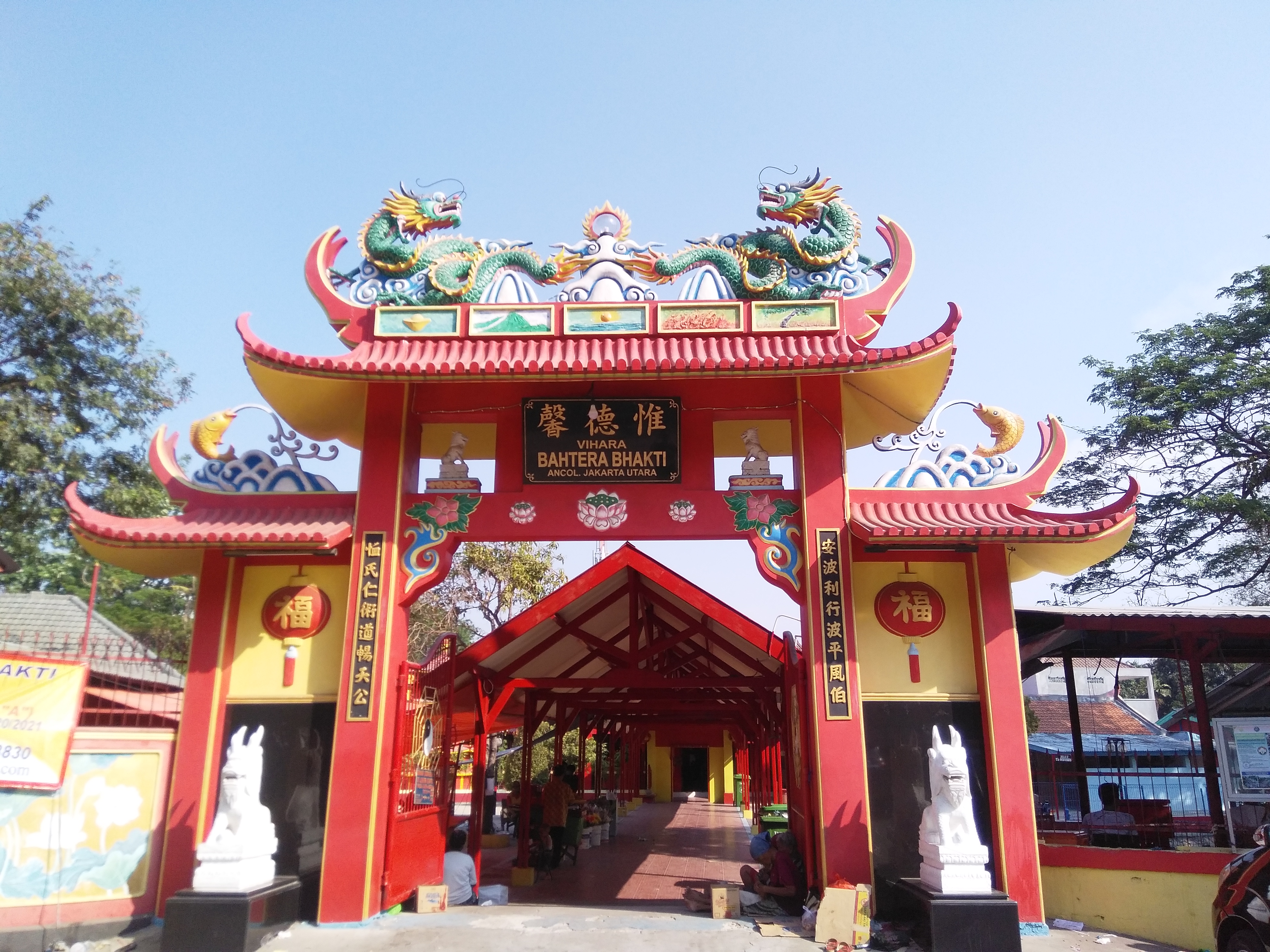
The Temple Where Faiths Converge
A Muslim helmsman left behind in Java by one of history's greatest admirals. A Taoist deity of land and wealth. A Buddhist sanctuary. A tomb with an Islamic blessing. These are not the ingredients of four separate places of worship - they coexist within a single shrine complex in Jakarta's Ancol neighborhood, tucked between the river and the sea. Vihara Bahtera Bhakti, known locally as Klenteng Ancol, has been standing since around 1650, which makes it one of the oldest Taoist temples in Jakarta and a living record of how Chinese, Muslim, and Buddhist traditions braided themselves together in the ports of maritime Southeast Asia long before anyone thought to call it multiculturalism.
The Helmsman Who Stayed Behind
The temple's origin story centers on a man the records call Sampo Soei Soe - a Muslim cook or helmsman who sailed with Admiral Zheng He during the great Chinese naval expeditions of the early 15th century. Zheng He, known in Indonesia as Sampo Toa-lang or Sampo Tai-jin, commanded fleets of hundreds of ships that visited ports across Southeast Asia, India, Arabia, and East Africa between 1405 and 1433. When the fleet departed Java, one of its crew members stayed behind. This man, believed to be identical with Wang Ching-hung (also rendered as Wang Zschu-cheng), is said to have founded the shrine of Da Bo Gong on this site. Whether he chose to remain or was left by circumstance, the helmsman's decision to settle on the north coast of Java placed a Muslim sailor at the founding of a Chinese temple - a juxtaposition that makes perfect sense in the context of Zheng He's fleet, which was itself a meeting point of Chinese and Islamic worlds.
Three Altars, Many Traditions
The main sanctuary houses three altars arranged with deliberate symbolism. At the center stand statues of the helmsman and his wife, Ibu Sitiwati - the couple believed to be buried within the sanctuary itself. To the left, an altar honors San-bao daren alongside Ibu Mone, the younger sister of Sitiwati. To the right sits the tomb of Kong Toe-Tjoe-Seng. Behind the main building lies the tomb of Embah Said Areli Dato Kembang, an Islamic holy figure whose presence transforms the architectural meaning of the entire complex. The temple's design blends Chinese-Buddhist architecture with elements specifically associated with Muslim tomb shrines, creating a visual and spiritual language that belongs to no single tradition. The shrine complex also includes a House of Guardian and a Sanctuary of Buddha, further layering the religious geography. What a visitor encounters is not syncretism as academic concept but syncretism as lived practice - generations of worshippers who saw no contradiction in honoring Chinese deities and Islamic saints under the same roof.
Da Bo Gong and the God of the Earth
The temple's primary dedication is to Da Bo Gong, known in the Hokkien dialect as Tua Pek Kong - a deity of land and wealth who is one of the most widely worshipped figures in Chinese folk religion across Southeast Asia. Da Bo Gong is identical with Fu-de zheng-shen, the God of the Earth and Riches, who is also venerated at the Kim Tek Ie Temple in Jakarta's Glodok district. The deity's domain encompasses the prosperity of the land, the fertility of the soil, and the wealth of merchants - a fitting patron for a temple founded by a sailor who became a settler. His wife, Bo Pog, shares the central altar. In the broader Indonesian context, Da Bo Gong temples served as anchors for Chinese communities in port cities, providing not just spiritual services but social infrastructure: a place to gather, to settle disputes, to maintain cultural identity far from the ancestral homeland. Klenteng Ancol was one of the earliest such anchors in what would become Jakarta.
Zheng He's Long Shadow
Admiral Zheng He casts a long shadow across the temples and mosques of maritime Southeast Asia. The largest Chinese temple in Semarang, Sam Poo Kong, is dedicated to him directly. Across Indonesia, shrines and place names reference his expeditions, his crew, and the communities they left behind. Vihara Bahtera Bhakti fits into this pattern as a site tied not to the admiral himself but to one of his men - a reminder that the great voyages were not just feats of navigation but acts of cultural seeding. Zheng He's crews included Muslims, Buddhists, and followers of Chinese folk religion, and the ports they visited absorbed all of these traditions simultaneously. The temple on the Ancol River embodies that absorption. Its architecture tells a visitor that Chinese-Buddhist aesthetics and Islamic sacred space are not contradictions but collaborations, shaped by centuries of coexistence in a port city where everyone arrived from somewhere else. Nearly four hundred years after its founding, Klenteng Ancol still burns incense for a Muslim helmsman in a Taoist temple beside a Buddhist sanctuary - and no one finds this strange.
From the Air
Located at 6.120°S, 106.854°E in Jakarta's Ancol neighborhood along the northern coast. The temple sits in a dense urban area near Ancol Dreamland, Jakarta's waterfront recreation park, which is identifiable from the air by its green spaces and amusement park structures along the coast. From 2,000-3,000 feet, the Ancol coastline and the adjacent harbor areas are clearly visible. Nearest airport is Soekarno-Hatta International (WIII), approximately 22 km to the west-northwest. Jakarta Bay stretches to the north, with the Thousand Islands visible on clear days.