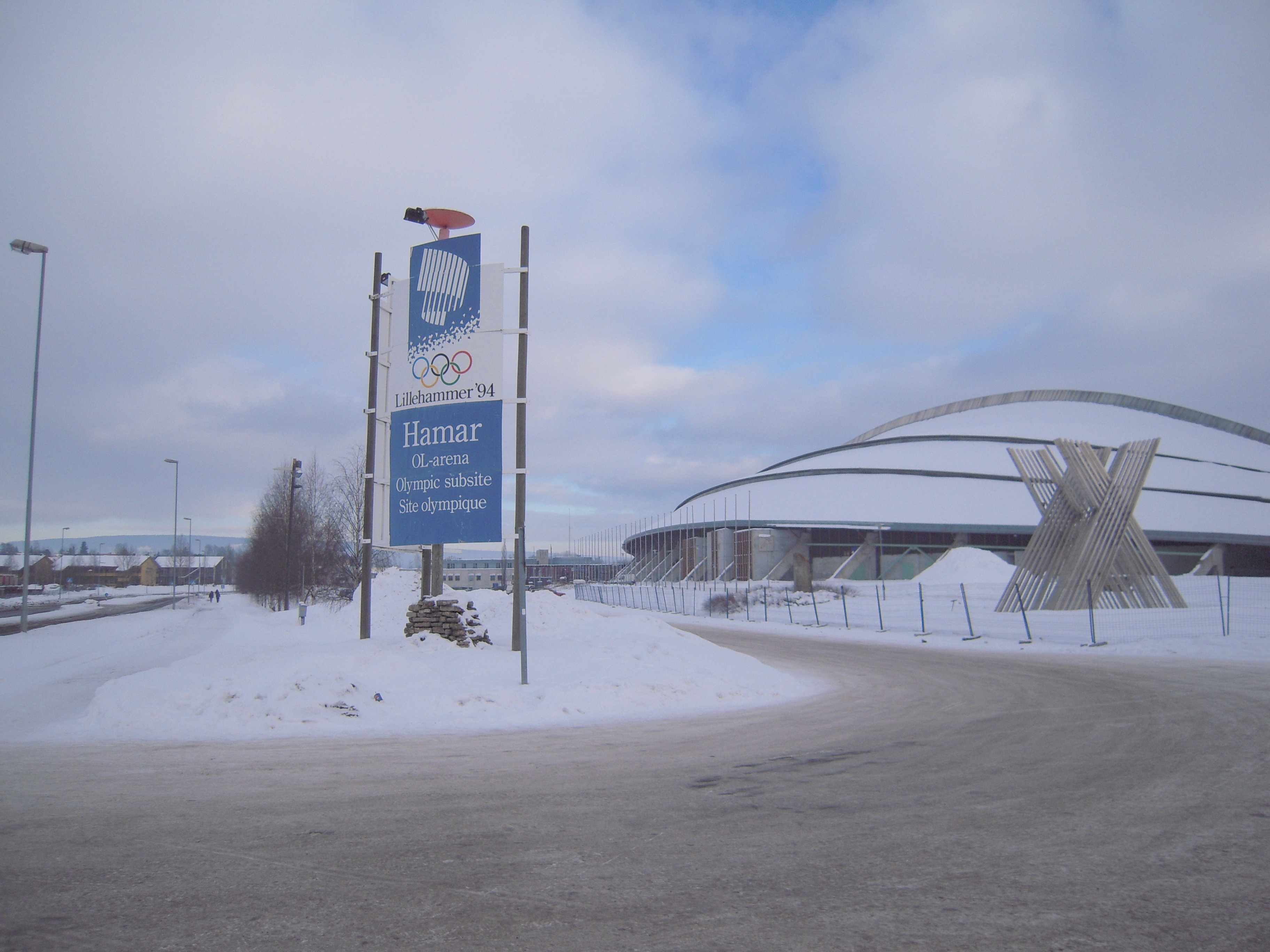
Vikingskipet
From the shores of Lake Mjosa, the building looks like a Viking longship flipped upside down -- which is exactly the point. Vikingskipet, officially Hamar Olympic Hall, was designed to evoke the hull of a vessel that once carried Norsemen across oceans, repurposed here as the hull of a building that carries skaters around a 400-meter oval at speeds their ancestors could not have imagined. When it opened on December 19, 1992, it was the largest indoor sports venue in the world, with twice the spectator capacity of Calgary's Olympic Oval.
Building the Ship
The story of Vikingskipet begins with a rule change. When Lillehammer bid for the 1992 Winter Olympics, indoor speed skating was not yet required. Calgary had built an indoor oval for the 1988 Games after wind interference wrecked outdoor races, but Albertville used a temporary outdoor track for 1992. In 1986, the International Skating Union mandated that Olympic speed skating events be held indoors, and suddenly Lillehammer's planned open-air temporary rink at Stampesletta was inadequate. Architects Niels Torp and Biong & Biong designed the massive new venue, its signature roofline inspired by Norse maritime heritage. Construction was approved by Parliament in April 1990 and cost 230 million Norwegian krone, almost entirely financed through state grants. The site at Akervika was controversial -- it sits on a Ramsar wetland, and environmental group Nature and Youth protested that it had "destroyed part of one of the world's most important bird reserves."
Koss, Jansen, and Blair
The 1994 Winter Olympics made Vikingskipet the stage for some of speed skating's most memorable moments. Norway's Johann Olav Koss won three gold medals -- in the 1,500, 5,000, and 10,000 meters -- setting world records along the way. Four of the five men's distances produced new world records during the Games. But the story that resonated most deeply was Dan Jansen's. The American had been haunted by Olympic failure for a decade, stumbling and falling when gold seemed within reach. At Vikingskipet, in the 1,000 meters, Jansen finally broke through, winning gold in world-record time. For women, Bonnie Blair defended her 1992 titles in both the 500 and 1,000 meters, cementing her status as America's most decorated Winter Olympian at the time. The venue also hosted ice sledge speed skating during the 1994 Winter Paralympics, where Norwegian athletes claimed 23 of 24 medals.
Beyond the Ice
Vikingskipet's 25,000 square meters of floor space and 400,000 cubic meters of volume were designed from the start for reinvention. Within months of the Olympic flame going out, the rink hosted the 1993 UCI Track Cycling World Championships after a temporary velodrome was installed for four months. Motorcycle speedway, rally racing, association football, and bandy have all filled the enormous space. The Speedway Grand Prix visited in 2002, 2003, and 2004, while Rally Norway used the hall as its service depot and race headquarters for World Rally Championship rounds in 2007 and 2009. Every Easter since 1996, the Viking ship fills with a different kind of competitor: The Gathering, one of the world's largest computer parties, draws thousands of gamers who set up their rigs across the arena floor. Concerts by Andrea Bocelli, Beyonce, and Stevie Wonder have echoed off the inverted hull.
The Arena's Long Season
Speed skating remains Vikingskipet's core identity. It is Norway's national venue for the sport, hosting annual ISU World Cup races alongside a steady rotation of major championships: World Allround, World Sprint, World Single Distance, and European championships have all been held here multiple times. The venue's refrigeration system uses an ammonia and saline solution circulated through pipes in the concrete, maintaining ice temperatures between minus 5.5 and minus 6.5 degrees Celsius while recycling the waste heat for the rest of the building. Attendance challenges have periodically raised questions about the arena's future -- in 2011, the Norwegian Skating Association considered moving World Cup events to Stavanger -- but Vikingskipet endures, hosting the 2016 Winter Youth Olympics long track events and continuing to serve as a venue where world records are not just possible but expected.
From the Air
Located at 60.79°N, 11.10°E on the eastern edge of Hamar, at Akervika along Lake Mjøsa's eastern shore. The distinctive inverted-hull roofline is visible from the air. Nearest major airport is Oslo Gardermoen (ENGM), approximately 120 km south. Hamar's Stafsberg airfield (ENHA) for light aircraft is nearby. The Hamar Olympic Amphitheatre sits to the northwest. Approach from over Lake Mjøsa at 3,000-5,000 feet to see both Olympic venues and the lake.