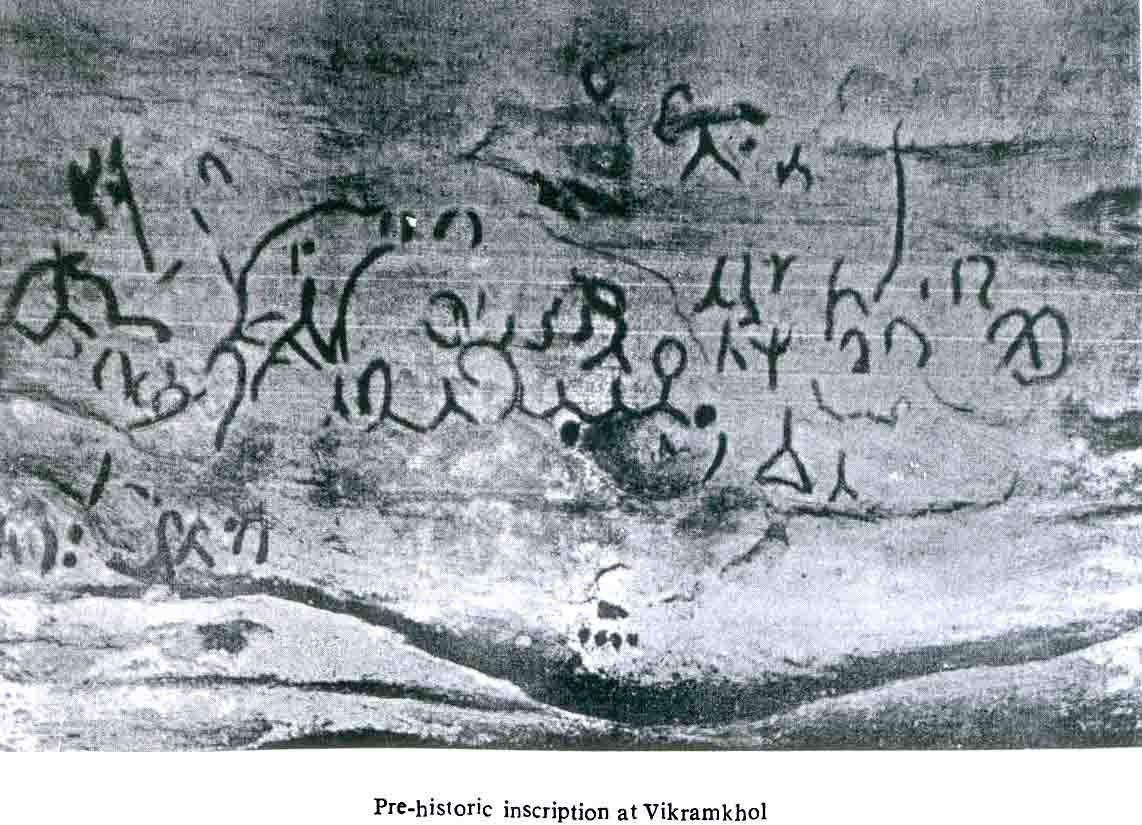
Vikramkhol Cave Inscription
Twelve kilometers from Belpahar, inside the reserved forest of the Belpahar range, a rock shelter holds a secret that has confounded scholars since the 1930s. Painted in red ochre and then incised into an uneven rock surface, the Vikramkhol inscriptions stretch across an area of 35 feet by 7 feet -- 42 distinct symbols arranged in three lines. Are they writing? Dr. K.P. Jayaswal thought so when he first studied them, tentatively dating the marks to around 1500 BC. Nearly a century later, the debate remains unresolved, and the inscriptions themselves are slowly fading away.
The Case for a Lost Script
Jayaswal's argument was meticulous. The characters at Vikramkhol, he proposed, represent a picto-syllabic writing system that mixes elements of the Harappan script with early Brahmi -- forming a bridge between two of India's most significant ancient writing traditions. His evidence was detailed: the symbols were carefully painted before being incised, a technique paralleled in known Brahmi rock inscriptions. The marks follow regular lines, accommodating the rough surface beneath them. They display set forms that reveal what handwriting experts call "writing habits" -- the hand that painted these letters was accustomed to working with a pen. Some characters bear dots below them, possibly functioning as diacritical marks similar to those in Semitic writing. Repeated symbols may indicate numerals. If Jayaswal was right, Vikramkhol represents nothing less than the evolution of literacy on the Indian subcontinent made visible in stone.
The Skeptics' Rebuttal
Not everyone was convinced. Scholar Richard Salomon dismissed the Vikramkhol markings entirely as pseudo-inscriptions -- marks that resemble writing but carry no linguistic content. C.L. Fabri took a middle position: the incised signs bear some resemblance to Brahmi script, he argued, but do not constitute writing in any formal sense, though the possibility of a primitive rural writing form could not be denied either. Naresh Prasad Rastogi cautioned that the dating remained debatable and that the symbols deserved more searching scrutiny before any conclusions could be drawn. The ambiguity is part of what makes Vikramkhol so compelling. These marks sit at the boundary between art and language, between ritual mark-making and the dawn of literacy -- and the evidence is not sufficient to place them firmly on either side.
A Bridge Between Scripts
More recent study by calligrapher and researcher Dr. Subrat Kumar Prusty has added new dimensions to the debate. His analysis identifies 24 distinct characters among the 42 symbols, finding similarities with both Indus Valley and Brahmi scripts. Some characters appear more than once, suggesting intentional repetition rather than random mark-making. Quantitative markings appear at the top and bottom of certain symbols. The writing proceeds from left to right. If these observations hold, they place Vikramkhol in a developmental sequence: from the Yogimatha rock paintings, through the Indus Valley script, to Vikramkhol, and finally to Brahmi -- a chain linking India's earliest known writing systems across millennia. Other prehistoric inscription sites in Odisha, including Garjan Dongar in Sundergarh district and Ushakothi in Sambalpur district, may eventually help scholars reconstruct this chain more completely.
Fading Into the Forest
The inscriptions are disappearing. Located inside a reserve forest with remote access, the rock shelter receives no meaningful protection. It stands open to the atmosphere, exposed to weather, vandals, and visitors who have defaced portions of the ancient markings. Coal mines in the surrounding hills and sponge iron industries add environmental pressure to a site that has survived since the second millennium BC. Historians have repeatedly sounded the alarm about government neglect, but the site's isolation -- the same quality that preserved it for thousands of years -- now works against it. Whatever the Vikramkhol inscriptions represent, whether the missing link in Indian writing or an elaborate form of prehistoric art, they carry information from a world separated from ours by thirty-five centuries. That information is eroding, year by year, into the red soil of Odisha.
From the Air
Vikramkhol cave is located at 21.85N, 83.80E, approximately 12 km from Belpahar and 35 km west of Jharsuguda in the Belpahar range reserved forest of western Odisha. The site is not visible from the air as it sits within dense forest cover. The nearest airport is Jharsuguda (VEJH/JRG), about 35 km to the east. The landscape is hilly with forested ridges typical of the northern Eastern Ghats foothills. Coal mining operations in surrounding hills provide visual reference points.