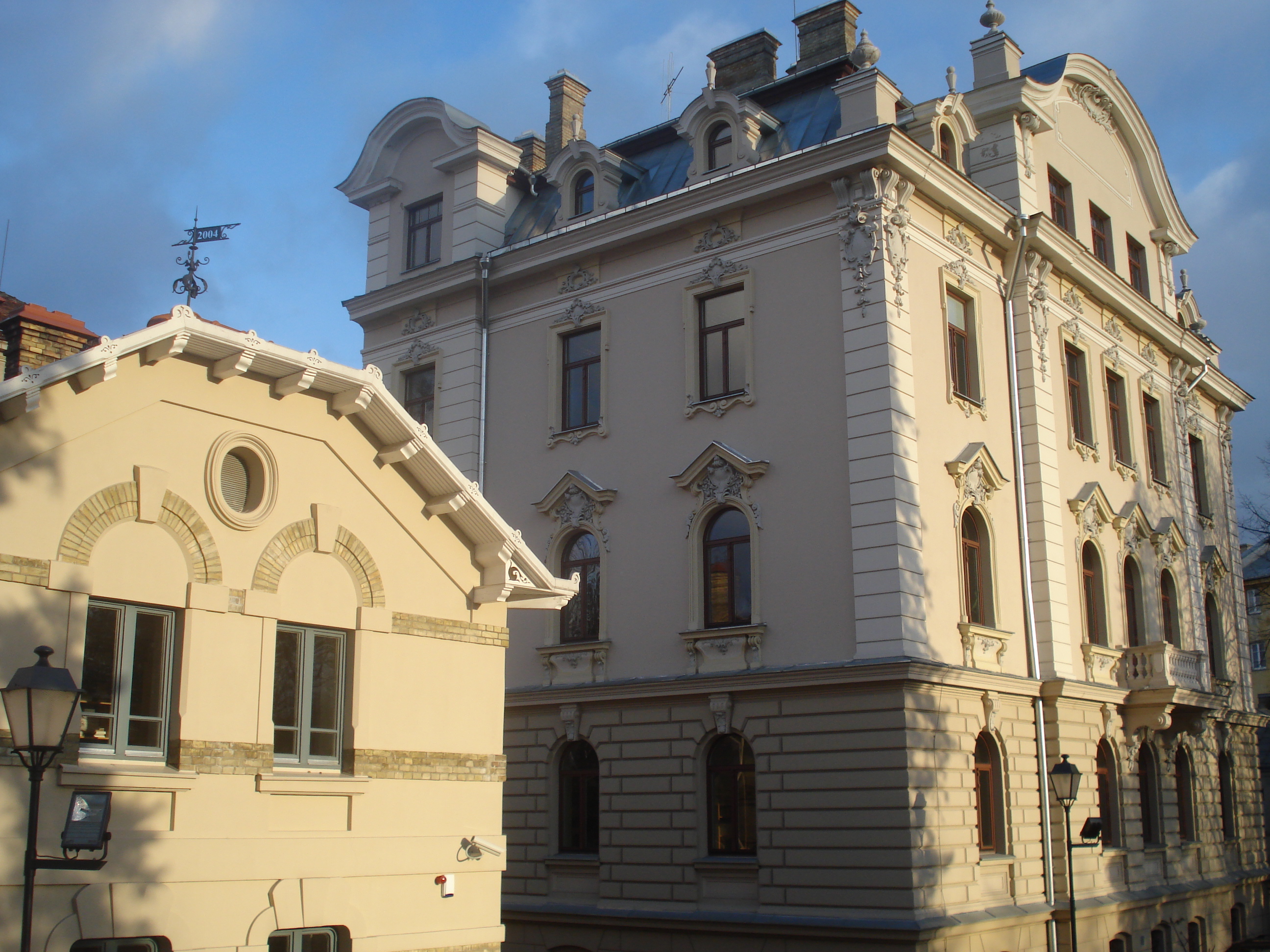
Vileišis Palace
Petras Vileišis was the kind of person Lithuania needed and rarely got: a railway engineer who made money, a political activist who used it well, and a publisher who put a printing press in his own basement so the country could finally read a newspaper in its own language. When he commissioned the palace in 1904, the architect August Klein offered him two designs - one Neo-Classical, one Neo-Baroque. Vileišis picked the Baroque, reasoning that it would speak with rather than against the Baroque facade of nearby St. Peter and St. Paul's Church. The decision is the first thing anyone notices about the building: a pale, ornamented mansion that wears 19th-century theatricality without apology, on a street that mostly does not.
Diluted with Milk
Construction methods at the Vileišis Palace were either inspired or eccentric, depending on which witness you believe. According to contemporary accounts, the lime used in the building was diluted not with water but with separated milk - an old folk technique meant to harden plaster and resist cracking. Less folkloric was Vileišis's willingness to pay for newer materials: ferroconcrete, then unusual in residential construction, plus building materials shipped in from Finland and the Netherlands. Work began in 1904 and finished in 1906. The result occupies a half-hectare site fenced in wrought iron and elaborately landscaped, with three buildings - main house, guesthouse, and outbuilding - arranged like a small estate dropped into the middle of Vilnius.
Inside the Two Floors
The main palace has two floors and a working logic. Vileišis's office and ante-room sat on the first floor along with the hallway, two drawing rooms, and the dining room. The vestibule held a chandelier that workers at the Vilija factory had given as a gift - the kind of detail that says more about the man than any official biography. Bedrooms occupied the second floor; servants lived in the attic under a mansard roof. The interior mixes Neo-Classical with Rococo: crown moldings, sculptural elements, pastel tiles. Portraits, busts, and bas-reliefs of Lithuanian writers and cultural figures fill the rooms - a building decorated as a deliberate statement that Lithuanian culture existed and deserved a setting.
The Newspaper in the Basement
The guesthouse mattered as much as the palace itself. Three stories tall with two stairways, it housed the printing press for Vilniaus žinios - the first legal Lithuanian-language daily newspaper printed in Vilnius - in its basement. Editorial and administrative offices filled the first floor; other operations the second. On 9 January 1907, the guesthouse hosted the First Lithuanian Art Exhibition, presenting work by Mikalojus Konstantinas Čiurlionis, the painter-composer who became Lithuania's defining national artist, and Antanas Žmuidzinavičius. The exhibition was not just a gallery opening - it was an argument that Lithuanian visual culture deserved its own institutions. The palace served as midwife. From 1941 to 1990 it housed the Lithuanian literature and language institutes; since 1990 it has held the Institute of Lithuanian Literature and Folklore, continuing the same essential mission Vileišis began.
The Independence Act That Wasn't There
Three years of renovation in the early 2000s ended with a re-opening in 2007. The work was largely cosmetic; the building had remained structurally sound. During the renovation, workers found significant historical documents tucked into the walls - the kind of small archives Vilnius residents have hidden behind plaster for centuries. The most-hoped-for find never materialized. The original signed copies of the 1918 Act of Independence of Lithuania - the document that declared the modern country into existence - have been missing since World War II. Popular belief held that they were sealed somewhere inside Vileišis Palace, partly because Petras's brother Jonas Vileišis was one of the Act's twenty signatories. Restorers checked every cavity. The Act was not there. Wherever those copies are - if they survive - they remain hidden, a missing piece of national memory the building would have been honored to keep.
From the Air
Vileišis Palace sits at 54.6952 degrees north, 25.3054 degrees east, in the Antakalnis district of Vilnius about 1.5 km northeast of Vilnius Cathedral, near the Baroque domes of St. Peter and St. Paul's Church. From the air both buildings appear together along the Neris River bend. Vilnius International Airport (EYVI) is approximately 7 km south.