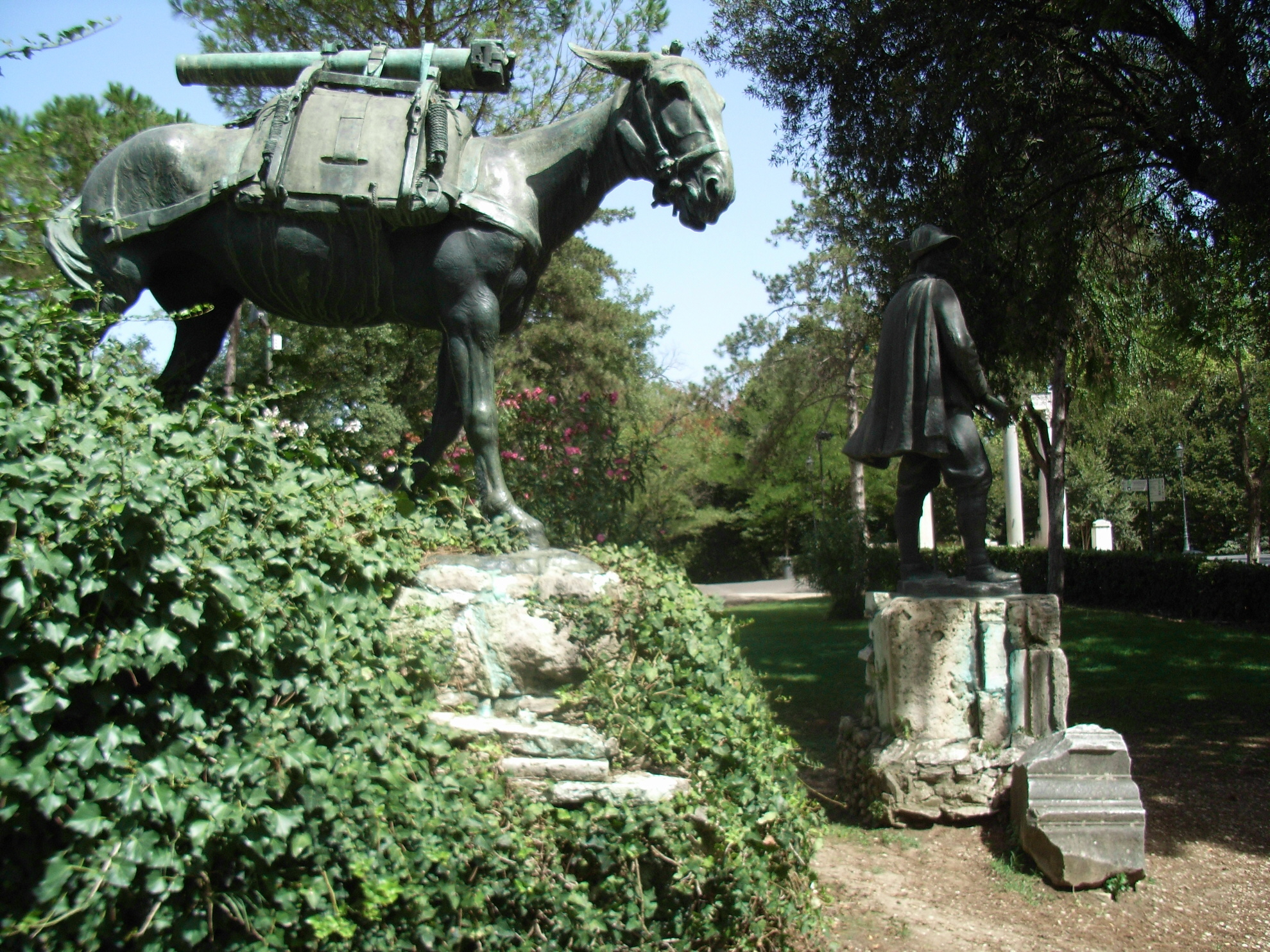
Villa Borghese Gardens
In 2004, scientists discovered a thriving colony of Mediterranean land snails living on a stone balustrade at Cliveden, an English country estate on the Thames. The snails belonged to the species Papillifera bidens, previously unknown in Britain. They had arrived, it turned out, with the Borghese Balustrade itself, purchased from Rome in 1896 by William Waldorf Astor and shipped to England with its invisible passengers. The snails had survived over a century of English winters. This is, in miniature, the story of the Villa Borghese gardens: things planted in Rome have a way of persisting far longer and traveling much farther than anyone intended.
A Cardinal's Party Ground
In 1605, Cardinal Scipione Borghese, nephew of Pope Paul V and patron of Bernini, began transforming a vineyard on the Pincian Hill into the most extensive gardens built in Rome since antiquity. The site was historically significant: it was identified with the gardens of Lucullus, the most famous in the late Roman Republic. Scipione intended the villa as a suburban retreat, a place for entertaining and displaying his growing art collection rather than a permanent residence. Domenico Savino da Montepulciano laid out the gardens, and the Borghese Balustrade was crafted by G di Gincome and P. Massoni in 1618 for the south forecourt of the Casino Nobile. The grounds eventually covered 80 hectares, making them the third-largest public park in Rome after the Villa Doria Pamphili and Villa Ada. Cardinal Scipione planted plane trees that still stand in the Valle dei Platani, largely unchanged since the 17th century.
From Formal Geometry to English Picturesque
The gardens underwent a dramatic transformation in the 18th century when Marcantonio Borghese, the 5th Prince of Sulmona, decided formal Italian garden architecture was out of fashion. He hired architect Antonio Asprucci and his son Mario, who spent over twenty years, starting in 1782, reshaping the grounds into an English landscape garden. They built the Temple of Aesculapius in the Ionic style at the center of an artificial lake between 1785 and 1792, added temples to Diana and Antoninus and Faustina, and scattered neoclassical statuary throughout. Vincenzo Pacetti executed the Sea Horse Fountain in 1791. The result was an unusual hybrid: an English-style landscape dotted with classical Roman temples and straight paths that owed more to Italy than to Capability Brown. The garden became public when the commune of Rome purchased the entire estate in 1903.
A Park of Museums
Six museums cluster within or at the edges of the Villa Borghese gardens. The Galleria Borghese occupies the original villa and holds Bernini sculptures, Caravaggio paintings, and works by Raphael and Titian. The Villa Giulia, built between 1551 and 1555 as Pope Julius III's summer residence, now houses the National Etruscan Museum. The Villa Medici serves as the French Academy in Rome. The Galleria Nazionale d'Arte Moderna specializes in 19th- and 20th-century Italian art, housed in a building that originated as a pavilion for Rome's 1911 world exposition. The most architecturally notable of those exposition pavilions was designed by Edwin Lutyens, who would later design New Delhi, and now houses the British School at Rome. The Fortezzuola, a Gothic garden structure, holds a collection memorializing the sculptor Pietro Canonica. In the 1650s, Diego Velazquez painted the Villa Medici's garden casino illuminated by torchlight at night.
Hidden Gardens and Vanished Deer
The park's named gardens each carry their own history. The Giardini Segreti, the Secret Gardens, originally flanked both sides of the Casino Nobile. The Parco dei Daini takes its name from the fallow deer and gazelles that roamed it through the 19th century. Its borders were marked by herms sculpted by Pietro and Gian Lorenzo Bernini, and a relief-decorated theatrical perspective from 1615. The Valle dei Platani, also called the Valley of the Dogs for its current use as a dog exercise area, preserves plane trees planted by Cardinal Scipione himself. At the rear of the Casino Nobile, a garden originally featured a Narcissus fountain surrounded by ancient statues and four herms attributed to the Berninis, later replaced by a Fountain of Venus in a 20th-century redesign. Each layer of renovation has added and removed, leaving traces of every era stacked atop one another.
Globe Theater, Hydrochronometer, and Olympic Horses
The park's curiosities span centuries. In 1873, a hydrochronometer was built in the gardens based on the 1867 design of Gian Battista Embriaco, a Dominican professor whose water-powered clock had won acclaim at the Paris Universal Exposition. A replica of Shakespeare's Globe Theatre was constructed in 2003 and named after the Italian actor Gigi Proietti. The former zoo was redesigned with minimal caging and reopened as the Bioparco. Nearby, the Casina di Raffaello offers a children's playroom where visitors can dress up in royal outfits. The Piazza di Siena hosted the first horse show in 1922 and served as the venue for equestrian events at the 1960 Summer Olympics, including dressage, individual jumping, and the jumping phase of the eventing competition. Ottorino Respighi immortalized the park's umbrella pines in his tone poem Pines of Rome, and Nathaniel Hawthorne set chapters 8 through 11 of The Marble Faun in its gardens.
From the Air
The Villa Borghese gardens (41.91N, 12.49E) are a large green expanse clearly visible from altitude in central Rome, situated on and around the Pincian Hill. The park's irregular shape and lake are distinctive from the air. Rome Fiumicino (LIRF) is 30km southwest; Ciampino (LIRA) is 15km southeast. The gardens border the Aurelian Walls and are adjacent to the Spanish Steps, Piazza del Popolo, and the Via Veneto neighborhood.