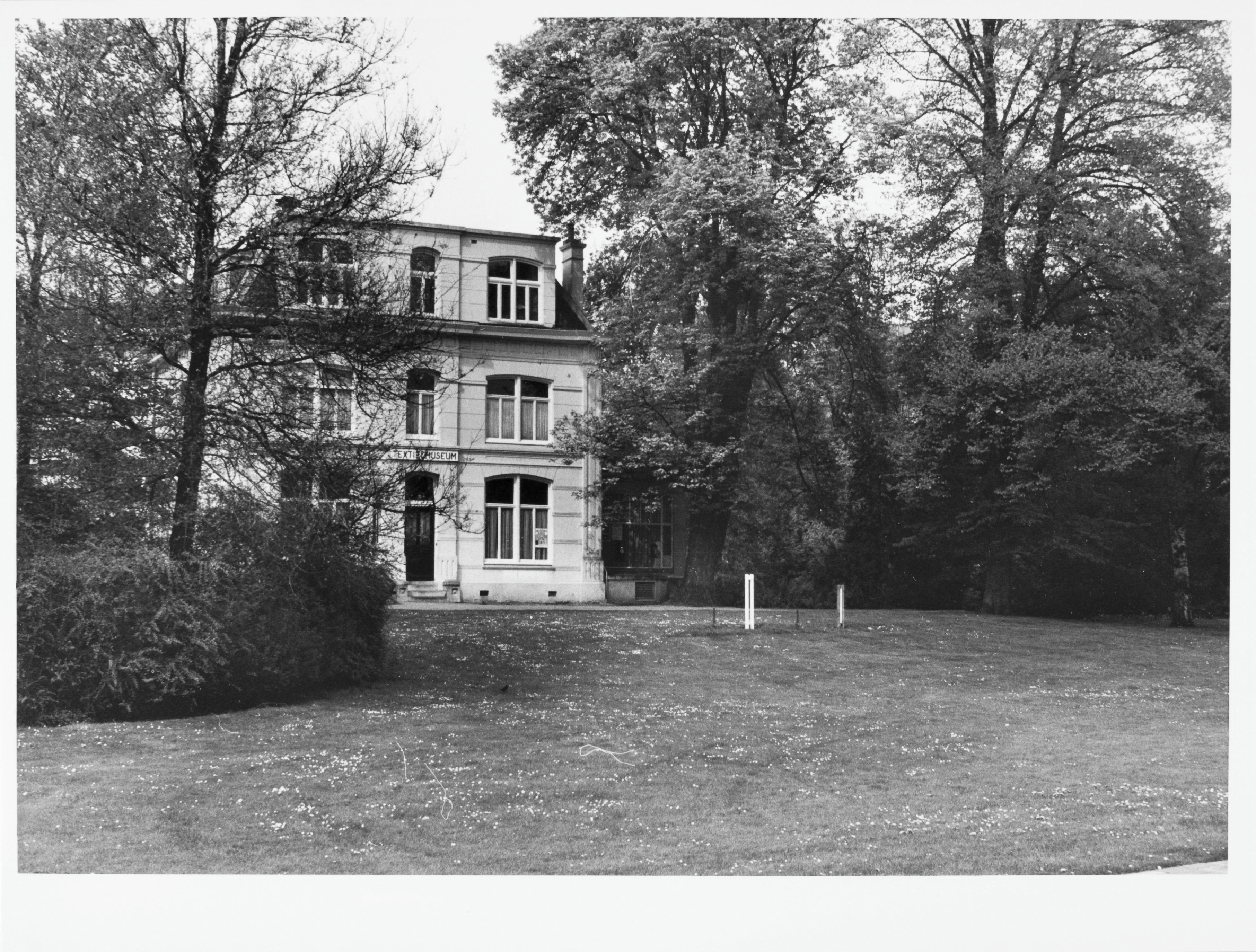
Villa de Bank
On the seventh of March, 1809, King Louis Bonaparte slept here. The brother of Napoleon was touring his short-lived Kingdom of Holland, and the villa beside the Espoort gate in Enschede was respectable enough to receive him. The current building on the site is not the one Louis stayed in; that one was replaced in 1881 with a stately neoclassicist mansion built by a textile baron and his wife. Today the same white-plastered facade looks out on a small park, and inside, where the family once entertained royalty, young artists hang their first solo shows.
The Blijdenstein Mansion
The Blijdenstein family made their fortune in textiles, the industry that built 19th-century Enschede. In 1806, Jan Bernard Blijdenstein, then fifty years old, commissioned a villa beside the Espoort. Three years later King Louis Napoleon Bonaparte spent the night of 7 March 1809 there during his visit to the city. That first villa was eventually replaced. In 1881, Herman Gijsbert Blijdenstein and his wife Emmerentia Johanna Ebeling commissioned a new house from the architect H.P. Timmer, neoclassicist in style with a symmetrical white-plastered facade and surrounded by an estate of five and a half hectares. Their daughter Johanna Ide Beltman-Blijdenstein was the last of the line to live in it. In 1958 the family transferred the estate to the city of Enschede so that the postwar Boulevard 1945 motorway could be built across the grounds; the city in turn agreed that the house itself would always hold a public function in science or the arts.
From Textiles to Studios
The first public use was almost on-brand for Enschede. From 1962, the villa became a museum dedicated to the local textile industry, the very industry that had built it. When that collection eventually moved to a former factory better suited to its scale, the city handed the keys to Stichting de Villa, a foundation that offered artists working space. Studios filled the upper floors. The ground floor became a gallery. Meanwhile, on the other side of town, a separate art space called De Bank had opened in 1985, founded by four artists, Jos Boomkamp, Albert Bouhuis, Eric de Gram, and Paul Silder. The name came from a London pub called the Bank of Friendship on Blackstock Road, where two of the founders had previously collaborated. In 1998 the two foundations merged. The combined initiative, Villa de Bank, took the mansion as its home, and Paul Silder, the only one of the original four still active in daily operations, helped steer the new identity.
MoMA at the Bank
Villa de Bank's exhibition policy is built around solo shows of younger artists, often graduates of the nearby AKI academy of fine arts, with a tilt toward the experimental and the not-yet-established. Around seven exhibitions run each year, each for roughly six weeks, supported by editions, books, and catalogues published alongside them. International exchanges with Kunstverein ArtHAUS in the neighbouring German town of Ahaus have become a regular fixture. In 2018, the gallery pulled off something its scale would not lead you to expect: it hosted a collaboration with the Museum of Modern Art in New York, showing work by Dutch artist Melle Nieling. A small mansion gallery in Enschede, sharing a wall label with MoMA. Other artists who have shown at Villa de Bank include Gijs Assmann, Hans Ebeling Koning, and Philip Akkerman.
The Fight to Stay
The villa's continued use as an artist-run space has not been automatic. Around 2010, the city of Enschede began looking at alternative locations for Villa de Bank after local entrepreneurs proposed transforming the mansion into a private club with a public bar, with a new art space planned alongside. The matter ended up in court. The judges ruled that Villa de Bank was already meeting the terms of the original 1958 bequest, since the house was being used both as private studio space for artists and as a public exhibition venue. The decision let the gallery stay. The mansion still sits in the small Blijdensteinpark just east of Enschede's centre, surrounded by trees and statues, including a colonial monument by Hans Petri that has prompted its own questions about how the city remembers the wealth that built places like this in the first place.
From the Air
Villa de Bank stands at roughly 52.22 degrees north, 6.91 degrees east, in the Blijdensteinpark just east of central Enschede. From altitude the park reads as a small green pocket separated from the city centre by the broad Boulevard 1945, the postwar motorway whose construction prompted the original transfer of the estate to the city. The nearest airport is Twente Airport (EHTW), a few kilometres north on the site of the former Twenthe Air Base, and Schiphol (EHAM) is the usual long-haul gateway. Münster/Osnabrück (EDDG) is just over the German border to the east.