Villa Ephrussi de Rothschild
Baroness Beatrice de Rothschild had her thirty gardeners dress as sailors, complete with berets topped with red pom-poms. The reason was architectural: she had designed her villa's main garden in the shape of a ship's deck, inspired by a voyage aboard the liner Ile de France, and from the loggia of the house -- positioned like a captain's bridge -- the Mediterranean was visible on all sides. The gardeners were the crew. The villa was christened Villa Ile-de-France, and its mistress ruled it from 1912 until her death in 1934 with the combination of refined taste and theatrical extravagance that only a Rothschild fortune could sustain.
A Palace Between Two Bays
The villa sits on the narrow isthmus of Cap Ferrat, a peninsula that juts into the Mediterranean east of Nice, with the sea visible in every direction. Beatrice de Rothschild -- born into the banking dynasty, married to Baron Maurice de Ephrussi -- chose this exposed promontory for its panoramic setting and commissioned the French architect Aaron Messiah to build a villa in a warm rose-pink Italian Renaissance style. Construction lasted from 1907 to 1912. The Baroness filled the interior with antique furniture, Old Master paintings, rare porcelain, sculptures, and objets d'art, assembling one of the most important private collections on the Riviera. She was a collector of compulsive thoroughness, and the villa became less a home than a museum in which she happened to live.
Nine Gardens, Nine Worlds
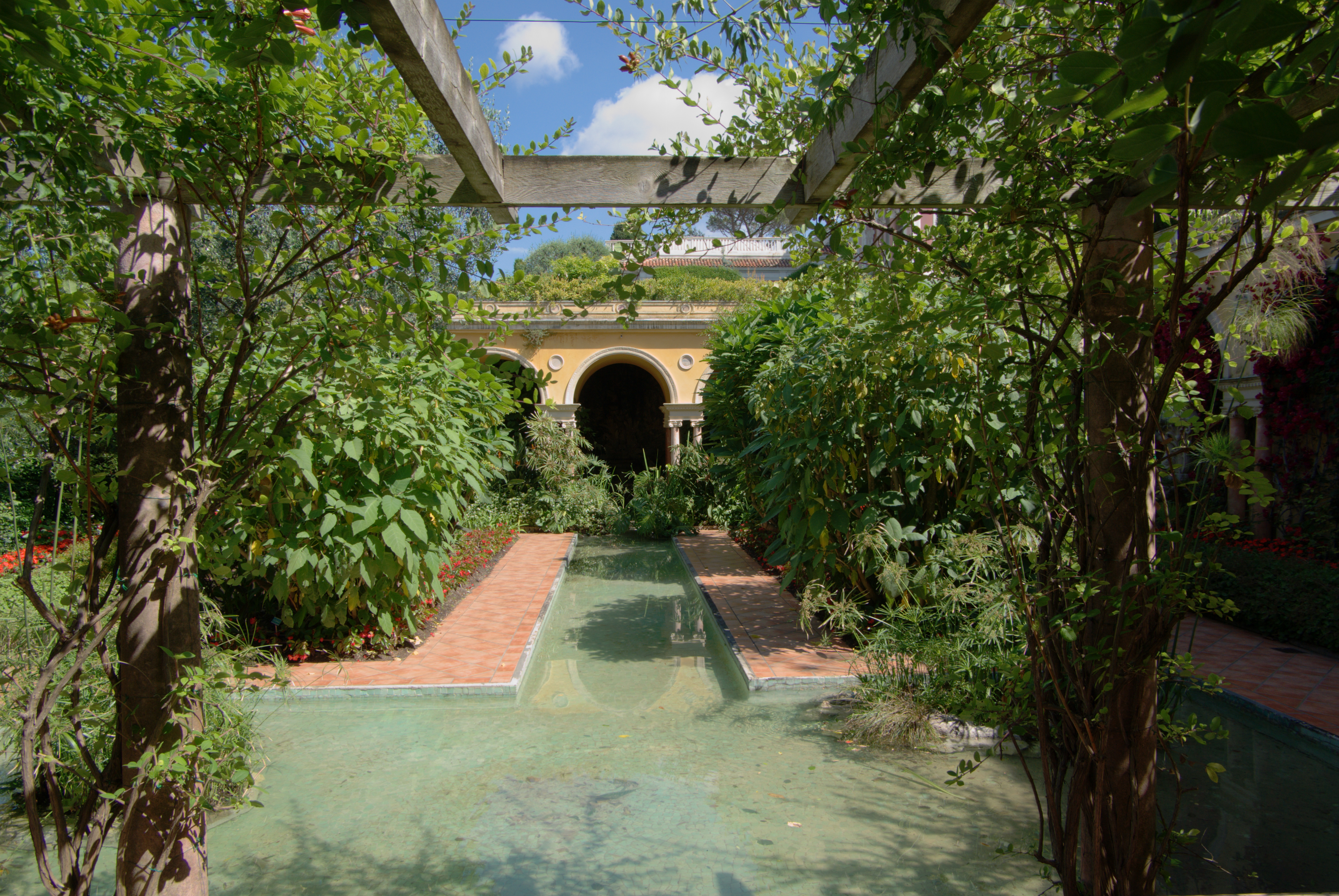
The villa's nine themed gardens are its greatest achievement. Created between 1905 and 1912 under the direction of the landscape architect Achille Duchene, each occupies its own space and evokes a different cultural tradition. The French formal garden, the largest, features a long basin ornamented with fountains and water lilies, climbing to a cypress-covered hill crowned with a replica of the Temple of Love from the Petit Trianon at Versailles. Below it, a Spanish garden offers a shaded courtyard with aromatic plants and Catalan amphorae. The Florentine garden faces the rade of Villefranche-sur-Mer, with a marble ephebe and an artificial grotto. A Japanese garden holds a wooden pavilion, bridge, and stone lanterns. The exotic garden bristles with giant cacti. A rose garden -- pink, naturally, the Baroness's favorite color -- adjoins it. A lapidary garden displays gargoyles and columns salvaged from ancient and medieval buildings. Gardens of Provencal plants and Sevres porcelain decorations complete the ensemble.
The Ship That Never Sailed
The garden's ship-deck design reveals something about the Baroness's worldview. Viewed from above -- or from the villa's loggia -- the main garden reads as a vessel's prow pointed toward the open sea, its basin serving as the deck, the Temple of Love as the figurehead. The conceit extended to the staff: the gardeners in their sailor costumes were performing a kind of permanent theater, maintaining a floating palace that never left port. The villa was a declaration of wealth so confident it could afford to be whimsical. A water cascade descends from the Temple in the form of a stairway, feeding the long basin below. The whole composition manages to be both grand and playful -- a quality that sets it apart from the many other Riviera villas of the Belle Epoque, which tended toward the merely ostentatious.
A Gift to the Nation
Upon her death in 1934, the Baroness bequeathed the villa, its gardens, and its collections to the Academie des Beaux-Arts, a division of the Institut de France. The gesture was characteristic: rather than leave her treasure to family or to commerce, she placed it in the custody of an institution dedicated to art. The villa was classified as a monument historique in 1996, and its gardens are officially designated among the Remarkable Gardens of France. Today it operates as a public museum, and each June it hosts 'The Painters' Day,' opening the nine gardens to working artists. An annual summer opera festival, Les Opera Azuriales, fills the grounds with music. The Baroness's sailors are gone, but their garden-ship still rides at anchor on the isthmus, its Temple of Love still visible from the sea, its fountains still running in the Mediterranean light.
From the Air
Located at 43.70N, 7.33E on the isthmus of Saint-Jean-Cap-Ferrat, the narrow neck connecting the Cap Ferrat peninsula to the mainland. From the air, the villa and its gardens are visible as a distinctive green space on the peninsula's spine, with water visible on both sides. Nearest airport: Nice Cote d'Azur (LFMN). The Cap Ferrat peninsula itself is one of the most recognizable features of the Riviera coastline from the air. Best viewed at 2,000-4,000 feet AGL.