The Media Tycoon's Hilltop Folly
Above the reception room, a placard reads: M'ISOLO E VIVO -- I isolate myself and live. Dominique Willem Berretty chose the motto for his new hilltop villa in Bandung, and the irony has only sharpened with time. The Dutch media tycoon who founded the Aneta press agency -- the dominant news wire in the Dutch East Indies -- spent 500,000 guilders he could barely afford to build the most extravagant private residence in colonial Java. He moved in, hosted a legendary housewarming party for journalists and friends in December 1933, and then lived there for roughly one year. In December 1934, Berretty died in a plane crash in Iraq, aboard a DC-2 on the Amsterdam-to-Batavia route. He had isolated himself. The living part proved brief.
Six Months from Foundation to Folly
Villa Isola went up with extraordinary speed. Architect C.P. Wolff Schoemaker -- one of the most prolific designers in colonial Bandung, whose credits included the renovation of the Gedung Merdeka on Braga Street -- broke ground in October 1932 and finished the structure by March 1933. Six months for a building of this ambition was remarkable, even reckless. Berretty was nearly bankrupt by the time it was done, but the opening ceremony that December suggested a man who had gotten exactly what he wanted. Guests found rooms filled with warm furniture, Venetian glass crowns, and paintings by both Indies and European artists. There was a reception hall, a billiards room wide enough to impress, sleeping quarters, a family room with a balcony overlooking the city, open terraces on the east and west, and a bar outfitted with a movie projector. The villa was not a home in any modest sense. It was a declaration -- a press baron's announcement that he had arrived, even as his finances whispered that he was already leaving.
Circles Within Circles
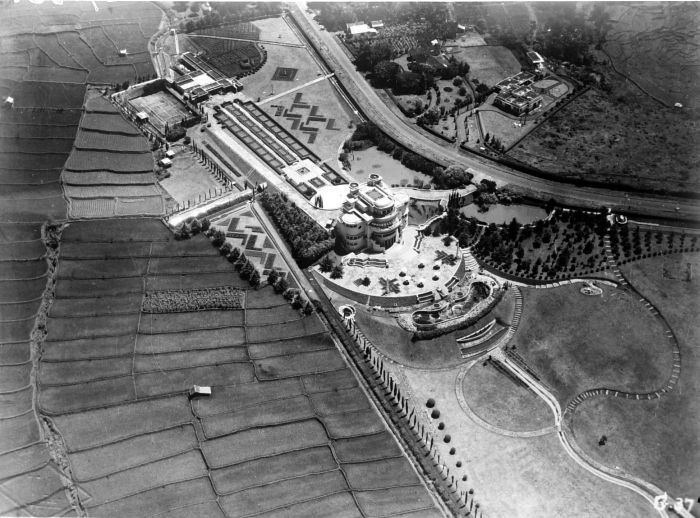
Schoemaker's design drew on an unlikely fusion. The architect was committed to Art Deco, but he filtered it through indigenous Javanese philosophy and the circular forms of the candi -- the Hindu-Buddhist temple structures of eastern Java. The result is a building obsessed with the circle. Round shapes appear everywhere: in the floor plans, the staircases, the toilet of the family room, and above all in the gardens that surround the complex. The villa sits on a north-south axis, its northern face oriented toward Mount Tangkuban Perahu, its southern facade overlooking the Bandung basin. The main entrance, on the north side, is shaded by a concrete canopy arch supported by a single pillar -- a structural flourish that feels both daring and precarious. Inside, a twisted staircase spirals from the lobby to the second floor, where corridors extending east and west to open terraces serve a dual purpose: connecting rooms and channeling airflow to cool the tropical interior. The south side, sitting lower on the slope, has an extra floor that Schoemaker designated as a service area -- integrated into the house rather than separated from it, a break with colonial convention that put servants' quarters at a remove from the main residence.
Black Swans and Borrowed Symmetry
The gardens were as theatrical as the house. Two terraced levels wrapped the complex, each with its own character. The upper north garden was European in conception -- a rectangular pond, a central statue, orchard flowers arranged in formal symmetry, and five black swans imported specifically to ornament the water. A road bisected the garden to allow cars to reach the garage, reinforcing the axis of symmetry that Schoemaker imposed on the entire composition. The south garden was larger, more elaborate, and more circular. Half-circle staircases descended from the building on three sides, and the garden was divided into concentric zones that placed the villa at their center. The effect was deliberate: the building appeared not to sit on top of the landscape but to emerge from within it, as if architecture and garden were different expressions of the same geometry.
From Spy Rumors to University
After Berretty's death, Villa Isola became a hotel, its rooms available to travelers who could appreciate the hilltop setting without the press baron's debts. During the Japanese occupation in 1942, the building became the army's headquarters for Bandung -- lending retrospective weight to unverified rumors that Berretty himself had been a Japanese spy, and that the tennis court was built on foundations sturdy enough to support a field artillery battery. Whether espionage or coincidence, the Japanese military clearly recognized the villa's strategic elevation and commanding views. After Indonesian independence, the building was renovated with an additional floor, and the name was changed to Bumi Siliwangi. In October 1954, Education Minister Mohammad Yamin designated the complex as the campus of a new pedagogical institute. Today, Villa Isola serves as the rectorate building of the Indonesia University of Education. Students walk past the placard that once announced a media tycoon's philosophy of splendid isolation, through gardens where black swans once floated, and into a building that has outlasted every purpose its owner imagined for it.
From the Air
Villa Isola is located at approximately 6.861S, 107.594E in northern Bandung, on elevated terrain overlooking the city to the south and facing Mount Tangkuban Perahu (2,084 m) to the north. The building sits on the campus of Indonesia University of Education and is visible as a distinctive structure on the hillside above the Bandung basin, which sits at roughly 700 meters elevation. Nearest airport is Husein Sastranegara International Airport (WICC) in western Bandung. Kertajati International Airport (WIIA) is approximately 70 km east.