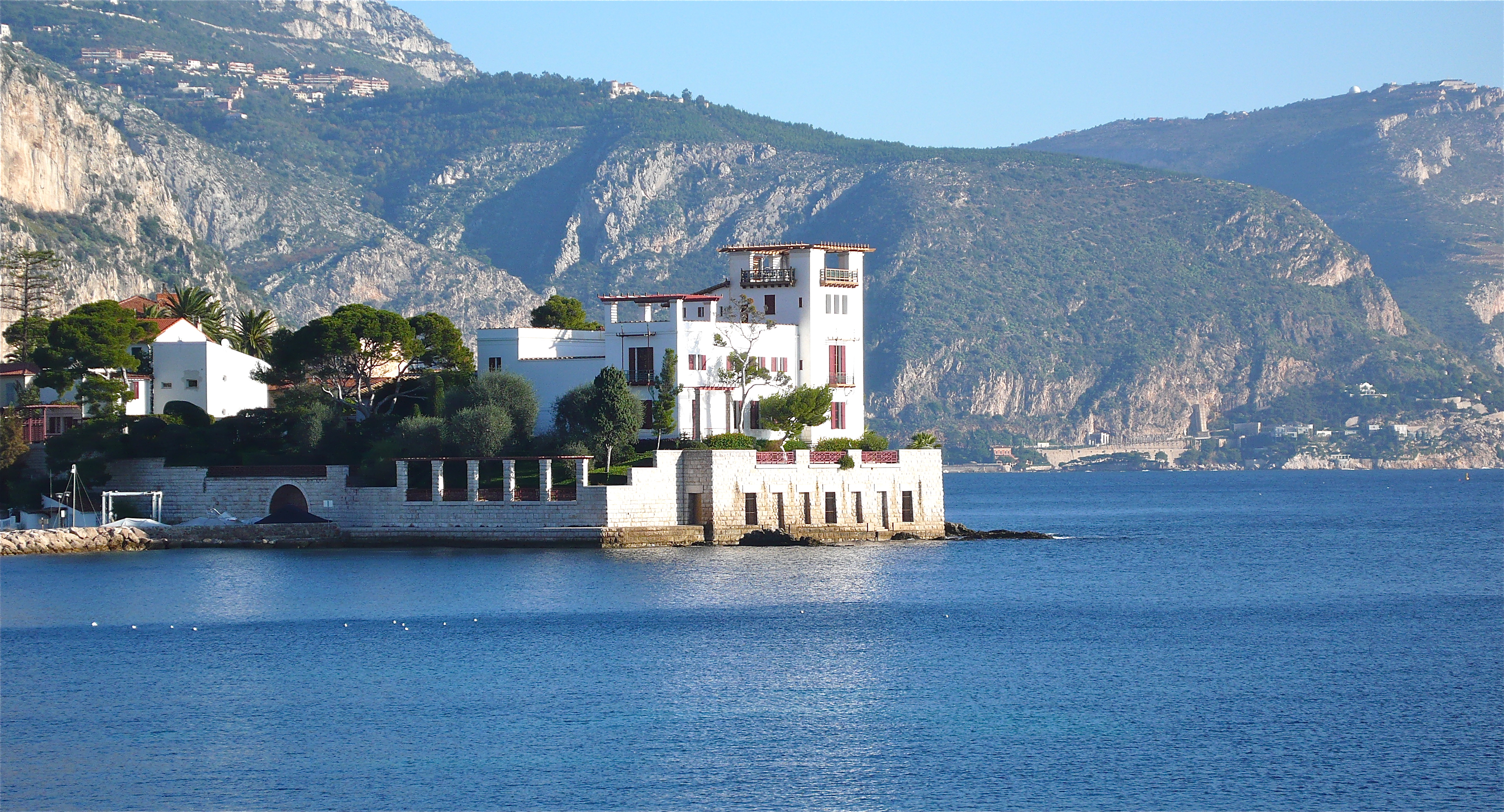
Villa Kerylos
Theodore Reinach was not content to study ancient Greece. He wanted to live in it. A polymath archaeologist, mathematician, and politician, Reinach purchased a rocky point at the tip of the Baie des Fourmis in Beaulieu-sur-Mer -- a site he felt resembled the headlands where Greek temples once stood -- and commissioned a full-scale reconstruction of a nobleman's villa from the island of Delos, built as it would have appeared in the 2nd century BC. He named it Kerylos, after the Greek word for the halcyon kingfisher, a bird of good omen. Construction began in 1902 and took six years. When it was finished, the French Riviera had gained its most improbable building: an ancient Greek house, complete in every detail, perched above a 20th-century sea.
An Archaeologist's Obsession
Reinach was no dilettante. He was a serious scholar who had studied Greek architecture, art, and daily life with the rigor of an academic and the passion of a collector. For the design, he turned to the architect Emmanuel Pontremoli, who had traveled extensively in Asia Minor and the Greek islands. Together, they studied the excavated houses of Delos -- the island sacred to Apollo where wealthy merchants had built elaborate residences during the Hellenistic period. Pontremoli laid out Villa Kerylos around an open peristyle courtyard, following the Delian model, with rooms arranged for the patterns of Mediterranean light and breeze. Every detail was researched: the proportions of columns, the patterns of mosaics, the placement of furniture. Reinach intended not a museum piece but a functioning home, one that would demonstrate how gracefully the ancient Greeks had lived.
Rome, Pompeii, and Egypt Under One Roof
While the floor plan was Greek, Reinach allowed the interior decoration to draw from a broader classical palette. The artists Gustave Louis Jaulmes and Adrien Karbowsky oversaw the interior, integrating influences from Rome, Pompeii, and Egypt into a unified aesthetic. Stucco bas-reliefs by the sculptor Paul Jean-Baptiste Gascq adorned the walls. The rooms were furnished with reproductions of ancient furniture, and the materials -- marble, bronze, exotic woods, ivory -- were chosen for their authenticity. The building's mosaics, frescoes, and carved details represent one of the most thorough attempts ever made to recreate the sensory experience of an ancient interior. Reinach and his wife Fanny Kann -- whose family connections linked her to the Ephrussi banking dynasty -- entertained here with an awareness that their dinner parties occupied a space designed to recall the symposia of classical Athens.
Family Ties and Rival Villas
The Reinach family's connection to the nearby Villa Ephrussi de Rothschild adds a layer of social history to both buildings. Fanny Reinach was a cousin of Maurice Ephrussi, who married Beatrice de Rothschild. According to family accounts, Beatrice was so inspired by the beauty of Villa Kerylos and the Cap Ferrat coastline that she built her own villa -- the rose-pink Villa Ephrussi -- on the neighboring peninsula. The two houses represent different expressions of the same impulse: the desire of cultivated, wealthy families of the Belle Epoque to create private worlds that reflected their intellectual and aesthetic passions. Where Beatrice built a ship-garden fantasy, Reinach reconstructed an ancient civilization. Both survive as public museums, separated by a few kilometers of coastline, testifying to an era when personal wealth and scholarly ambition could produce buildings that doubled as arguments about how life should be lived.
A Greek House on the French Sea
Villa Kerylos has been classified as a monument historique since 1966. Visitors walking through its peristyle courtyard, past its mosaic floors and frescoed walls, experience something closer to time travel than tourism. The building sits on its rocky point with the Mediterranean breaking below, and the illusion works because Reinach understood something fundamental: Greek architecture was designed for exactly this relationship between building and sea, between column and light, between interior shade and the glittering surface of water. The French Riviera's climate and coastline share enough with the Aegean that the transposition feels natural rather than absurd. The name Reinach chose -- Kerylos, the halcyon kingfisher -- was a wish as much as a label. In Greek mythology, the halcyon calmed the seas during winter so it could nest on the waves. Reinach built his nest on the most beautiful coastline he could find, and filled it with the civilization he loved most.
From the Air
Located at 43.70N, 7.33E at the tip of the Baie des Fourmis headland in Beaulieu-sur-Mer, between Nice and Monaco. The villa occupies a prominent rocky point visible from the sea and air. It is adjacent to the Cap Ferrat peninsula, where the Villa Ephrussi de Rothschild sits. Nearest airport: Nice Cote d'Azur (LFMN). The coastline between Beaulieu, Cap Ferrat, and Villefranche is one of the most scenic stretches of the Riviera from the air. Best viewed at 1,500-3,000 feet AGL.