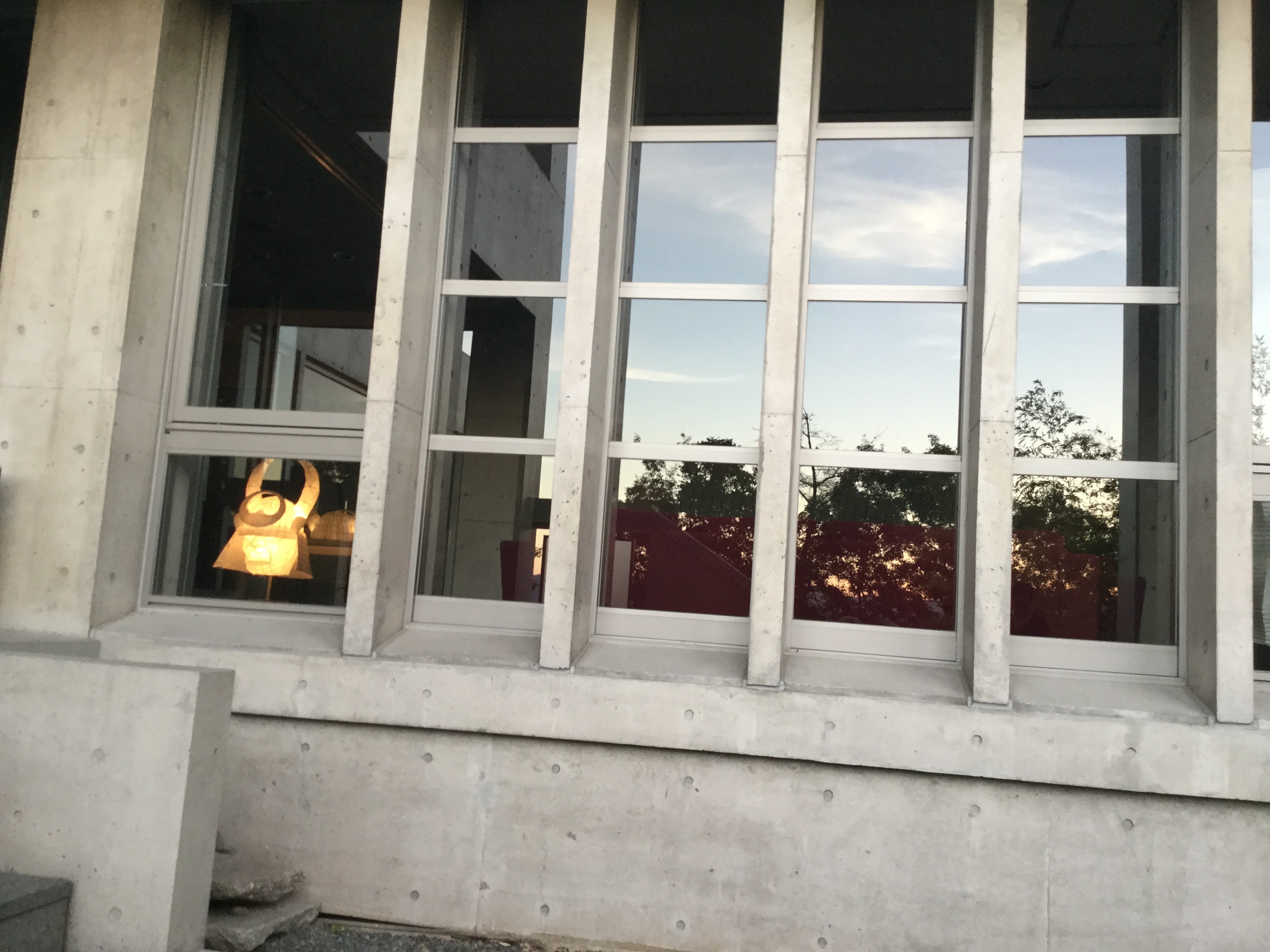
Villa Kujoyama
The poet-diplomat Paul Claudel dreamed it first. In 1926, while serving as French Ambassador to Japan, Claudel envisioned a cultural bridge between France and Japan anchored in the hills of Kyoto. With the help of Osaka industrialist Katsutaro Inabata, that dream materialized as the Franco-Japanese Institute on Mount Higashi, a place where French language courses mingled with the scent of hinoki cypress drifting up from the ancient capital below. The institute moved to a new location in 1936, and the original hillside site sat empty for nearly fifty years. But the dream refused to die. Today, that same hilltop hosts Villa Kujoyama, one of the most prestigious artist residencies in Asia, where French and Japanese creators live and work in a building designed to be a balcony overlooking Kyoto.
A Balcony Above the Ancient Capital
Villa Kujoyama occupies a thousand square meters on Mount Higashi, the eastern hills that frame Kyoto's skyline. Architect Kato Kunio, a professor at the University of Kyoto, designed the building at the intersection of two aesthetic traditions, blending what he described as the "rigor of modular composition" with "freedom in the arrangement of spaces." Construction began in January 1991 and took eighteen months. The villa opened its doors to its first residents in October 1992, with an official inauguration on November 5 of that year. Six housing workshops accommodate about fifteen residents annually, each arriving with a project that connects to Japan in some way. They come to work in architecture, fine arts, music, dance, culinary arts, fashion, photography, literature, and digital creation. Since 2019, even video game designers and circus artists have found a home here.
From Ruin to Renaissance
The original 1926 building on Mount Higashi deteriorated for decades after the Franco-Japanese Institute relocated in 1936. By the 1970s, neighbors were protesting its decrepit state. Demolition came in 1981, and the cleared land was slated for sale. Then the French government intervened, recognizing the site's extraordinary vantage point above one of the world's most historically layered cities. In 1986, French and Japanese administrators agreed to build an artist residency instead, a decision formalized on November 11 of that year. Fundraising from Kansai-region companies took three years, overseen by Inabata Katsuo, grandson of the original institute's champion. Securing the construction permit took another three. The patience paid off: between 1992 and 2012, Villa Kujoyama hosted 275 French artists and creators.
Saved by Patrons
After two decades of continuous operation, the building showed its age. Discussions turned to shutting Villa Kujoyama down entirely. Two foundations stepped in to prevent that outcome. The Pierre Berge - Yves Saint Laurent Foundation contributed 500,000 euros toward insulation, flooring, and compliance upgrades, enabling the villa to reopen on January 1, 2014. The Bettencourt Schueller Foundation committed 754,000 euros between 2014 and 2017 for operations and cultural programming, then renewed its patronage through 2026. Their support brought more than money: the Bettencourt Schueller Foundation also expanded the residency to include digital arts and crafts, and since 2022, laureates of its Liliane Bettencourt Prize for the Intelligence of the Hand have received dedicated one-month stays to explore the intersection of their craft with Japanese culture.
Where Two Cultures Meet
More than 400 laureates have passed through Villa Kujoyama since 1992, working across disciplines from contemporary art to humanities research. The residency operates three programs: solo projects of four to six months, paired residencies for two France-based candidates, and duo residencies pairing a France-based artist with a Japanese collaborator. Every first Thursday of the month since March 2023, the villa opens its doors to the public, inviting visitors to engage directly with the art being created inside. Residents showcase their work at the annual Nuit Blanche Kyoto festival and in partner venues across the city. The cultural exchange does not end when residents leave Japan: post-residency support extends for five years, with partnerships at the Musee de la Chasse et la Nature in Paris and the Abbaye de Maubuisson in Val-d'Oise providing exhibition and studio space.
A Global Network of Villas
Villa Kujoyama is not alone in its mission. It belongs to a constellation of French residencies abroad, alongside Villa Albertine in the United States, the Academie de France at Villa Medicis in Rome, and the Casa de Velazquez in Madrid. Together, these four institutions participate in the Viva Villa! festival, launched in 2016 to showcase returning residents' work. The villa is also one of five branches of the Institut francais du Japon, operating with its own independent direction since 2014. In a city that has practiced the art of combining tradition with innovation for centuries, Villa Kujoyama fits naturally into Kyoto's cultural fabric, a place where a French ceramicist might learn from a Japanese lacquer master, or a Parisian choreographer might find new movement vocabulary in a temple garden.
From the Air
Located at 35.005N, 135.793E on Mount Higashi, the eastern hills of Kyoto. Look for the modern architectural form amid the forested hillside east of central Kyoto. The nearest major airport is Osaka Kansai International (RJBB), approximately 75 km south. Kyoto sits in a basin surrounded by mountains on three sides, so approach from the south or southwest for the best views. At 2,000-3,000 feet AGL, the villa's rooftop is visible among the temple-dotted eastern hills, with the Kyoto city grid stretching out to the west.