Village Vanguard
Max Gordon needed two johns, two exits, two hundred feet from a church or synagogue, and rent under a hundred dollars a month. That was the complete specification for the club he had in mind — not exactly a vision of artistic grandeur. What he found in 1934 was a speakeasy called the Golden Triangle at 178 Seventh Avenue South, a basement room whose floor plan traced an isosceles triangle. He opened it in 1935 as the Village Vanguard. Ninety years later, it is still there, still triangular, still in the basement, and now generally acknowledged as the oldest operating jazz club in New York City.
Folk Songs and Fifty Cents
The Vanguard began as something else entirely. Gordon was a literary man — he wanted a forum for poets and folk musicians, a Greenwich Village salon that happened to sell drinks. Through the 1930s and 1940s, Lead Belly played blues and folk music from the stage; Maxwell Bodenheim and Harry Kemp read poetry; the Duke of Iron brought Caribbean calypso. Jazz sessions crept in on Sunday afternoons, where the cover was fifty cents and the names onstage were Lester Young and Ben Webster. Lorraine Gordon, who would later marry Max and run the club for decades after his death, remembered that you could hear the greatest jazz musicians in the world for pocket change. Nobody called it the jazz club yet. That came later.
The Policy Reversal
By 1957, Max Gordon had made a decision. Jazz went to the top of the bill. Folk acts and comedians would fill the gaps. Within months, the booking list read like a fantasy — Miles Davis, Thelonious Monk, Gerry Mulligan, Sonny Rollins, Bill Evans, Stan Getz, Carmen McRae, Charlie Mingus. The Monk booking was Lorraine's doing. She had met Max at a bakery on Fire Island and proposed that he give the relatively obscure pianist a week at the club. Max agreed. When Monk opened on September 14, 1948, nobody came — not the critics, not the cognoscenti, nobody. The Vanguard would eventually help make Monk's name. It took longer than a week.
The Room Where Masterpieces Were Made
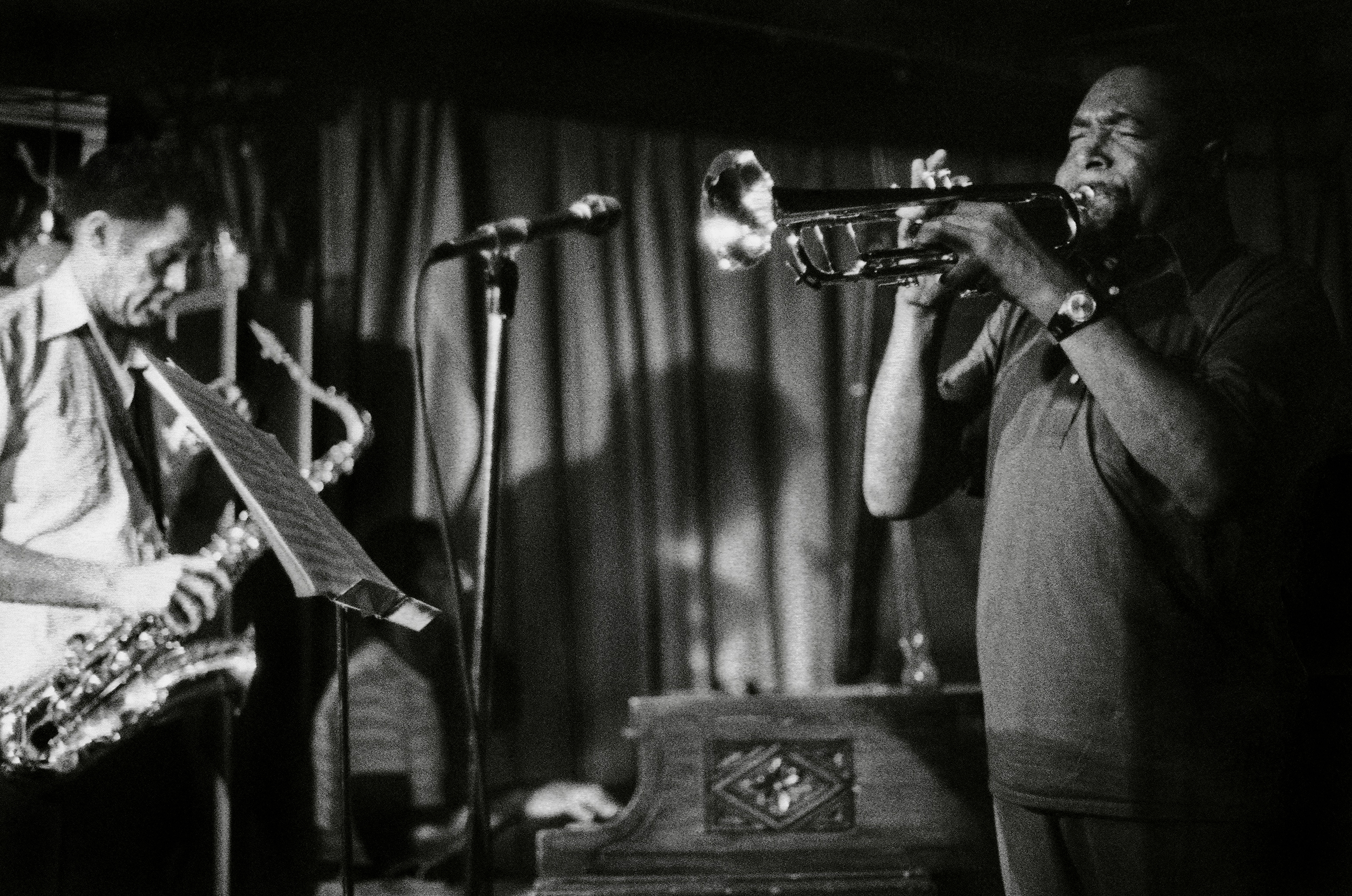
What separates the Vanguard from other legendary jazz venues is the recordings. On November 3, 1957, Sonny Rollins recorded three LPs in one session in that triangular basement, laying the foundation for the piano-less trio and shaping the hard-bop movement. John Coltrane's Vanguard recordings from 1961 — five titles drawn from 22 songs over four nights — became some of the most studied documents in jazz history. Bill Evans recorded there so extensively that his Vanguard sessions constitute a small library; the last significant ones came just three months before his death in 1980. The phrase 'Live at the Village Vanguard' on an album cover became, as Blue Note Records president Bruce Lundvall once observed, a direct and positive influence on sales. The room's acoustics, the intimate pressure of those angled walls, pulled something out of musicians that they didn't always find elsewhere.
The Gordons' Legacy
Max Gordon died on May 11, 1989. Lorraine closed the club for one day. The next day, she reopened it and ran it for nearly thirty more years. She died in June 2018 at age 95. The Thad Jones/Mel Lewis Orchestra — later the Vanguard Jazz Orchestra — had been playing Monday nights at the club since 1965, a residency that outlasted both of its founders. The club's calendar has barely paused since the 1930s. It remains, as one writer put it, a room with a life of its own: a wedge in the ground on a Greenwich Village corner where the history of jazz is still accumulating.
From the Air
The Village Vanguard is located at 40.736°N, 74.002°W in Greenwich Village, Manhattan, at 178 Seventh Avenue South. From the air it is invisible — a basement room beneath the dense street grid. The West Village streets nearby form a distinctive non-grid pattern, diverging from the city's regular blocks. Nearest major airport is KEWR (Newark), approximately 10 miles west. KJFK is roughly 13 miles southeast.