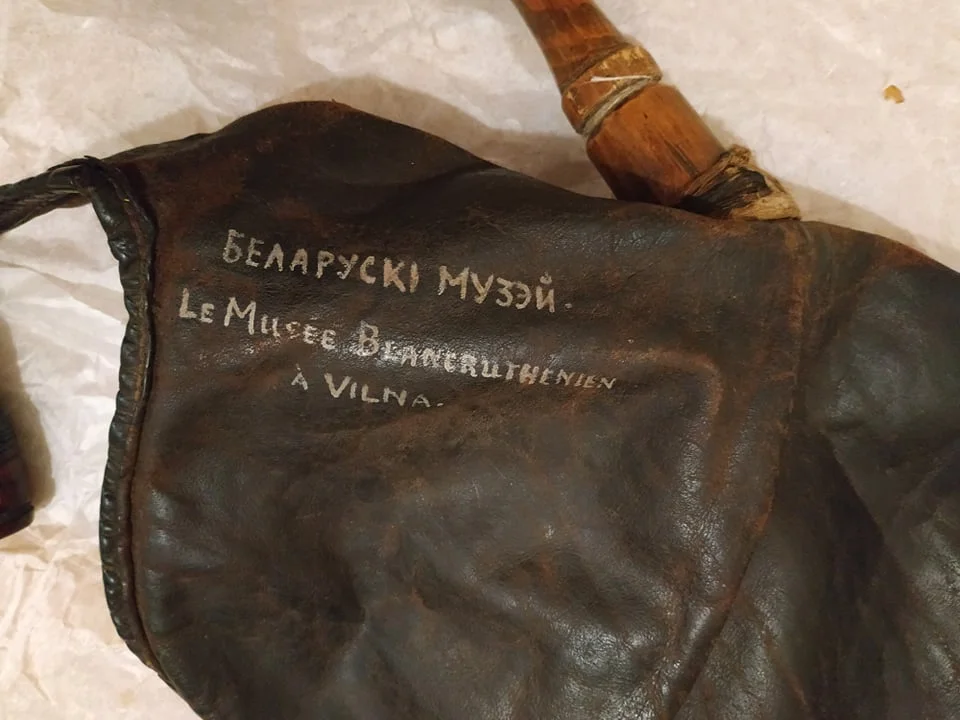

Vilnius Belarusian Museum
Ivan Luckievič started collecting Belarusian antiques while still in school. By 1908 his collection - already including a Skaryna Bible, a Statute of Lithuania, several Slutsk belts, and bound issues of the underground newspaper Mużyckaja prauda - lived in the editorial offices of Naša Niva, the Belarusian-language paper he had helped found. He died in 1919, his lungs ruined by tuberculosis, before he could see the museum his collection would become. Two years later, in 1921, the Belarusian Scientific Society opened the Vilnius Belarusian Historic-Ethnographic Museum Named after Ivan Luckievič in four or five small chambers inside the Monastery of the Holy Trinity. It survived for 24 years before the Soviet state took it apart, piece by piece.
A Museum Built by Brothers
Ivan's younger brother Anton Luckievič ran the new museum together with the engineer Liavon Dubeikauski. Their goal was specific and pointed: to gather the material and intangible culture of Belarusians, with particular emphasis on the centuries when Belarusians shaped the Grand Duchy of Lithuania. In a city ruled by interwar Poland, where Belarusian was a language of villages rather than government, the museum was an argument that this culture had a history worth its own institution. The first inventory in 1922 catalogued 106 folklore items, 797 hand drawings, 126 pieces of armor, and hundreds of tiles and bricks. By 1933 the collection had grown to include a 200-item prehistoric section spanning Palaeolithic through Iron Age, religious objects, wooden sculpture, and a sigillographic collection of 103 stamps. By 1937 the museum held 4,228 items - among them 2,492 numismatic pieces and a library of 10,555 volumes.
Caught Between Three Regimes
Vilnius's borders moved more often than its people did. In September 1939, after Soviet forces took the city, members of the museum committee - including Anton Luckievič - were arrested. The museum did not formally close, but it stopped functioning from October 1939 to July 1940. Then it was reorganized as a subsidiary of the new Academy of Sciences of the Lithuanian SSR. It reopened in October 1940 with the ethnographer Yan Shutovich appointed director, a post he held through the German occupation from February 1941 to November 1944. He kept the collection together through three years of Nazi rule, no small thing for a museum dedicated to a Slavic minority. When the Soviets returned in 1944, his thanks was arrest and deportation to the Gulag.
Liquidation by Committee
Juozas Pertulis took over briefly. A liquidation committee formed, including the deputy Commissar of People's Education and the historian Albinas Daukša-Paškevičius from the Lithuanian Communist Party's Central Committee. The committee finished its work in June 1945 with a tidy bureaucratic logic: items with text in Belarusian went to Belarus, items linked to the Grand Duchy of Lithuania stayed in Lithuanian institutions, and a portion went to central museums in Moscow. The collection that Ivan Luckievič had spent his short life building, that his brother and a small circle of intellectuals had grown for two decades, was dispersed across three Soviet republics in a few months. Most of the artifacts that wound up in Belarus passed into the Belarusian National Arts Museum in Minsk. Many others have never been precisely located since.
The Slow Return
In 2001, the activist Siaržuk Vituška launched an initiative to restore the museum. The founding group - Halina Voitsik, Siaržuk and Liudevika Vituška, Siarhei Dubaviets, Tatiana Poklad - registered an NGO called the Ivan Lutskievitch Belarusian Museum in Lithuania. For two decades it operated mostly without a building. Then in 2021 the Vilnius City Municipality granted the museum a house at Vilniaus Street 20, and on 4 August that year the first exhibition opened, featuring four Belarusian women artists: Zoia Koush, Zhana Gladko, Sviatlana Petushkova, and Aliesia Zhytkuevitch. The director today is Liudvika Kardzis. A second exhibition celebrated 115 years of Naša Niva and 100 years of the museum. The reborn institution holds book launches, concerts of Belarusian musicians like Zmitar Bartosik and Andrej Hadanovich, poetry festivals, and theatre - much of it now sustained by Belarusian writers and artists who fled Lukashenko's crackdown after 2020. Vilnius, once again, has become a Belarusian cultural capital in exile.
What the Originals Did
From 15 October to 12 December 2021, the Belarusian National Arts Museum in Minsk hosted an exhibition for the museum's centenary - displaying artifacts that had once belonged to Luckievič's collection and had been transferred to Belarus during the 1945 liquidation. The exhibition was a kind of accidental reunion: objects gathered by one man in early 20th-century Vilna, scattered by Soviet committee in 1945, briefly reassembled in 2021 to mark a century since their first museum opened. The originals are mostly in Minsk now, beyond easy reach of the Vilnius successor. But they exist. They were preserved. The brothers Luckievič, Yan Shutovich, the activists who registered an NGO in 2001 and waited two decades for a building - all of them are part of the same long argument that this culture deserves a museum. The argument continues.
From the Air
The reborn Vilnius Belarusian Museum sits at 54.6751 degrees north, 25.2875 degrees east on Vilniaus Street 20 in central Vilnius, about 600 meters southwest of Vilnius Cathedral. The historical site at the Monastery of the Holy Trinity is roughly 800 meters southeast in the Old Town. Vilnius International Airport (EYVI) is approximately 6 km south.
Nearby Stories
- Dubingiai Castle 20 km away
- Battle of Vilnius (1915) 35 km away
- Pažaislis Monastery 40 km away
- Lida Castle 68 km away
- Battle of Raseiniai 92 km away
- Grodno Ghetto 103 km away
- Mir Ghetto 127 km away
- Daugavpils Fortress 136 km away