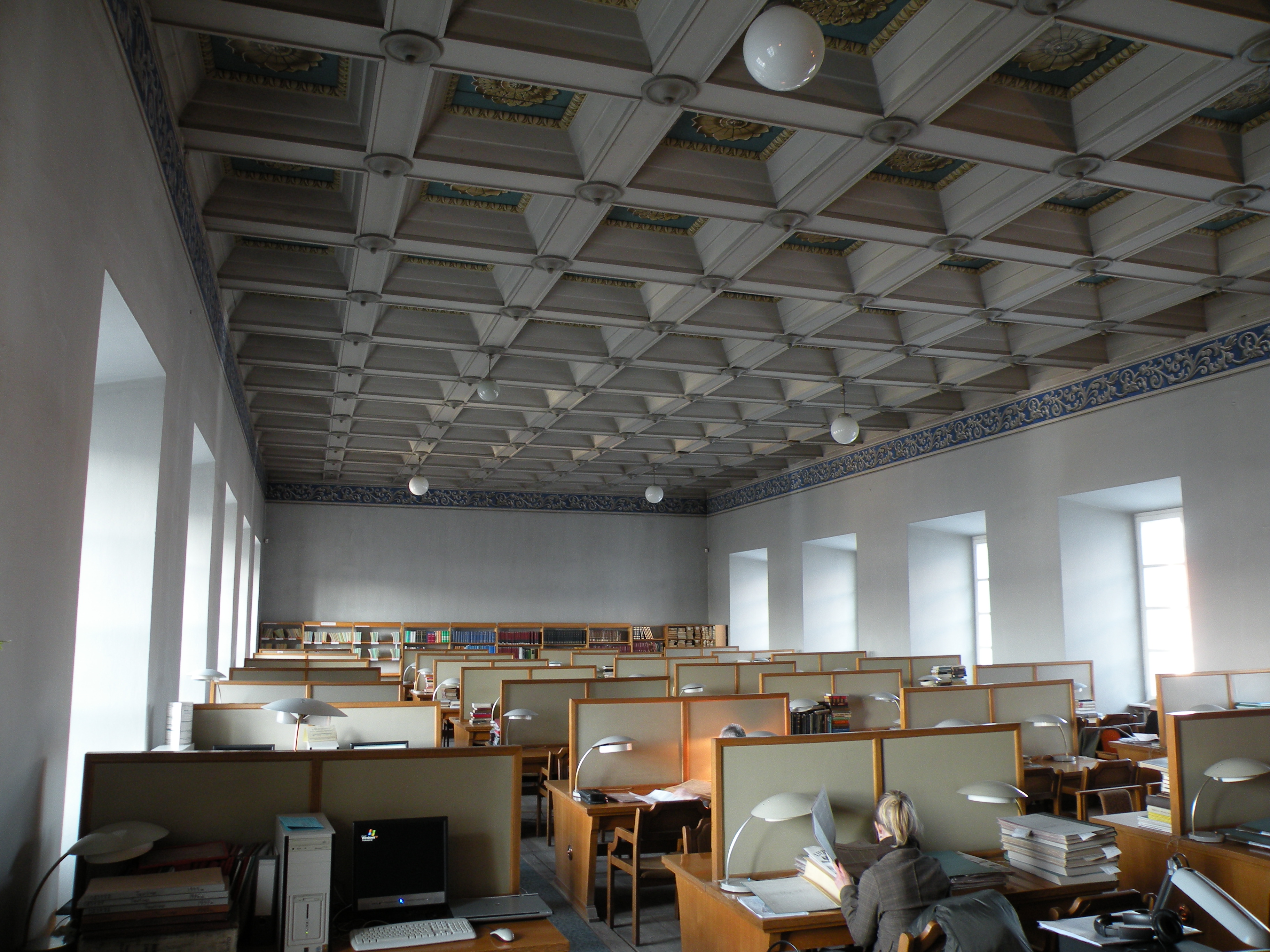
Vilnius University Library
Vilnius University Library is older than the university it serves. The Jesuits founded the library on 17 July 1570, nine years before King Stephen Báthory's 1579 charter elevated their college into a full university. The founding collection arrived as two donations: the personal library of King Sigismund II Augustus - the Polish-Lithuanian monarch and bibliophile - and the books of suffragan bishop Georg Albinius. Sigismund's collection alone was a 16th-century researcher's dream: travelogues, classical authors, chronicles, Martin Luther's German Bible, works by Euclid and Ptolemy, and a first edition of Copernicus's De revolutionibus orbium coelestium. Today the library holds 5.4 million documents on 166 kilometers of shelving and serves 36,000 users. Its central building still occupies the 16th-century rooms where the Jesuits first stacked Sigismund's books.
Two Hundred Years Under the Jesuits
The collection grew slowly. By 1773, when Pope Clement XIV suppressed the Jesuit order, the library held about 11,000 volumes - up from 4,500 at the founding. War, fire, and plunder had skimmed off thousands more, scattering Vilnius books to libraries in Russia, Poland, and Sweden. The Commission of National Education - the world's first ministry of education, established by Poland-Lithuania in the same year as the Jesuit suppression - took over the university and renamed it the Head School of Lithuania. The curriculum shifted toward natural science and medicine; the library acquired books to match. By the 1820s, under Tsarist rule, professor Gottfried Ernest Groddeck made the library publicly accessible, opened a lending department in 1815, and began compiling the alphabetic and systematic card catalogues that pulled the library up to advanced European standards.
The Empire Takes the Books
After the failed November Uprising, Tsar Nicholas I closed Vilnius University on 1 May 1832. The library suffered the kind of bureaucratic dismemberment Russian authorities specialized in: a large portion of the collection was crated up and shipped to academic institutions across the empire, redistributed by what Russian planners considered scholarly merit. The remainder eventually became the Vilnius Public Library and Museum in 1865, joined by nearly 200,000 volumes seized from Catholic monasteries and private libraries closed after the 1831 and 1863 uprisings. By 1914 the public library held more than 300,000 books, ranking fourth in the Russian Empire. Then World War I came and the books traveled east again. After Polish authorities reopened the university as Stefan Báthory University in 1919, the library managed to recover roughly 13,000 of its valuable publications. World War II inflicted another round of plunder and fire.
The Smuglewicz Hall
The library's halls are works of art that happen to hold books. The oldest, the Hall of Franciszek Smuglewicz, was the original Jesuit refectory until 1803, when the painter and university professor Smuglewicz - one of Lithuania's most celebrated Classical-era artists - was hired to decorate it. Between the windows he painted twelve portraits of antique masters: Socrates, Plutarch, Pindar, Anacreon, Hesiod, Heraclitus, Aristotle, Euripides, Diogenes, Homer, Archimedes, and Plato. The poet Adam Mickiewicz received his diploma here in 1819. Napoleon visited. Tsar Alexander II walked through. In 1867, after the university's closure, a painter named Vasilii Griaznov replaced Smuglewicz's classical scheme with pseudo-Byzantine ornament. A 1929 restoration peeled it all back to the original. During that work, restorers uncovered a 16th- or 17th-century fresco of Mary enveloping the founders of the old university - hidden for centuries on the ceiling.
An Observatory in the Roof
The White Hall is part of an old observatory founded in 1753 by VU professor Tomasz Zebrowski. Funds came from Ignacy Ogiński and his daughter Elżbieta Ogińska-Puzynina, whose 200,000 zloty contribution earned her the title of observatory patron. Six massive Baroque pillars divide the hall into three parts. An oval opening in the ceiling appears to connect the White Hall with the Small Hall above it - a Baroque trick that conveys infinite space. A portrait of King Stanisław August Poniatowski sits in the tympanum, surmounted by allegorical figures of Diana and Urania - Diana holding a portrait of patron Elżbieta, Urania crowned with stars. Marcin Odlanicki Poczobutt added a Classical extension at the end of the 18th century, designed by Marcin Knackfus, to house a large quadrant. Fire damaged the observatory in 1876. It closed in 1883 and reopened as a hall in 1997 after a decade of renovation, now displaying globes made in Amsterdam in 1622 and others from 1750 dedicated to Stanisław August Poniatowski.
What Sits on the Shelves
The Rare Books Division holds over 170,000 items from the 15th through 21st centuries - the largest depository of early books in Lithuania, equal to the most famous libraries in Eastern Europe. Among them: 328 incunabula including Roberto Valturio's De re militari (Verona, 1472); about 1,700 post-incunabula; the world's richest collection of early printed Lithuanian books, including Martynas Mažvydas's Catechism (1547, the first printed Lithuanian book), Mikalojus Daukša's Catechism, and works by Baltramiejus Vilentas; about 1,200 old atlases and 10,000 maps. The Manuscripts Division contains over 325,000 items. The Division of Graphic Arts holds about 92,000 prints. In 2013 the National Open Access Scholarly Communication and Information Centre opened in Saulėtekis Valley - designed by Rolandas Palekas, open 24/7, with 800 study spaces, underground storage with mist-spray fire suppression, and a quiet reminder that the library founded in 1570 still expects to be in business another 500 years.
From the Air
Vilnius University Library's central halls sit at 54.6828 degrees north, 25.2875 degrees east in Vilnius Old Town, immediately west of the Cathedral and the Presidential Palace. The Saulėtekis Scientific Communication Centre is 4 km northeast in Saulėtekis Valley. From the air the Old Town's medieval roofline is unmistakable. Vilnius International Airport (EYVI) is approximately 6 km south.