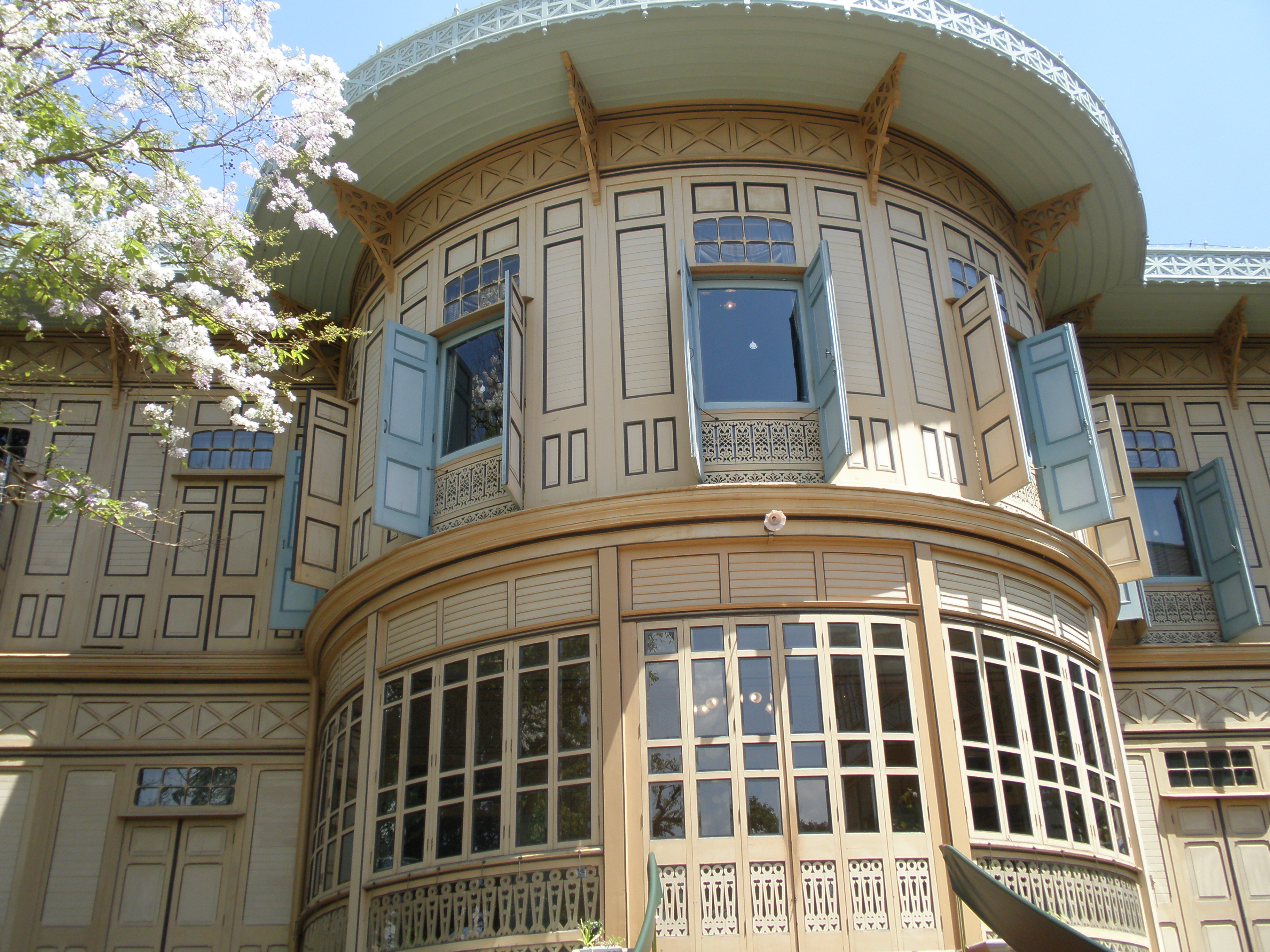
Vimanmek Mansion
A building that has been taken apart and reassembled twice probably has something to say about impermanence. Vimanmek Mansion started life as the Munthatu Rattanaroj Residence on Ko Sichang, a small island off the coast of Chonburi Province. In 1900, King Chulalongkorn -- back from a European tour that had filled his head with grand palaces -- ordered the island residence dismantled, shipped upriver, and rebuilt inside his new Dusit Garden in Bangkok. The result was a 72-room mansion made almost entirely of golden teak, L-shaped and topped with cream-and-red roofing in traditional Thai style. It became the first permanent structure in the garden and, for five years, the king's primary residence.
A King Returns from Europe
In 1897, Chulalongkorn, Rama V, made a royal visit to Europe -- the first sitting Thai monarch to do so. He toured palaces in London, Vienna, and St. Petersburg, absorbing the architecture of empires. Upon his return, he appropriated land north of Bangkok's old center and named it Dusit Garden, envisioning a modern royal quarter free of the claustrophobic grandeur of the Grand Palace. Vimanmek was his first statement of intent. The mansion blended Victorian structure with Thai architectural detail: elaborate fretwork on the windows and ventilators in the pattern called kanom pang khing, each room painted a distinctive color -- light blue, green, pink, ivory, or peach. The lowest level was brick and cement, but the upper three stories were pure golden teak, warm to the touch in the Bangkok heat. The octagonal tower at its center rose to four stories, giving the king a vantage over his growing garden.
Five Years of Residence
The 72-room palace was inaugurated on 27 March 1901. For five years, Chulalongkorn lived and worked here while the grander Amphorn Sathan Residential Hall took shape nearby. The interior decoration mixed European neoclassical taste with traditional Thai motifs -- a combination that reflected the king's own position, modernizing a centuries-old monarchy without abandoning its visual language. Each room displayed the possessions of the king and his court: photographs, artworks, handicrafts, and the accumulated objects of a reign that was reshaping Siam. When Amphorn Sathan was completed in 1906, the king moved there, and Vimanmek began a long slide into disuse. By 1932, the year a revolution ended absolute monarchy, the palace had been reduced to a storage facility for the Bureau of the Royal Household.
Rescued by a Queen
In 1982, on the occasion of Bangkok's bicentennial, Queen Sirikit asked King Bhumibol Adulyadej, Rama IX, to renovate Vimanmek as a museum honoring King Chulalongkorn. The palace was restored and opened to the public, its rooms filled with photographs, royal art, and handicrafts from the reign of Rama V. It became one of Bangkok's signature tourist attractions, marketed as the world's largest golden teakwood mansion. Visitors walked through the pastel rooms in stocking feet, guards enforcing a strict no-shoes policy on the polished teak floors. The mansion stood as proof that golden teak, properly maintained, could outlast the dynasty that built with it.
Dismantled Again
Then, in 2018, satellite imagery from Google Maps revealed that the mansion was gone. Where the L-shaped structure had stood, there were only tents covering stacked timbers. The building had been quietly disassembled. In July 2019, an official in the Office of His Majesty's Principal Private Secretary confirmed that the wood and metal pilings had deteriorated and needed replacement with steel pilings and a concrete foundation. The mansion would be rebuilt exactly as it looked, the official said, with the addition of a fishpond to the north. But it would be permanently closed to the public. The restoration cost was estimated at 81 million baht. Vimanmek had been taken apart for the second time in its existence -- once to bring it to Bangkok, and once, perhaps, to keep it from collapsing. Whether anyone outside the palace walls will walk its teak floors again remains uncertain.
From the Air
Located at 13.774N, 100.513E within the Dusit Palace compound in Bangkok's Dusit district. The palace grounds are visible from altitude as a large green compound near the Ananta Samakhom Throne Hall's white dome. Note: the mansion was disassembled in 2018 and may not be visible as a structure. Best viewed at 2,000-3,000 feet. Nearest airports: Don Mueang (VTBD) approximately 14 nm north, Suvarnabhumi (VTBS) approximately 17 nm east-southeast.