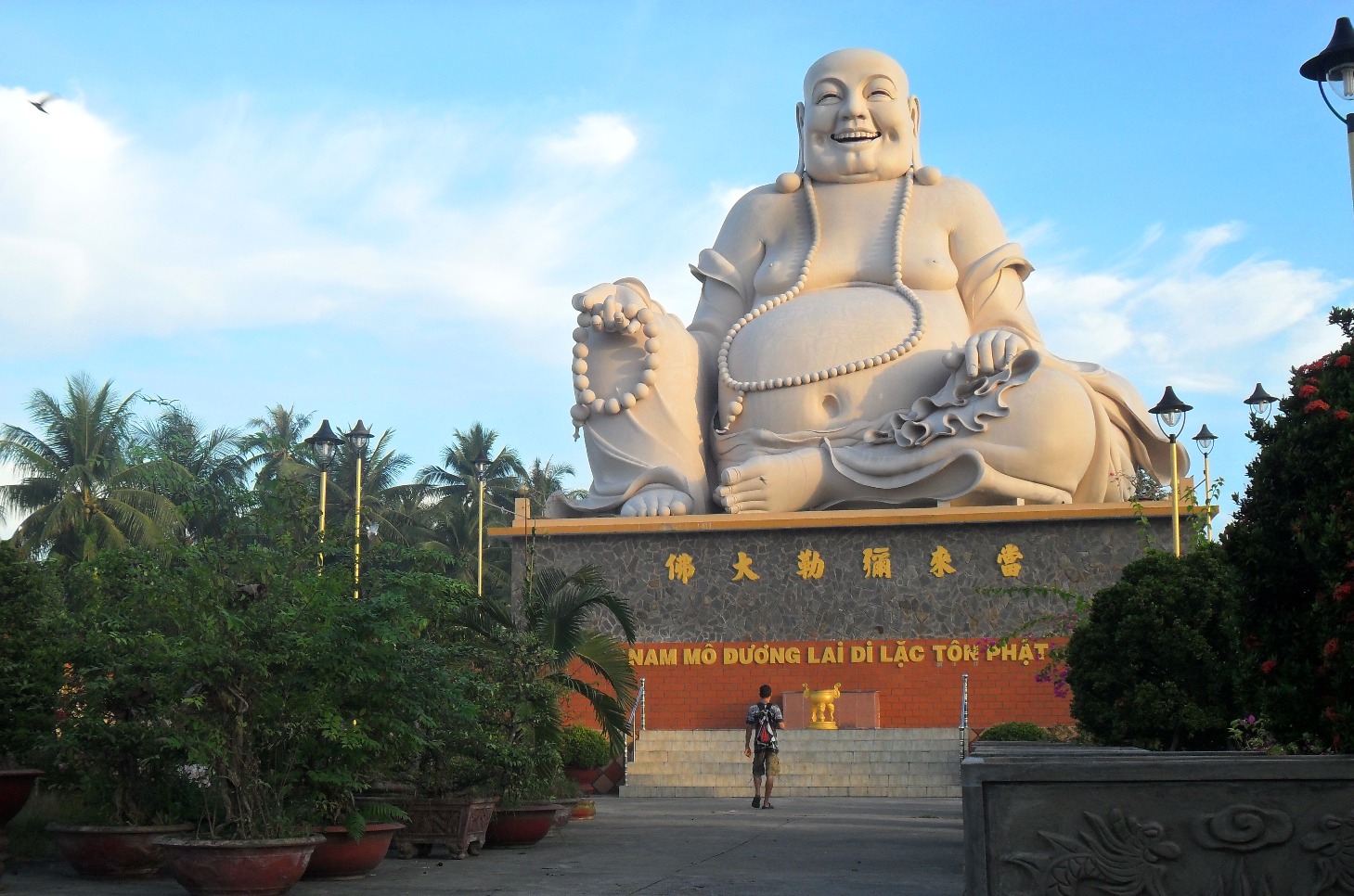
Vĩnh Tràng Temple
Fruit trees shade two hectares of sacred ground on the banks of the Bảo Định Canal, and somewhere beneath one of them rest the ashes of the monk who gave Vĩnh Tràng Temple the form it holds today. Completed in 1850, damaged by the French conquest of Cochinchina, wrecked by a tropical storm, and rebuilt each time by a succession of devoted abbots, this Buddhist temple near Mỹ Tho in the Mekong Delta has survived by being perpetually remade. Its front gate looks like it belongs on a European fortress. Its halls hold bronze Buddhas, carved wooden arahants, and a life-sized statue of the Jade Emperor. The mixture should not work, and yet it does — a building that absorbs contradictions the way the delta absorbs water.
A District Chief's Gift
Vĩnh Tràng owes its existence to Bùi Công Đạt, a district chief who organized the temple's construction in the mid-19th century. He recruited the monk Thích Từ Lâm from Bửu Lâm Temple to preside over the new foundation. When Bùi Công Đạt died before the project was finished, Thích Huệ Đăng oversaw its completion in 1850. The temple had barely settled into its rhythms when history intervened. Between 1859 and 1862, French colonial forces fought the Nguyễn dynasty of Emperor Tự Đức for control of the south. The French prevailed, and Tự Đức ceded three southern provinces to become the colony of Cochinchina. In the fighting, Vĩnh Tràng was seriously damaged. Thích Thiện Đề managed the reconstruction, but after his death the temple fell into disuse — a building without a champion, slowly returning to the delta's damp embrace.
The Thirty-Three-Year Abbot
Revival came in 1890 when Thích Trà Chánh was recruited from Sắc tứ Linh Thứu Temple to become abbot. A native of Mỹ Tho and disciple of Thích Minh Phước, the new abbot threw himself into restoration. By 1895, Thích Chánh Hậu had organized a complete renovation, breathing new life into the aging structures. Then nature struck: a devastating tropical storm in 1904 ravaged the temple, necessitating a major rebuilding effort that was completed in 1907. The same year, southern craftsmen carved the eighteen wooden arahant statues that still stand in the temple, each approximately 80 centimeters tall and 58 centimeters wide. Thích Chánh Hậu presided for 33 years until his death in 1923, the longest tenure of any abbot — long enough to see the temple through a complete cycle of destruction and renewal. His ashes rest in a stupa beneath the shade of the temple gardens, a quiet memorial to decades of persistent devotion.
Where Huế Meets the Mekong
The temple's most striking feature is its main Tam Quan gateway, built in 1933 under the direction of Thích Minh Đàn, successor to Thích Chánh Hậu. Craftsmen recruited from the imperial capital in Huế traveled south to create it, bringing techniques refined in central Vietnam's grand palaces. The central gate is made from steel, while the two flanking gates are concrete styled to resemble a historical fortress. Above them rises a second level with another large gate on top, creating a layered entrance that announces the temple's ambitions. Statues of both Thích Chánh Hậu and Thích Minh Đàn, sculpted by Nguyễn Phi Hoanh, flank the gateway. The entire front facade blends European and Asian architectural elements — an unlikely fusion that reflects the cultural crosscurrents of a region where French colonialism and Vietnamese Buddhism shared the same soil for nearly a century.
Bronze, Wood, and Absence
Inside the main hall, the temple's spiritual life takes physical form in a dense population of sacred figures. Statues of Amitabha Buddha and Gautama Buddha preside alongside bodhisattvas and arahants. The three oldest statues — Amitabha, Avalokiteshvara, and Đại Thế Chí bodhisattva — were cast in bronze, anchoring the collection with the weight of their material and age. But one absence tells its own story: the original bronze Avalokiteshvara has been lost for so long that no one remembers when or how it disappeared. A wooden replacement stands in its place, a reminder that even sacred objects are not immune to the passage of time. Nearby, a statue of the Ngọc Hoàng — the Jade Emperor of Taoist tradition — stands roughly life-sized, reflecting the syncretic nature of Vietnamese Buddhism, which has long woven together Buddhist, Taoist, and folk traditions into a single devotional practice.
Still Standing, Still Serving
Today Vĩnh Tràng serves as the office of the provincial Buddhist Association of Tiền Giang Province, an administrative role that sits comfortably alongside its spiritual one. Pilgrims and tourists arrive in roughly equal measure, drawn by the temple's reputation as one of the best-known in the Mekong Delta. The gardens remain carefully tended, pot plants arranged around the fruit trees that have shaded the compound since its earliest days. From the air, the temple grounds appear as a dense green rectangle set against the patchwork of paddies and waterways that define this landscape. Nearly two centuries of floods, wars, storms, and colonial upheaval have passed through this place, and each time someone has rebuilt. That persistence may be Vĩnh Tràng's most remarkable quality — not the architecture, but the refusal to let it fall.
From the Air
Located at 10.36°N, 106.37°E on the banks of the Bảo Định Canal near Mỹ Tho in the Mekong Delta. The temple compound appears as a densely treed two-hectare rectangle amid surrounding agricultural land. Nearest major airport is Tan Son Nhat International (VVTS) in Ho Chi Minh City, approximately 70 km to the north. Can Tho International Airport (VVCT) lies about 100 km to the southwest. Best appreciated at 2,000-4,000 ft to distinguish the temple grounds from the surrounding delta landscape. The Bảo Định Canal running alongside provides a useful visual reference.