Viretta Park
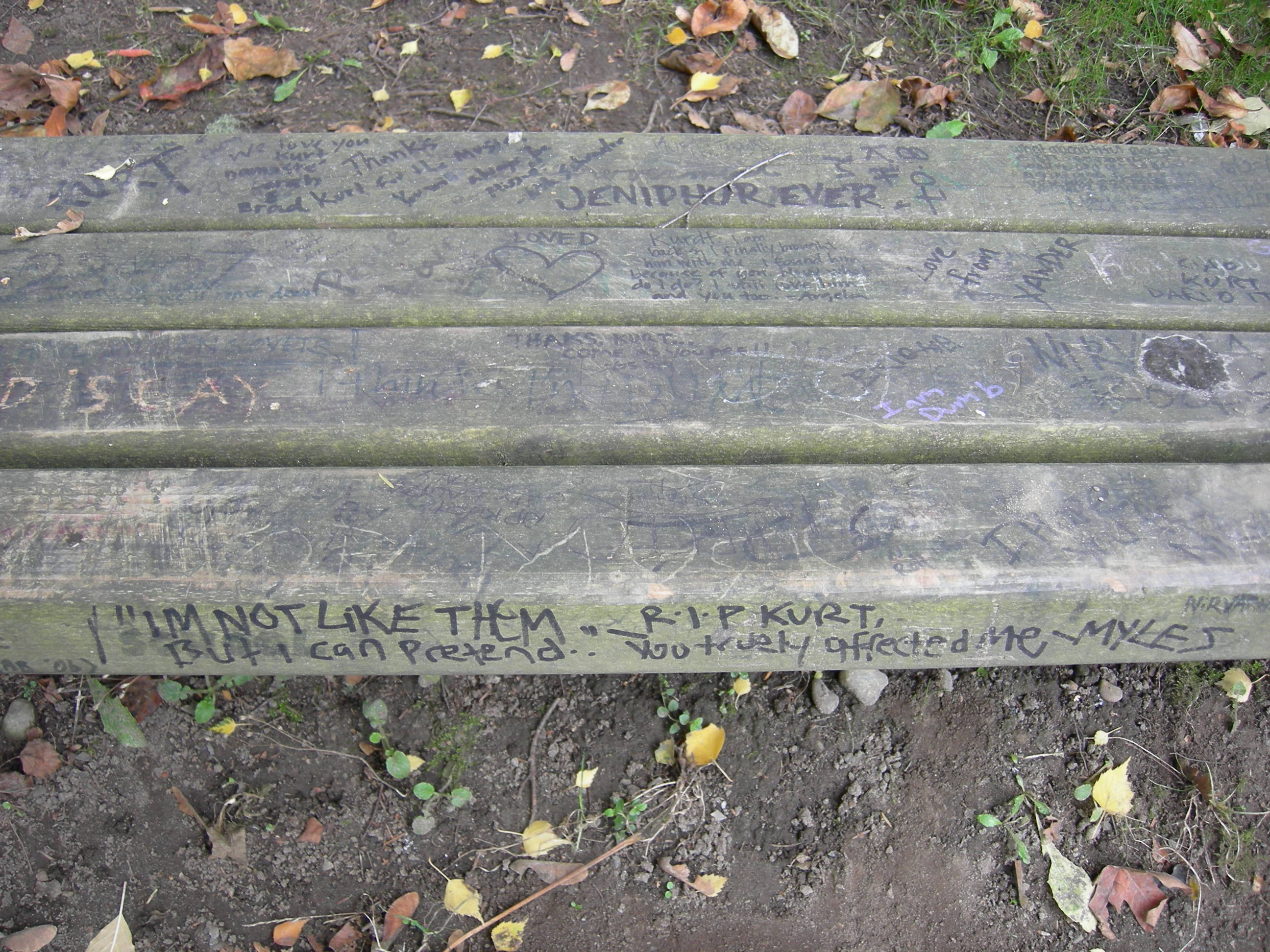
The wooden bench is barely visible beneath the ink. Decades of Sharpie messages, carved initials, and lyric fragments cover every surface, turning a simple park seat into something between a confessional and a guest book. Viretta Park is small, less than an acre of sloping lawn and trees tucked into Seattle's exclusive Denny-Blaine neighborhood, stretching from East John Street down to Lake Washington Boulevard. Charles L. Denny named it for his wife, Viretta Chambers Denny, and for most of its existence, the park was nothing more than a pleasant green pocket in one of the city's wealthiest enclaves. Then, on April 8, 1994, an electrician arriving to install a security system at the gray shingled house just to the north discovered the body of Kurt Cobain. The park next door has never been the same.
The Bench That Became a Shrine
Seattle has no official Kurt Cobain memorial. The city considered and rejected the idea multiple times, leaving Viretta Park's graffiti-covered benches to fill the void. Fans began writing messages almost immediately after Cobain's death, and the practice never stopped. Every April 5, the anniversary of his death, and to a lesser extent every February 20, his birthday, Nirvana fans gather in the park to pay tribute. They bring guitars, flowers, candles, and marker pens. The messages range from raw grief to gratitude to simple song lyrics scrawled at odd angles. There has been recurring speculation about renaming the park to "Kurt's Park," but the proposal has never gained official traction. The benches remain the closest thing Seattle has to a sanctioned memorial for the frontman of one of the most influential rock bands in history.
Neighbors, Billionaires, and Boundary Disputes
Viretta Park has long been a flashpoint between public access and private wealth. The Denny-Blaine neighborhood surrounding it is among Seattle's most exclusive, and the park's small footprint has made it a target for encroachment. In the 1990s, a group called Friends of Viretta Park formed during a dispute with then-neighbor Howard Schultz, the CEO of Starbucks, who lived just south of the park. The conflict centered on boundaries and use of adjacent land. Schultz eventually moved to a different residence, but the episode highlighted the tension that defines Viretta Park: a sliver of public ground wedged between mansions, drawing thousands of mourners and pilgrims into a neighborhood that prizes its quiet. The park sits on a hillside above Lake Washington, and from its paths, visitors can glimpse the water below and the houses above, a geography that makes the collision between public grief and private privilege feel almost inevitable.
Volunteers with Mulch and a Mission
By 2010, years of pilgrimages and deferred maintenance had taken a toll on Viretta Park. A group called Viretta Park Repair organized to restore the grounds and, more ambitiously, to create a proper memorial to Cobain. Their first work party was scheduled for February 20, 2011, what would have been Cobain's 44th birthday. Volunteers traveled from across the Western United States and Southwestern Canada. But when the group planned follow-up events for March and April, Seattle Parks and Recreation Superintendent Christopher Williams shut them down after a neighbor complained about memorial events and a sculpture that did not actually exist. The complaint confused the Viretta Park effort with a separate memorial project underway in Aberdeen, Washington, Cobain's hometown. Williams sided with the neighbors, blocking any formal memorial despite the fact that Seattle had already honored Jimi Hendrix with a dedicated park elsewhere in the city. Eventually, Viretta Park Repair received approval to continue volunteer restoration work, and a second work party in June 2011 saw volunteers pulling invasive holly and blackberry bushes, laying burlap, and spreading bark mulch across the cleared ground.
A Footnote That Outlived the Headlines
Viretta Park occupies a strange place in Seattle's cultural landscape. It is not on any official tour, not marked by any plaque, and not managed any differently from the city's hundreds of other small parks. Yet it draws visitors from around the world who know exactly which bench to find and exactly what to write on it. The park's power comes entirely from proximity. Stand on the upper lawn and the gray house is right there, partially screened by trees but unmistakable to anyone who has seen the photographs. The absence of any formal recognition has, paradoxically, made the park more personal. There are no roped-off areas, no admission fees, no interpretive signs explaining what happened in April 1994. There is only a small green space on a hillside above a lake, a bench covered in ink, and the persistent belief of fans that grief deserves a place to land.
From the Air
Viretta Park sits at 47.619N, 122.282W in Seattle's Denny-Blaine neighborhood, on the western shore of Lake Washington. From the air, it is a small green patch on the steep hillside between the large lakefront homes and Lake Washington Boulevard. The park is directly south of the former Cobain residence, identifiable by its gray shingle exterior and proximity to the waterfront. Nearest airports: Boeing Field/King County International (KBFI) 6nm southwest, Seattle-Tacoma International (KSEA) 12nm south, Renton Municipal (KRNT) 8nm southeast. Best viewed at low altitude from over Lake Washington.