Virginia State Capitol
Somewhere inside the walls of the Virginia State Capitol, John Brown's carpet-bag lies hidden. The abolitionist's personal documents were stashed "between the wall and the plastering" by a Confederate state senator when Richmond fell in April 1865 -- hidden so the Yankees could not find them. No one has found them since. The bag is one small mystery inside a building that has accumulated more American history per square foot than almost any structure in the nation. Thomas Jefferson designed it from Paris, modeling it after a 2,000-year-old Roman temple. It served as the seat of the Confederacy. Its floors once collapsed and killed 62 people. And it still houses the Virginia General Assembly, the oldest elected legislative body in North America, whose roots stretch back to the House of Burgesses in 1619.
A Roman Temple on Shockoe Hill
The building that dominates Capitol Square began as a transatlantic collaboration. Thomas Jefferson, serving as Minister to France, worked with French architect Charles-Louis Clerisseau to design a statehouse modeled on the Maison Carree in Nimes -- an ancient Roman temple that had survived nearly two millennia in southern France. Jefferson insisted on substituting the Ionic order for the more ornate Corinthian columns of the French original, and Clerisseau suggested a variant designed by Vincenzo Scamozzi, a student of Andrea Palladio. The cornerstone was laid on August 18, 1785, with Governor Patrick Henry present, before the design was even finalized. A plaster model and architectural drawings arrived from France in 1786, and the building was sufficiently complete for the General Assembly to convene there by October 1792. It remains one of only twelve state capitols in the United States without an external dome -- Jefferson's Roman model needed none.
The Eighth Statehouse
The current Capitol is the eighth building to serve Virginia's government, a lineage that traces the colony's geography from tidewater to piedmont. The first legislative assembly -- the House of Burgesses -- convened at Jamestown Church on July 30, 1619, making it the first representative legislature in North America. Jamestown burned through four statehouses before the capital moved inland to Williamsburg in 1699. The grand new Capitol building there was completed in 1705, with the Governor's Palace nearby. It too burned, in 1747, and was replaced in 1753. When the Revolutionary War made coastal Williamsburg vulnerable, Governor Jefferson urged relocation to Richmond. The Assembly adjourned from Williamsburg for the last time on December 24, 1779, reconvening in Richmond the following May in a makeshift building near Shockoe Bottom. The current Capitol on Shockoe Hill, overlooking the falls of the James River, finally gave the Commonwealth a permanent home.
Capital of the Confederacy
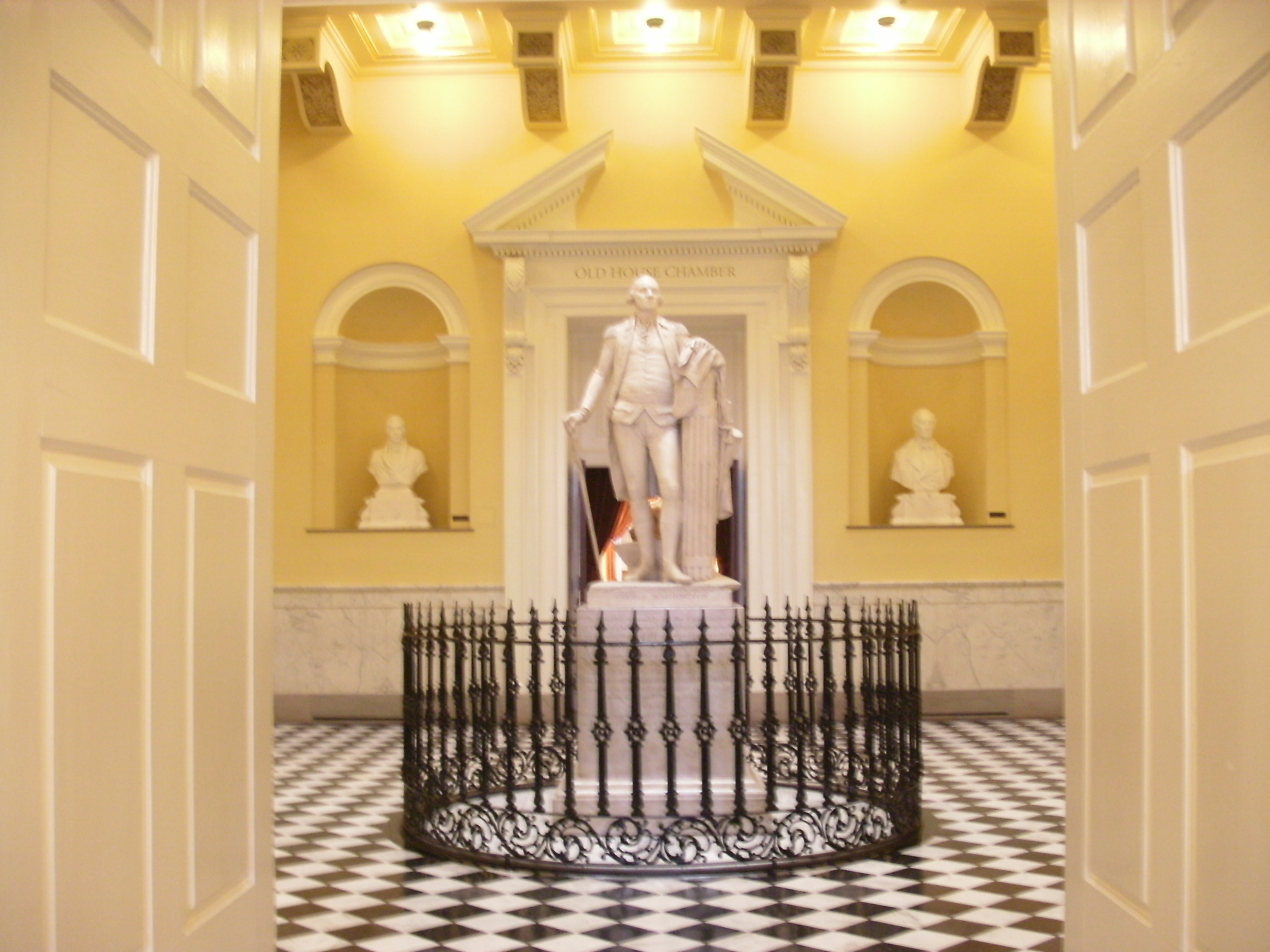
From 1861 to 1865, the building served double duty as the Capitol of the Confederate States of America -- its second home after the Alabama State Capitol in Montgomery. When Richmond fell in April 1865, departing Confederate troops burned the city's warehouses and factories, and the fires spread out of control. The Capitol, the adjacent Governor's Mansion, and the White House of the Confederacy three blocks north on East Clay Street were all spared. Abraham Lincoln toured the building about a week before his assassination, and Lieutenant Johnston L. de Peyster hoisted the first United States flag to fly over the dome since secession. For four days between Richmond's fall and the Confederacy's collapse, the Virginia government operated briefly from Lynchburg under Governor William Smith. In 2020, House Speaker Eileen Filler-Corn ordered the removal of a statue of Robert E. Lee and busts of J.E.B. Stuart, Stonewall Jackson, and Jefferson Davis from the historic Old House Chamber.
The Day the Floor Gave Way
The Capitol's worst day came five years after the war ended. On April 27, 1870, during Reconstruction, the Virginia Supreme Court of Appeals held a hearing on a contested Richmond mayoral election in the large courtroom on the second floor. Several hundred spectators crowded in. Before proceedings could begin, the gallery collapsed onto the courtroom floor. The combined weight of fallen gallery and crowd was too much -- the entire courtroom floor gave way, dropping everyone into the House of Delegates chamber below. Sixty-two people were killed and 251 injured. The dead included a grandson of Patrick Henry and three members of the General Assembly. Among the injured were both men contesting the mayoral seat, the Speaker of the House of Delegates, and former governor Henry H. Wells. Confederate general Montgomery D. Corse was partially blinded. Despite demands for demolition, the building was repaired. It has stood ever since.
Still Standing, Still Changing
The Capitol has continued to evolve around its Jeffersonian core. In 1904, two wings were added to the east and west ends -- designed collaboratively by three of Virginia's leading architectural firms: Frye and Chesterman of Lynchburg, John Kevan Peebles of Norfolk, and Noland and Baskervill of Richmond. A major renovation completed in 2007, costing approximately $104 million, added a modern underground expansion beneath the south lawn with visitor access, office space, and updated mechanical systems. The rotunda still holds Jean-Antoine Houdon's life-size statue of George Washington, sculpted from life in 1785 -- one of the most accurate representations of the first president in existence. Designated a National Historic Landmark in 1960, the Capitol remains what Jefferson intended: a working seat of government built in the image of a civilization that believed representative government could outlast empires.
From the Air
Located at 37.539°N, 77.434°W atop Shockoe Hill in downtown Richmond, Virginia. The neoclassical building with its distinctive lack of external dome sits within Capitol Square, a landscaped park visible from altitude. The James River and its falls are immediately to the south. Main Street Station is visible a few blocks southeast, and the White House of the Confederacy is three blocks north on East Clay Street. Nearest airports: Richmond International Airport (KRIC) approximately 8nm east-southeast; Chesterfield County Airport (KFCI) approximately 10nm southwest. Best viewed from 2,000-4,000 ft AGL to appreciate the building's position commanding Shockoe Hill above the river. The 1904 wings extending east and west are distinguishable from altitude.