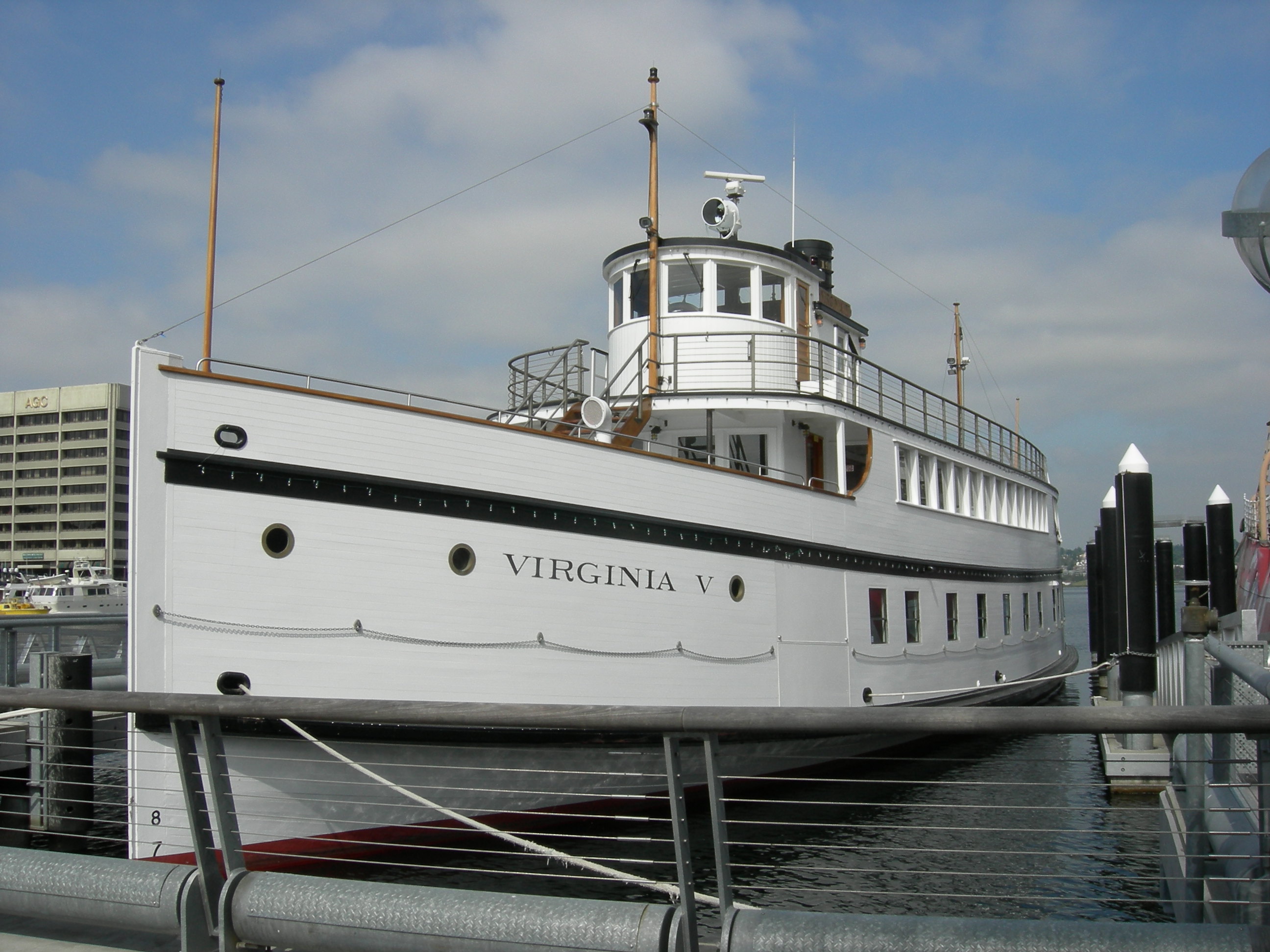
Virginia V
Ask an engineer aboard the Virginia V about the mysterious squeak her engine makes, and you will owe a dollar to the repair fund. The tongue-in-cheek toll is fitting for a ship that has survived bankruptcy, seizure by U.S. Marshals, a devastating Pacific storm, and more than a century of service on the waters of Puget Sound. Launched in 1922 and built from old-growth fir at Maplewood, Washington, the Virginia V is the last operational steamship from the Mosquito Fleet, the swarm of small passenger and freight vessels that once connected the islands and shoreline communities of the Sound. Today she sits at Heritage Wharf at Lake Union Park in Seattle, a National Historic Landmark that still carries passengers on excursions through the same waters she has known for over a hundred years.
Born from Frustration on the West Pass
The Virginia V owes her existence to the dissatisfaction of farmers and shopkeepers along Colvos Passage, the narrow waterway between Vashon Island and the Kitsap Peninsula. In the early 1900s, the primary shipping lane between Seattle and Tacoma ran along the east side of Vashon Island, leaving communities on the west side with unreliable service. In 1910, Captain Nels Christensen and John Holm formed the West Pass Transportation Company and bought a gasoline-powered tug called Virginia Merrill, renaming her simply Virginia. She was the first in a line of vessels that would bear the name. Virginia II arrived in 1912, Virginia III in 1914, and Virginia IV in 1920. When Anderson & Company began constructing the fifth Virginia in 1921, they built her hull from local old-growth fir. Her engine, a triple-expansion steam engine cast in 1904 at the Heffernan Engine Works in downtown Seattle, was transplanted from Virginia IV. On June 11, 1922, Virginia V made her maiden voyage from Elliott Bay to Tacoma via the West Pass, a run she would make nearly every day for the next sixteen years.
Battered at Olalla
On October 21, 1934, a severe Pacific storm swept into Puget Sound and caught Virginia V attempting to dock at Olalla, a small community on the Kitsap Peninsula. The winds shoved the ship against the dock while waves hammered her into the pilings, nearly destroying her upper decks. She was towed to the Lake Washington Shipyard at Houghton, near present-day Kirkland, where shipwrights rebuilt her superstructure. By December 5, just six weeks later, Virginia V was back in service. The storm revealed something about the ship's character: she could be broken and remade, a pattern that would repeat across the decades.
Camp Fire Summers and Changing Fortunes
Each summer from 1922 to 1970, Virginia V carried girls from Seattle to Camp Sealth on Vashon Island for the Camp Fire Girls. Thousands of women across the Pacific Northwest grew up remembering a ride on 'Virginia Vee' as the start of a camping adventure. But the ship's business life was far less idyllic. The West Pass Transportation Company folded in 1942, and Virginia V was transferred to the Columbia River for the Portland-to-Astoria run, making her the last scheduled passenger vessel to operate on both Puget Sound and the Columbia. The venture failed. Her owners could not pay the crew, and she was legally seized for debts and sold at Vancouver, Washington, by U.S. Marshals. Rescued by new owners, she landed in the hands of Captain Howell Parker, who ran her as a wartime ferry between Poulsbo and the Keyport Naval Torpedo Station, with his wife Mary serving as steward and purser.
The Great Steamboat Race
After World War II, the Parkers turned Virginia V into an excursion vessel. In 1948, the newly formed Puget Sound Maritime Historical Society organized a publicity stunt: a race between Virginia V and the Grayline Sightseer, a similar steamer formerly known as Vashona. On May 22, National Maritime Day, the two ships lined up across the Seattle waterfront. Virginia V won by a small margin. The race cemented her reputation as a living piece of maritime history, but keeping her alive grew harder with each passing decade. She changed hands multiple times through the 1950s and 1960s, passing through a series of owners and excursion companies. In 1968, the Northwest Steamship Company formed specifically to save her, and in 1973, Virginia V was placed on the National Register of Historic Places. Still, the economics of operating a century-old steamship proved relentless.
A Six-Year Resurrection
The nonprofit Steamer Virginia V Foundation was established in 1976 and acquired the ship in 1980 for $127,000. But it was the foundation's six-year, $6.5 million stem-to-stern restoration, completed in 2002, that truly brought Virginia V back to life. Workers rebuilt the steam engine, constructed a new Babcock & Wilcox oil-fired water-tube boiler, and reconstructed the superstructure using traditional tongue-and-groove fir planking. The Washington State Historical Society honored the project with its David Douglas Award in 2001. Today, Virginia V's original 1904 engine still turns at approximately 200 RPM. She burns diesel fuel now instead of the heavy bunker oil of her youth, but the rhythmic pulse of her triple-expansion cylinders is unmistakable. And then there is the squeak from the low-pressure valve, a mystery that has vexed her engineers for years. No scuffing, no galling, no sign of metal-on-metal contact. It comes and goes with the engine's temperature. If you want to discuss it with an engineer, bring a dollar.
From the Air
Virginia V is moored at Heritage Wharf, Lake Union Park, Seattle (47.628N, 122.337W). Best spotted from 1,500-2,500 feet AGL looking for the distinctive white steamship hull at the south end of Lake Union. Nearby airports include Boeing Field/King County International (KBFI, 4nm south) and Kenmore Air Harbor (S60, 7nm north). Lake Union seaplanes operate in the vicinity. Clear weather recommended for visual identification.