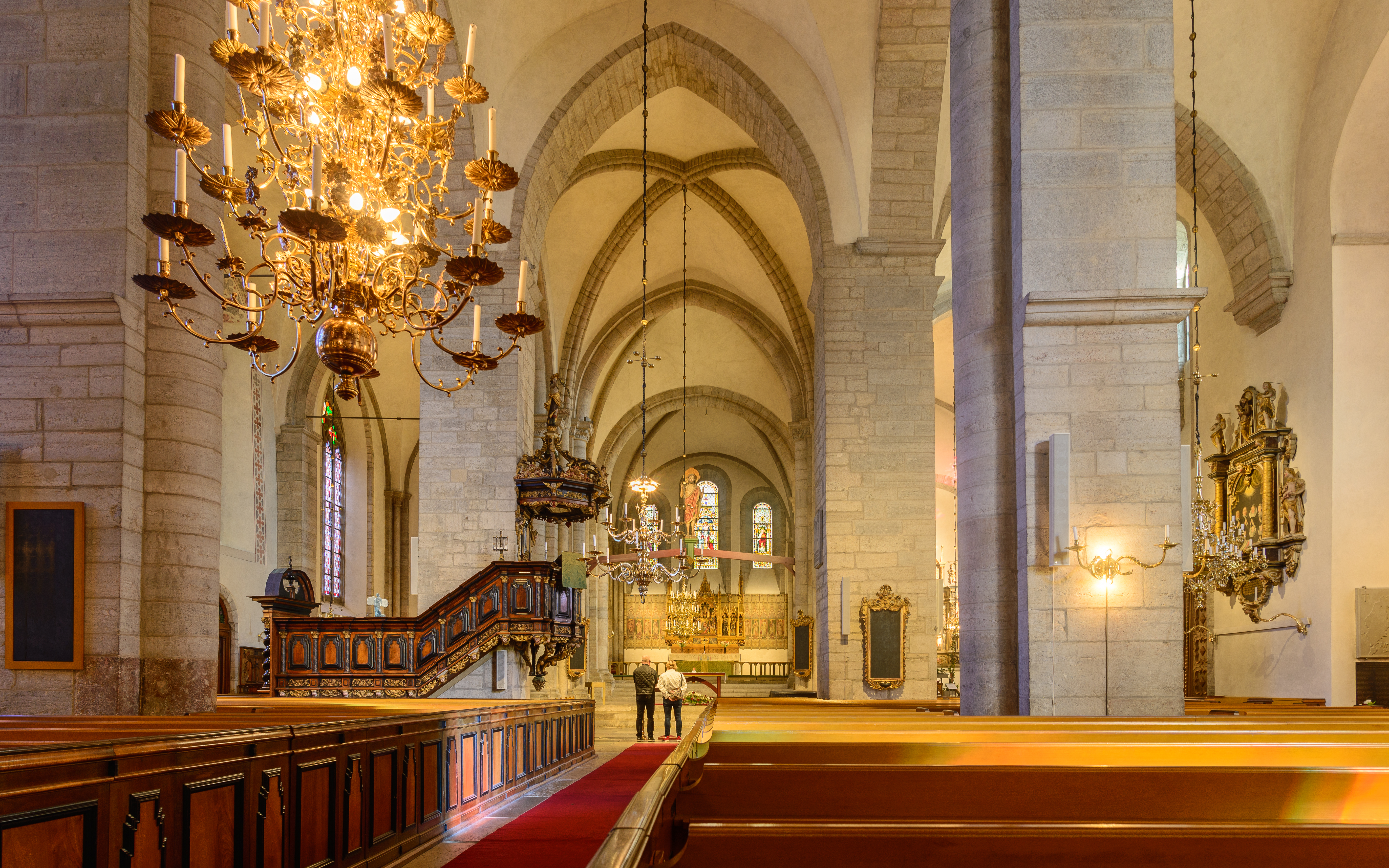
Visby Cathedral
When the Danish army swept across Gotland in 1361, Visby was a city of churches - wealthy merchants had built so many that the skyline bristled with spires. After the Reformation, only one would survive. Saint Mary's Church, raised by German traders who brought their own priests and paid for the stone with a special levy, became Visby Cathedral in 1572. Today it stands within the UNESCO World Heritage Site of the medieval town, its three towers marking the spot where Hanseatic commerce once made this Baltic island one of the richest places in Scandinavia. The other churches exist only as romantic ruins scattered through the old streets, while this cathedral - the second-largest church medieval Visby ever possessed - draws over 205,000 visitors annually.
A Church for Strangers
The German traders who built Saint Mary's Church in the 13th century had no intention of creating a cathedral. They needed a place to worship during their stays in Visby, one of the most important ports of the Hanseatic League. Unlike local churches, this one had no territorial congregation - the merchants brought their own clergy and simply locked the doors when they sailed away. The building stood empty between trading seasons. Funding came from a levy on all visiting German traders, and construction of the stone building began during the second half of the 12th century. Bishop Bengt of Linkoping consecrated the completed church on July 27, 1225. Only later, when some traders settled permanently in Visby, did the church gain a regular congregation subjected to the Bishop of Linkoping. By the end of the Middle Ages, Saint Mary's had become the richest church in Visby by far.
Stone Upon Stone
The cathedral's architecture tells the story of shifting fashions across centuries. The first stone church was a Romanesque basilica with a nave, two aisles, a western tower, and a transept. Construction began with limestone, the material that defines Gotland's geology and made the island a supplier of stone and stonemasons to cathedrals across Sweden. In the middle of the 13th century, the nave was reconstructed and the transepts absorbed, transforming the building into a hall church after models from western Germany. The builders' origins show in every detail - the bridal portal displays typically late Romanesque Rhenish style, and the overall design relates closely to churches in Westphalia and the Rhineland. Yet some elements proved influential far beyond Gotland. The hipped tower with its galleries inspired similar designs across the island, and the cathedral's architecture likely influenced elements of both Uppsala and Linkoping cathedrals on the Swedish mainland.
Gargoyles and Glory
The great chapel projects from the south facade like a separate building, its walls decorated with buttresses, pinnacles, and gargoyles unlike anything else in Swedish medieval architecture. Three of the gargoyles are original medieval work; one depicting Samson fighting the lion is a 19th-century copy. The entrance portal to this chapel bears decoration so elaborate - pinnacles climbing the sides of the wimperg - that comparable work exists only at Strasbourg and Cologne cathedrals. French stonemasons who came to Sweden to work on Uppsala Cathedral may have brought this decorative vocabulary. Inside, the keystones of the great chapel's vaults are carved with the Lamb of God, the head of Christ, and floral motifs. The furnishings span centuries: a 13th-century wooden sculpture of the resurrected Christ, an oak tabernacle from the same era, a pulpit from 1684 gifted by a German trader who became mayor, and a Gothic Revival altarpiece designed by architect Axel Haig in 1905.
The Prodigal Architect
Axel Haig was born on Gotland but built his career as an architect in the United Kingdom. In the 1890s, he produced an unsolicited proposal for renovating the cathedral and presented it to the cathedral chapter. They accepted, the Swedish government funded the work, but no money was allocated to pay Haig himself. He completed the restoration between 1899 and 1903 without salary. His changes aimed to preserve rather than transform: he restored the 14th-century clerestory, lowered the aisle roofs, removed the whitewash that had covered the facade since medieval times, and built a new sacristy. The tympanum above the sacristy entrance depicts Saint Nicholas - whose face, observers noted, bears a striking resemblance to the bishop serving at the time. Haig also installed sculptures, wrought iron details, and ridge turrets in Gothic Revival style, giving the cathedral much of its present character.
Memorials to Maritime Tragedy
The cathedral's tombstones and funerary memorials chronicle eight centuries of Gotland's dead. The oldest dates from the 14th century. Among the graves lies Eric, son of Albert of Mecklenburg-Schwerin, who briefly served as king of Sweden. But the most poignant memorials are more recent, marking maritime disasters that scarred the Baltic. One remembers the sinking of the SS Hansa in 1944, torpedoed by a Soviet submarine. Another commemorates the MS Estonia, which went down in 1994 with the loss of 852 lives - still the deadliest peacetime maritime disaster in European waters. A memorial to the 2004 Indian Ocean tsunami reminds visitors that Gotland's connections extend far beyond the Baltic. The stained glass windows in the great chapel, installed between 1985 and 1990, carry themes that resonate with this history of loss and hope: the guardian of truth, the vine, New Jerusalem, the Apocalypse, and the gardener.
From the Air
Located at 57.64N, 18.30E in the center of Visby's medieval old town, within the UNESCO World Heritage Site. The cathedral's three towers - one large western tower and two smaller octagonal eastern towers - are visible landmarks within the ring wall. Visby Airport (ESSV) lies approximately 3 km north of the town center. The cathedral occupies lower ground than the city wall, so approach from the sea side (west) provides the best aerial perspective of how the church relates to the surrounding medieval townscape.