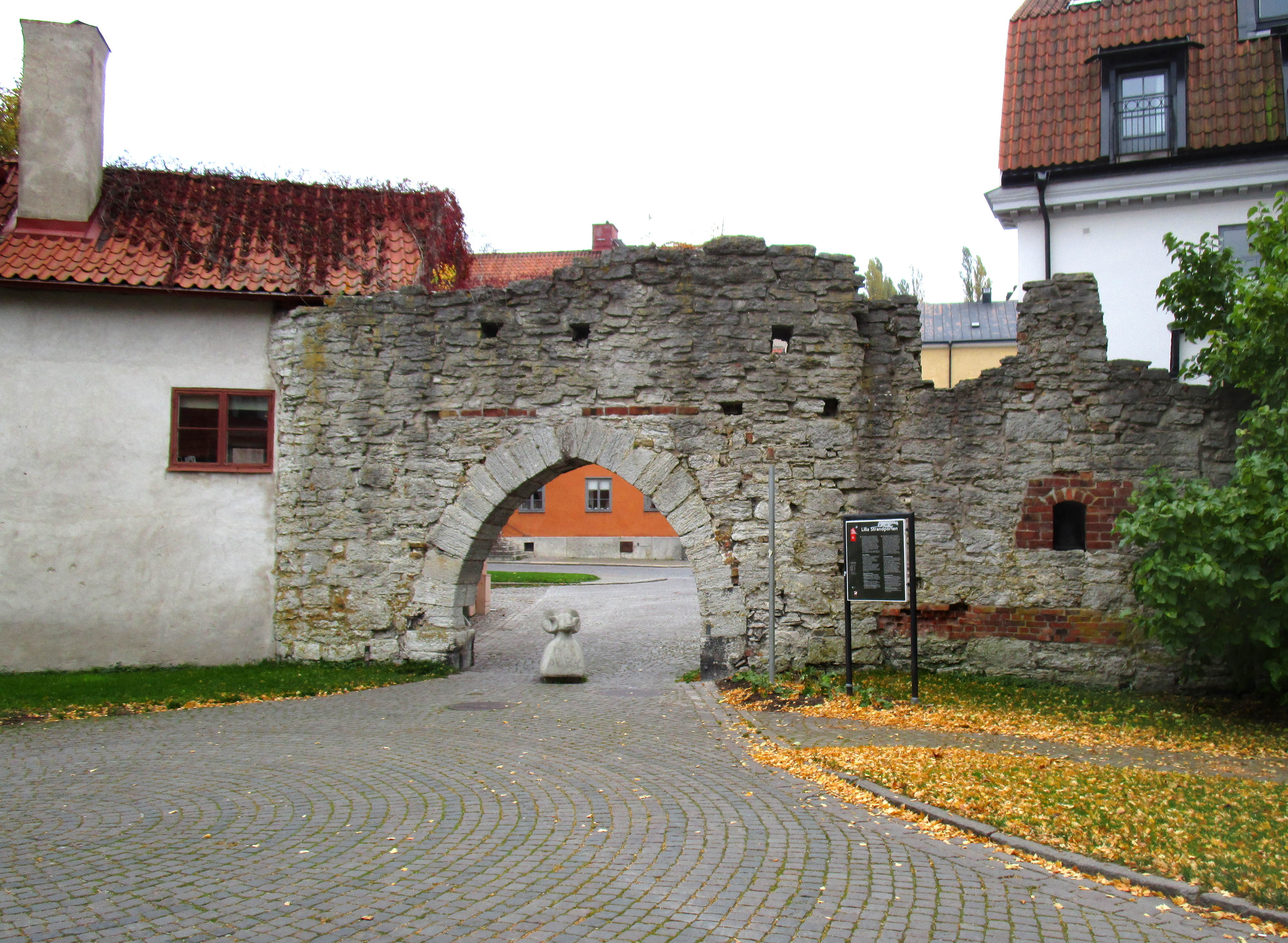
Visby City Wall
The oldest part of this ring wall predates the wall itself by a century. The Kruttornet - the Gunpowder Tower - was erected at Visby's harbor entrance in the 12th century, making it the oldest surviving non-religious building in all the Nordic countries. Not until the 1270s did the merchants of this wealthy Hanseatic port begin constructing the proper defensive circuit that would eventually stretch for 3.4 kilometers around their town. Today, approximately 3.4 kilometers of the original wall still stands, along with 27 of the 29 large towers and 9 of the 22 smaller 'saddle towers' that once rode atop the ramparts. In an age when most medieval fortifications have crumbled or been demolished, Visby's ring wall remains so complete, so authentic, that walking along it offers perhaps the most genuine experience of what a 13th-century city wall actually looked like.
Built for Civil War
The construction of city walls was unusual in Nordic countries during the Middle Ages, and Visby's ring wall speaks to both the town's exceptional wealth and its exceptional conflicts. Work began in the 1270s and 1280s with the land-facing wall, funded by merchants who had grown rich on Hanseatic trade. This first wall stood approximately 5-6 meters tall, with a raised platform for archers featuring regularly spaced openings for firing arrows and narrower arrowslits between. Dendrochronological dating tells us the East Gate (Osterport) rose no earlier than 1286, followed by the North Gate in 1289 and the Snackgards Gate in 1294. Around 20 large towers were added between the gates in the 1290s and early 1300s. The timing was not coincidental. Conflict between the town of Visby and the thing (assembly) of Gotland erupted into civil war in 1288, and a section of wall east of the Mill Tower that has been razed may date from when Visby was captured and plundered during that conflict.
Knights and Pirates
The wall's story interweaves with the turbulent history of the Baltic. In 1361, King Valdemar Atterdag of Denmark invaded Gotland, and 1,500 Gotlandic farmers died defending their island at the Battle of Masterby. The walls of Visby held, though the town fell under Danish rule. In 1394, the Victual Brothers - a pirate confederation that terrorized Baltic shipping - occupied the island and established their headquarters within Visby's defenses. The Teutonic Knights received Gotland as a fief on condition that they expel these pirates, and they held the island from 1398 to 1408. The corner tower known as the Silverhattan (Silver Cap) probably dates from this period. The last great assault came in 1525, when troops from Lubeck attacked. The 'Lubeckerbraschen' (Lubeck Breach) in the wall may mark where they broke through, though the visible gap more likely resulted from a later collapse. Either way, it stands in the section where Lubeck's soldiers most probably damaged the town's defenses.
From Defense to Landmark
By the 17th century, the wall's military purpose had faded. Two caponiers (covered passages for flanking fire) were added to the eastern section, but these were afterthoughts. The ring wall survived primarily because it served as a toll barrier - merchants entering Visby still had to pass through the gates and pay duties. When Sweden abolished domestic tolls in 1810, the wall might have been demolished like so many others across Europe. Instead, it had already become a known landmark, a monument to the medieval past that guaranteed its preservation. Architect Emil Victor Langlet restored the wall between 1884 and 1886, establishing the precedent of careful conservation that continues today. When a 20-meter section of the outer dressing collapsed in 2012, restoration work began the following year using techniques designed to maintain the wall's authentic character.
A Complete Medieval Picture
What makes Visby's ring wall exceptional is not just its length but its completeness. Large parts of the original wall remain intact, incorporating the majority of the medieval towers - both the full-length structures and the smaller 'saddle towers' that perch atop the ramparts. Beyond the wall, large portions of the original trench system have survived. Most remarkably, the wall remains largely unencumbered by modern buildings. Few contemporary structures are visible from outside, creating a view that medieval eyes would recognize. Individual towers bear evocative names: Tall Lisa, the Mill Tower, the Well Gate. The gates - East, North, South, and the Snackgards - still channel traffic as they have for 700 years. Walking the circuit, visitors pass arrowslits, embrasures, and the narrow platforms where archers once stood ready. This is not a reconstruction or a partial survival but a complete medieval defensive system, the strongest and best preserved anywhere in Scandinavia.
From the Air
Located at 57.63N, 18.30E, the ring wall encircles the medieval core of Visby on Gotland's west coast. From altitude, the wall appears as a distinct boundary separating the dense medieval town center from modern development. The approximately 3.4 km circuit is clearly visible, with towers spaced along its length. The wall follows an irregular path, hugging the terrain and incorporating the harbor area. Visby Airport (ESSV) lies approximately 3 km north. Best aerial views come from the west (sea side) where the wall's relationship to the harbor and coastline is most apparent. The wall is part of the UNESCO World Heritage Site that includes all of medieval Visby.