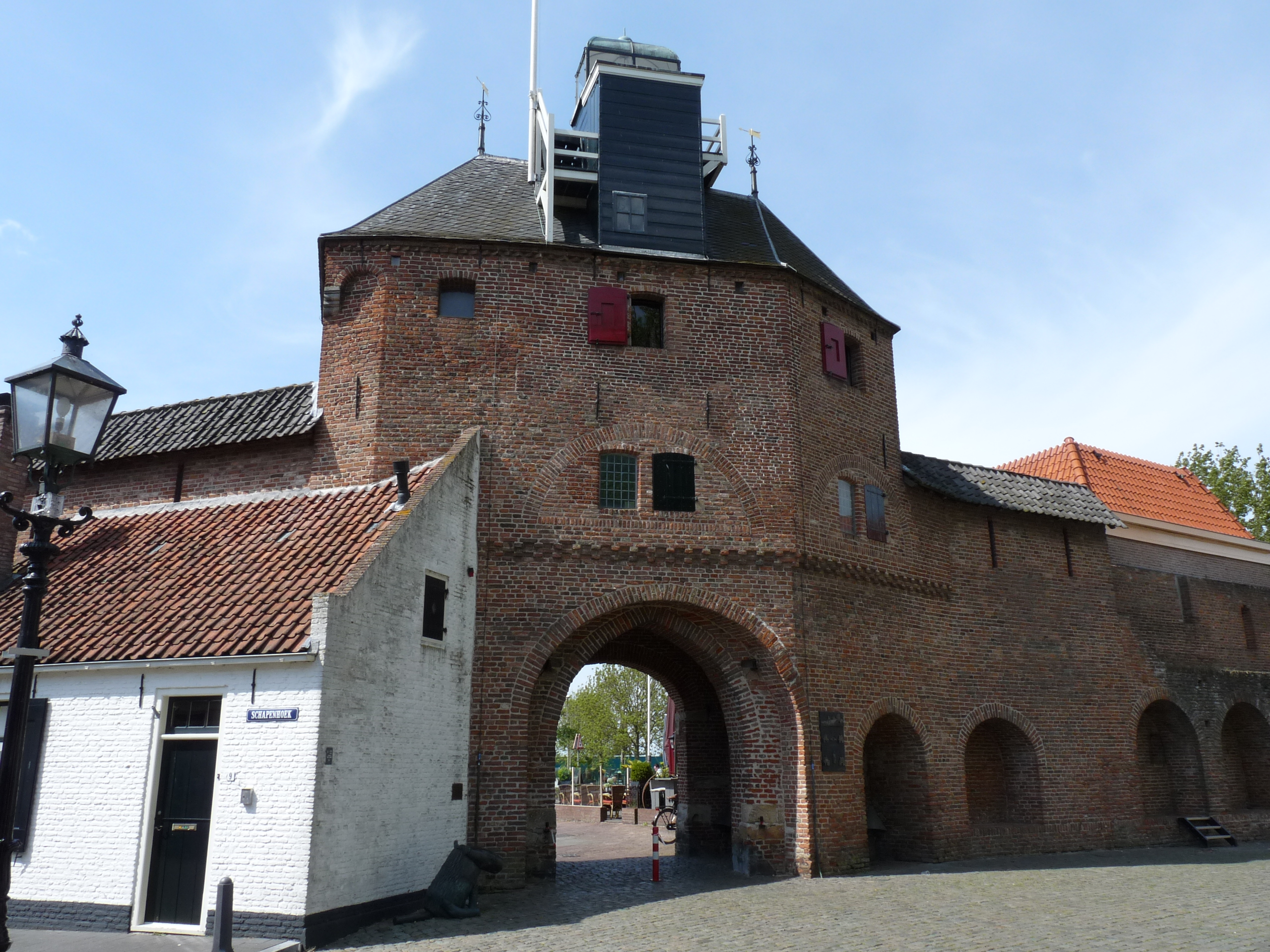
Vischpoort
Look closely at the inside of the arch and you can still see the grooves. Six hundred years ago, when storms pushed the Zuiderzee up against Harderwijk's seawall, townspeople slid planks into these slots and prayed the water held. The Vischpoort - the Fish Gate - is the last of five medieval gates that once ringed this Hanseatic port, and the only one that ever did double duty as a lighthouse. Today it stands a few blocks inland, the sea itself long since walled out and freshened into a lake.
A Gate That Faced the Sea
Harderwijk built its walls in the late 14th century, and the Vischpoort went up with them. Of the squat brick tower you see now, the lower half is original medieval work; the upper half, above the corbel that rings the structure like a belt, was added a century later. The gate had a working purpose. Small boats tied up at a wooden pier just outside, unloading fish and goods directly into the town. Larger ships had to anchor offshore - the Zuiderzee here was famously shallow - and ferry their cargo in by lighter. In the room above the arch, a guard kept watch over both the harbor and the streets behind him, one eye on the water and one on the town. Three more gates guarded the landward approach; two faced the sea. The Vischpoort, originally called the Lage Bruggepoort, is the only one of those five that survived the centuries of demolition that followed.
The Light Comes On
In 1851, a small turret was bolted onto the top of the gate. Inside it sat a gas lamp with a red lens, salvaged from a beacon in Scheveningen on the North Sea coast. Just like that, an inland-leaning medieval gatehouse became a working lighthouse. The arrangement was unusual even by Dutch standards: the national government paid for the gas, the town paid the lighthouse keeper, and the keeper himself lived inside the old gate, climbing wooden stairs along the outside wall to reach his quarters at the top. For ninety-six years the red light winked at fishing boats coming back across the Zuiderzee. Then, in 1928, austerity nearly killed it. Faced with the cost of running an aging gas lamp, The Hague proposed switching it off entirely.
Saved, Brightened, Retired
The light survived because someone blinked first. Rather than shutter the beacon, the government handed it - and the bill - to Harderwijk. The town accepted, and in 1930 swapped the dim gas flame for an electric lamp of one million candelas, spinning twenty-two times a minute. For a gate that had stood since the 1300s, this was a remarkable second act: medieval brick crowned with industrial-age brilliance, throwing a white beam across waters that themselves were about to change forever. The Afsluitdijk had closed off the Zuiderzee in 1932, and over the next decade and a half the salt water slowly turned fresh. By 1947 the harbor had shrunk, the shipping lanes had moved, and the light no longer served any working purpose. It was switched off, the keeper moved out, and the gate fell quiet.
Quiet Resurrection
For decades the Vischpoort served lesser duties - an architect's studio, then a small gallery - while Harderwijk reinvented itself as a lakeside town rather than a sea port. A 1973 renovation steadied the brickwork, and the gate was eventually entered into the national register as rijksmonument 20221, joining the country's official roster of protected heritage. In 2006, almost sixty years after the lamp was turned off, the light came on again. It runs only on special occasions now - festivals, anniversaries, the kind of nights when a town wants to remember what it used to be. The building itself hosts the local historical society, Oudheidkundige Vereniging Herderewich, and Harderwijk's volunteer city guides use it as a starting point. Walk through the arch today and you pass under six centuries of work in three or four strides.
From the Air
Vischpoort stands at 52.3517 N, 5.6187 E in the medieval core of Harderwijk on the eastern shore of the Veluwemeer, the narrow lake that used to be open Zuiderzee. From the air the old town is a clear oval pressed against the water, with the gate marking its western waterfront edge. Recommended viewing altitude is 1,500 to 2,500 feet AGL for orientation, dropping lower to pick out the small turret on top of the gate. Nearest airfield is Lelystad Airport (EHLE) about 12 nautical miles northwest; Hilversum (EHHV) lies 25 nautical miles southwest, and Schiphol (EHAM) is about 35 nautical miles west. Class G uncontrolled airspace below 1,200 feet AGL over most of the area, with Lelystad's CTR to the northwest - check NOTAMs for the Veluwemeer corridor. Best light is morning, when the sun comes off the lake and onto the gate's seaward face.