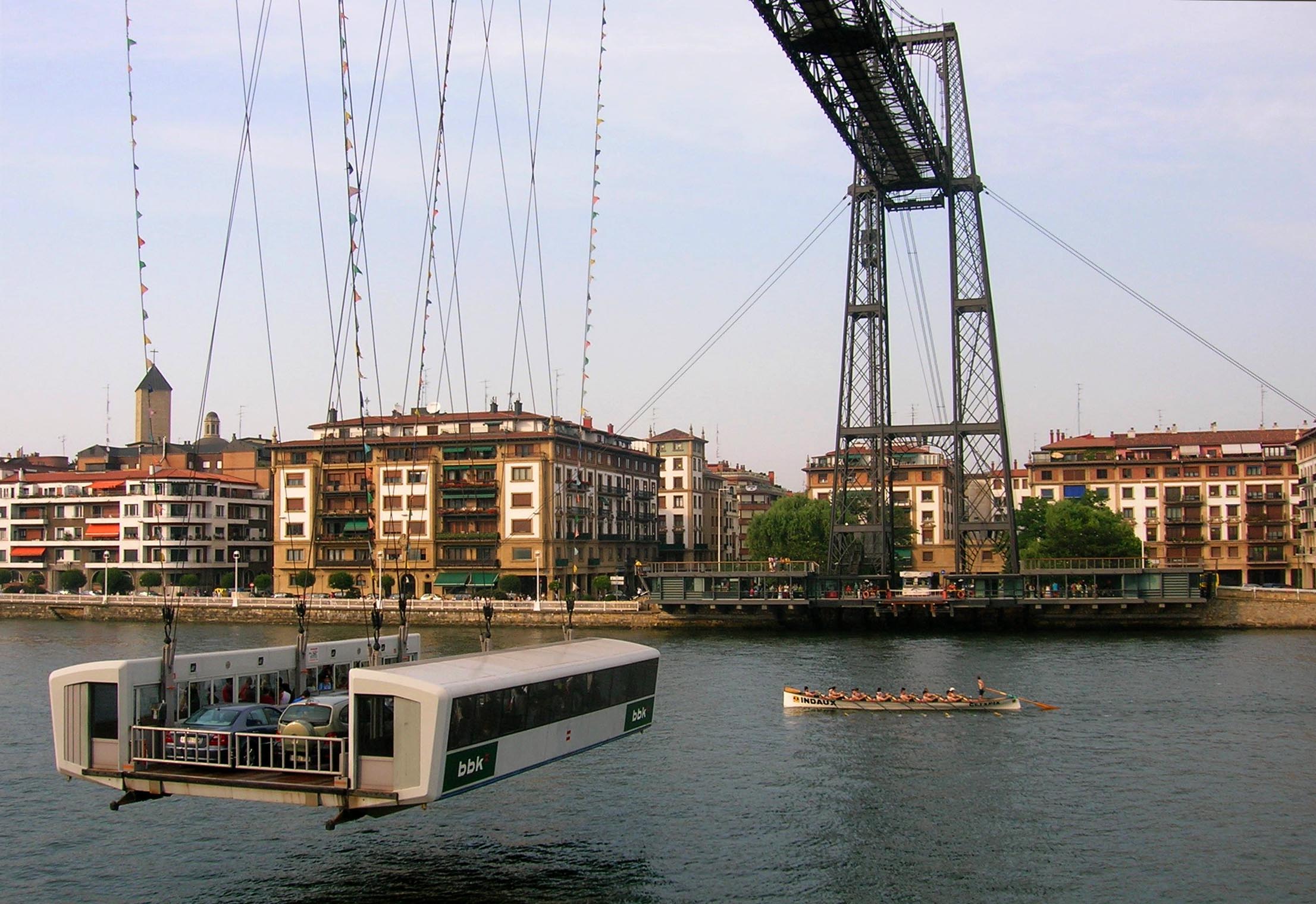
Vizcaya Bridge
Every eight minutes during the day, a gondola the size of a small parking lot glides silently across the mouth of the Nervion River, suspended from iron rails 45 meters overhead. The Vizcaya Bridge has been making this crossing since 1893, carrying six cars and several dozen passengers at a time between the towns of Portugalete and Las Arenas. It is the oldest transporter bridge in the world, and it is still working.
Eiffel's Legacy at the River's Mouth
Alberto Palacio, who designed the bridge, had studied under Gustave Eiffel, and the family resemblance is unmistakable in the latticed ironwork of the four 61-meter towers. The challenge Palacio faced was specific: connect the two banks of the Nervion estuary without blocking the tall-masted ships heading to and from the Port of Bilbao. A conventional bridge would have required massive ramps to achieve the necessary height, consuming land the towns did not have. Palacio and engineer Ferdinand Joseph Arnodin devised an elegant alternative: a high transverse beam spanning the river, with a gondola hanging below on wheeled trolleys. The system transported people and cargo while ships passed freely underneath. Santos Lopez de Letona financed the project, and the bridge opened in 1893.
Destruction and Survival
The bridge served without interruption for over four decades, until the Spanish Civil War arrived at the Nervion. In the fighting, the upper section was dynamited to prevent enemy use. Alberto Palacio, by then an old man, watched from his house in Portugalete as his masterpiece was partially destroyed. He died shortly after. The bridge was rebuilt and returned to service, resuming the rhythmic crossings that had become part of daily life on both banks. That wartime interruption remains the only break in service across more than 130 years of operation.
Iron, Steel, and World Heritage
On 13 July 2006, UNESCO declared the Vizcaya Bridge a World Heritage Site, the only monument in Spain in the Industrial Heritage category. The designation recognized the bridge as a perfect combination of beauty and functionality, and as a technological pioneer. It was the first bridge to combine traditional iron construction with the new lightweight steel cables that were transforming engineering in the late nineteenth century. That hybrid approach was later imitated by transporter bridges around the world, though most of those successors have since been demolished. The Vizcaya Bridge outlived them all.
The Daily Crossing
Today, an estimated four million passengers and half a million vehicles use the bridge annually. It runs every eight minutes by day and every hour at night, integrated into the regional transit system via the Barik card. Visitor lifts installed in the 50-meter-high pillars allow tourists to walk across the upper platform, where the views take in the port, the Abra bay, and the green hills that frame the estuary. Below, the gondola continues its crossings as it has since the last decade of the nineteenth century, connecting two communities with a 90-second ride that locals treat as routine and visitors find astonishing.
From the Air
Located at 43.32N, 3.02W at the mouth of the Nervion River estuary, linking Portugalete and Las Arenas (Getxo). The bridge's high iron framework is visible from the air spanning the narrow river mouth. Nearest airport is Bilbao (LEBB), approximately 12km southeast. Best viewed at 1,500-3,000 feet AGL. The Abra bay opens to the Cantabrian Sea to the north.