Vizcaya: The Harvester Fortune's Tropical Palace
Some of the ceramics inside Vizcaya were replacements. The originals, shipped from England in 1912, went down with the Titanic. James Deering, heir to the International Harvester fortune, had taken out insurance, so he ordered duplicates and kept building. That detail captures something essential about Vizcaya: the project was so ambitious, so indifferent to obstacles, that even losing furnishings to history's most famous shipwreck was merely a line item. Between 1914 and 1922, Deering spent $15 million constructing an Italian Renaissance villa on Biscayne Bay in what is now the Coconut Grove neighborhood of Miami. Seventy rooms of European antiques. Gardens modeled on Tuscan and Veneto estates but planted with palms and philodendrons that would have been unrecognizable in Florence. A telephone system that was the first in Miami-Dade County. The result is sometimes called the Hearst Castle of the East, and the comparison is not wrong.
The Team That Built a Fantasy
Deering did not design Vizcaya alone. In 1910, interior decorator Elsie de Wolfe introduced him to Paul Chalfin, a former art curator and painter who became the project's artistic director. F. Burrall Hoffman served as architect, with Iwahiko Tsumanuma -- also known as Thomas Rockrise -- as associate architect. The villa's facade drew primarily from the Villa Rezzonico, designed by Baldassarre Longhena at Bassano del Grappa in the Veneto region of northern Italy. In 1914, during a visit to Villa La Pietra in Florence, Deering and Chalfin recruited Colombian landscape designer Diego Suarez, who had trained with Sir Harold Acton. Suarez created the garden's room-like sections: the Secret Garden, the Theater Garden, the Maze Garden, and the Fountain Garden, each uniquely planted with exotic species including Cuban Royal Palms and giant elephant ears. But Chalfin and Suarez clashed over finishing touches, and Suarez left the project in 1917.
Tuscany Meets the Tropics
Vizcaya's genius lies in its adaptation of European traditions to South Florida's subtropical environment. French and Italian garden layouts were executed in Cuban limestone rather than the marble of their models. Floridian coral served as architectural trim. The plantings were deliberately tropical -- palms, philodendrons, species that would have been impossible in the emulated gardens of Tuscany or the Ile-de-France. Suarez designed an artificial hill, the garden mound, as the focal point, giving the flat bayfront property an exaggerated perspective that made the grounds feel larger than they were. To achieve the weathered appearance Deering wanted, the team incorporated mature trees, draping vines, coral stone sculptures, and European antiques throughout the gardens. The effect was of a centuries-old estate that happened to grow palm trees -- a deliberate illusion, carefully manufactured on a piece of land that had been wilderness a few years before.
Hurricanes, Thieves, and the Fight to Survive
Deering died in September 1925 aboard the steamship SS City of Paris, leaving Vizcaya to his two nieces. Hurricanes and mounting maintenance costs forced them to sell off surrounding land. In 1945, significant portions went to the Catholic Diocese to build Miami's Mercy Hospital. The Great Miami Hurricane of 1926 had already devastated the estate, destroying the rose garden when saltwater seeped in and killed every plant. In 1971, jewel thieves stole priceless artifacts, including a silver bowl that once belonged to Napoleon Bonaparte; most items were never recovered. The swimming pool grotto, built in 1916 and featuring one of only two surviving murals by artist Robert Winthrop Chanler, was submerged by hurricanes in both 1992 and 2005. Miami-Dade County has committed $50 million to restoration, matched by grants from FEMA and Save America's Treasures. Vizcaya endures, but every hurricane season is a reminder that it was built in the path of storms.
Where Presidents and Quinceañeras Meet
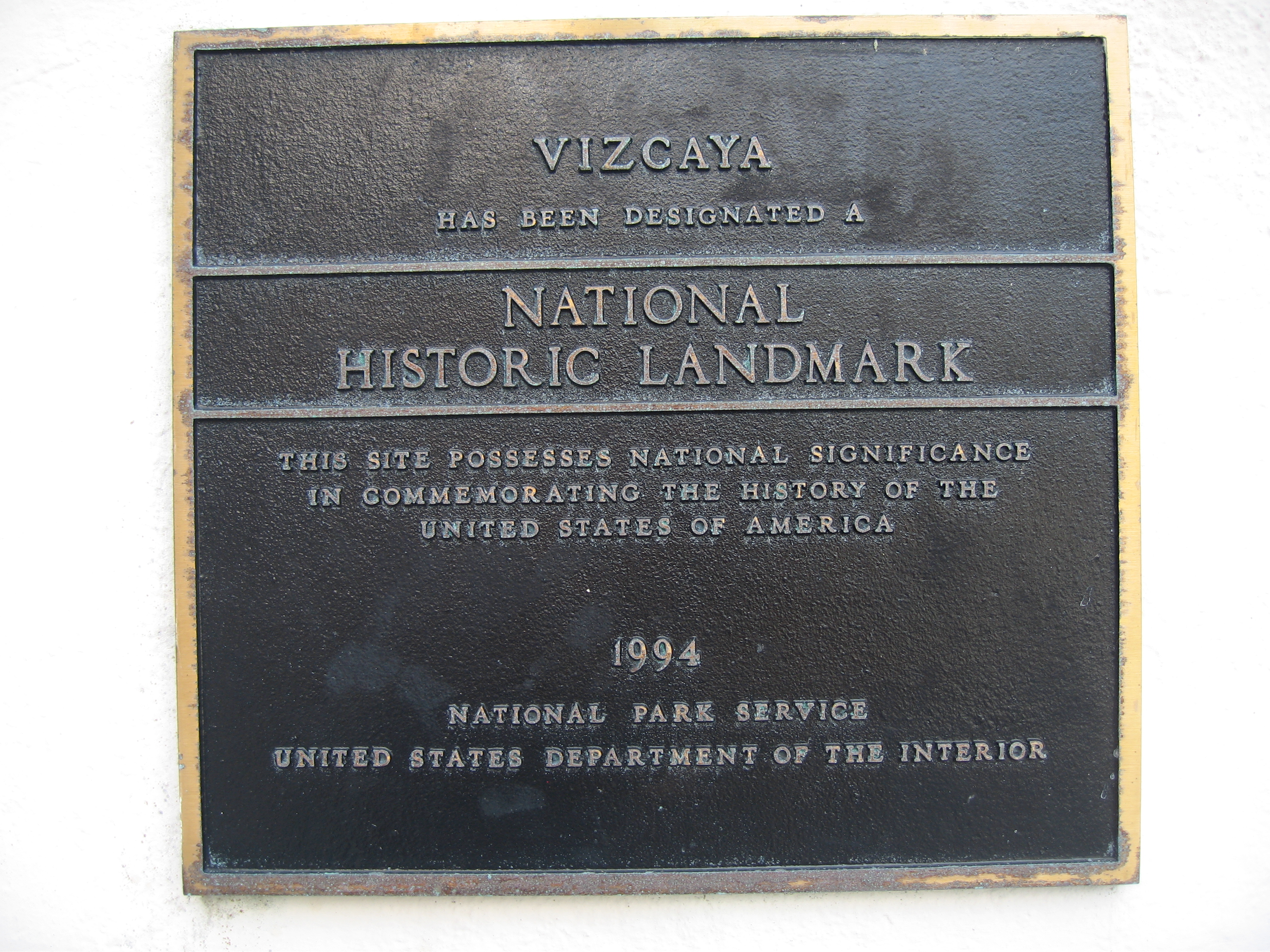
Vizcaya has hosted events its builder could never have imagined. In 1987, President Ronald Reagan received Pope John Paul II here on the pontiff's first visit to Miami. In 1994, President Bill Clinton convened the first Summit of the Americas at the estate, where thirty-four national leaders created the Free Trade Area of the Americas. The estate has appeared in films from Tony Rome to Iron Man 3, where the casino building doubled as the Mandarin's lair. But Vizcaya's most consistent cultural role may be as a backdrop for quinceañera photography -- for decades, young women celebrating their fifteenth birthday have posed among the Italian Renaissance colonnades and Biscayne Bay views. Designated a National Historic Landmark in 1994, Vizcaya opened as the Dade County Art Museum in 1953 and continues as a public museum today, its seventy rooms of antiques and subtropical gardens drawing visitors who come to see what one man's fortune and obsession built on the edge of the American tropics.
From the Air
Located at 25.74N, 80.21W on the western shore of Biscayne Bay in Coconut Grove, Miami. The estate is recognizable from the air by its formal Italian Renaissance garden layout -- geometric paths and hedgerows -- extending west from the villa toward South Miami Avenue. The stone barge breakwater is visible in Biscayne Bay east of the main house. Nearest airports: Miami International (KMIA) approximately 5 nm northwest, Opa-Locka Executive (KOPF) 12 nm north, Homestead ARB (KHST) 20 nm south. Best viewed at 1,500-3,000 ft AGL to see the garden geometry and bayfront setting. The contrast between the formal grounds and the surrounding urban development is striking from altitude.