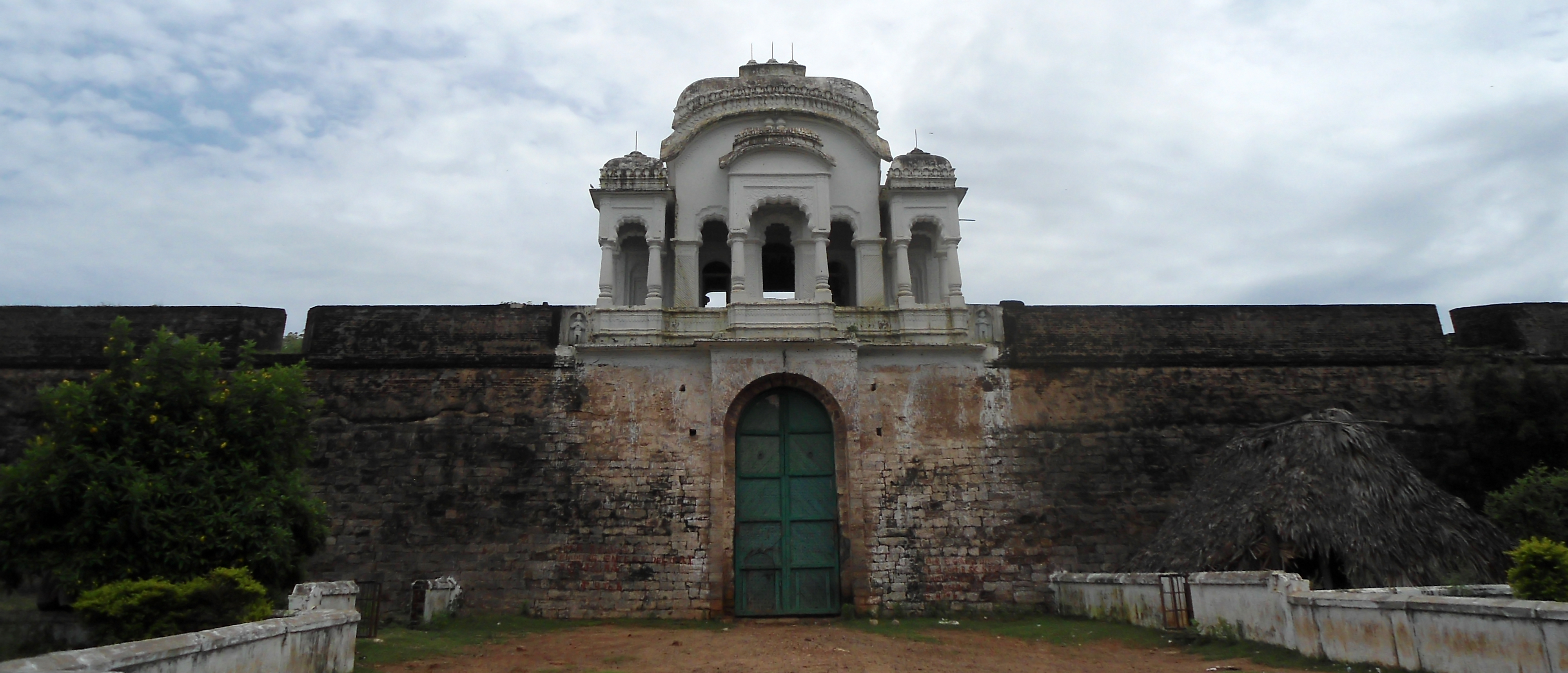
Vizianagaram Estate
The name was chosen to announce ambition. When Raja Vijayaram Raj broke away from the Kingdom of Jeypore in 1711 and established his own sovereign domain in northeastern Andhra Pradesh, he called it Vizianagaram -- "city of victory" -- spelling it with a Z to distinguish it from the Vijayanagar Empire far to the south. It was a bold declaration for a newly independent ruler, and for more than two centuries the Pusapati dynasty that followed him would live up to it, sometimes spectacularly and sometimes disastrously. They allied with the French East India Company, then pivoted to the British. They annexed neighboring principalities, earned the title Gajapathi -- "Lord of Elephants" -- and built a fort whose foundation ceremony was engineered to stack every possible omen of victory. Then the British turned on them, defeated them at the Battle of Padmanabham, and reduced their sovereign kingdom to a zamindari estate under the Madras Presidency.
Five Signs of Victory
The Pusapati family traced their origins to the Pericchedi ruling clan, whose founder Amala Raju built the village of Pusapadu and established himself as a tributary of the Kingdom of Jeypore in Odisha. Independence came in 1711, and with it the need for a capital that projected permanence. Construction of Vizianagaram Fort began in 1712 and was completed by 1714. The foundation ceremony was calibrated for maximum auspiciousness: it took place during the Hindu calendar year named Vijaya, on the tenth day of Dasara -- Vijayadasami, the festival of victory -- and on a Tuesday, which in Telugu is Jayavaram, meaning "victory day." Five vijayas, five signs of victory, converging on a single moment. A Muslim saint named Mahabub Valli, who had been performing penance in the surrounding forest, is said to have suggested the site itself.
Alliances and Betrayals
The Vizianagaram rulers were pragmatic about power. In 1754, Pusapati Vijaya Rama Gajapathi Raju allied with the French, hoping to leverage European military technology against rival principalities. The family used these alliances to annex the neighboring estates of Bobbili, Kurupam, Paralakhemundi, and eventually to challenge their former overlords in Jeypore. They earned the Gajapathi title by aiding British forces in the Northern Circars against Vikram Dev I of Jeypore. But alliances in colonial India were volatile. The British, having accepted Vizianagaram's help when it suited them, eventually found the estate's independence inconvenient. The Battle of Padmanabham ended the dynasty's sovereign ambitions, and in 1794 Vizianagaram was reduced from princely state to zamindari -- a revenue-collecting estate subordinate to the Madras Presidency. The permanent settlement was formalized in 1802-03, and though the rulers retained the title of Maharaja, real power had passed to the colonial administration.
The Prince Who Captained India
The Vizianagaram estate produced an unlikely cast of public figures well into the 20th century. P. S. Kumaraswamy Raja served as Chief Minister of Madras State from 1949 to 1952 and later as Governor of Odisha. But the family's most colorful member was Vijayananda Gajapathi Raju, the Maharajkumar -- prince -- of Vizianagaram, known universally as "Vizzy." A second son of Maharaja Vijayarama Gajapati Raju IV, Vizzy became captain of the Indian cricket team despite being, by most accounts, a mediocre player. His captaincy remains one of the more controversial chapters in Indian cricket history, widely attributed to his wealth and social connections rather than his sporting ability. The estate's more recent descendants have continued in public life: Ashok Gajapati Raju served as Union Cabinet Minister for Civil Aviation in the government of Prime Minister Narendra Modi.
Revenue and Reckoning
By 1938, the Vizianagaram estate generated annual revenue of approximately 26 lakh rupees, rising to nearly 30 lakh by the time of its abolition. The family paid a peskash -- a tribute -- of 4,96,580 rupees to the British as of 1877, the price of their continued authority over the estate. In 1827, Maharajah Vijay Rama Gajapati Raju III received the honorific "His Highness" from Lord Northbrook and was enrolled among the chiefs entitled to return visits from the Viceroy, a distinction that carried more ceremonial weight than actual power. When India gained independence in 1947, the estate's position became untenable. By 1949, Vizianagaram had acceded to the Indian Union, ending more than two centuries of Pusapati rule. The fort still stands in the city center, a square-walled reminder of those five carefully chosen signs of victory -- though what it commemorates now is less triumph than the complicated persistence of a family that outlasted its own kingdom.
From the Air
Located at 18.12°N, 83.42°E, approximately 40 km northwest of Visakhapatnam and 18 km from the Bay of Bengal. The city of Vizianagaram and its central fort are visible from low altitude. The Vizianagaram Fort is a square-shaped structure in the city center with distinctive walls and gates. Nearest major airport is Visakhapatnam (VOVZ/VTZ), about 40 km to the southeast. The flat coastal plain surrounding the city contrasts with the Eastern Ghats rising to the west. Best viewed at 2,000-4,000 feet in clear conditions.