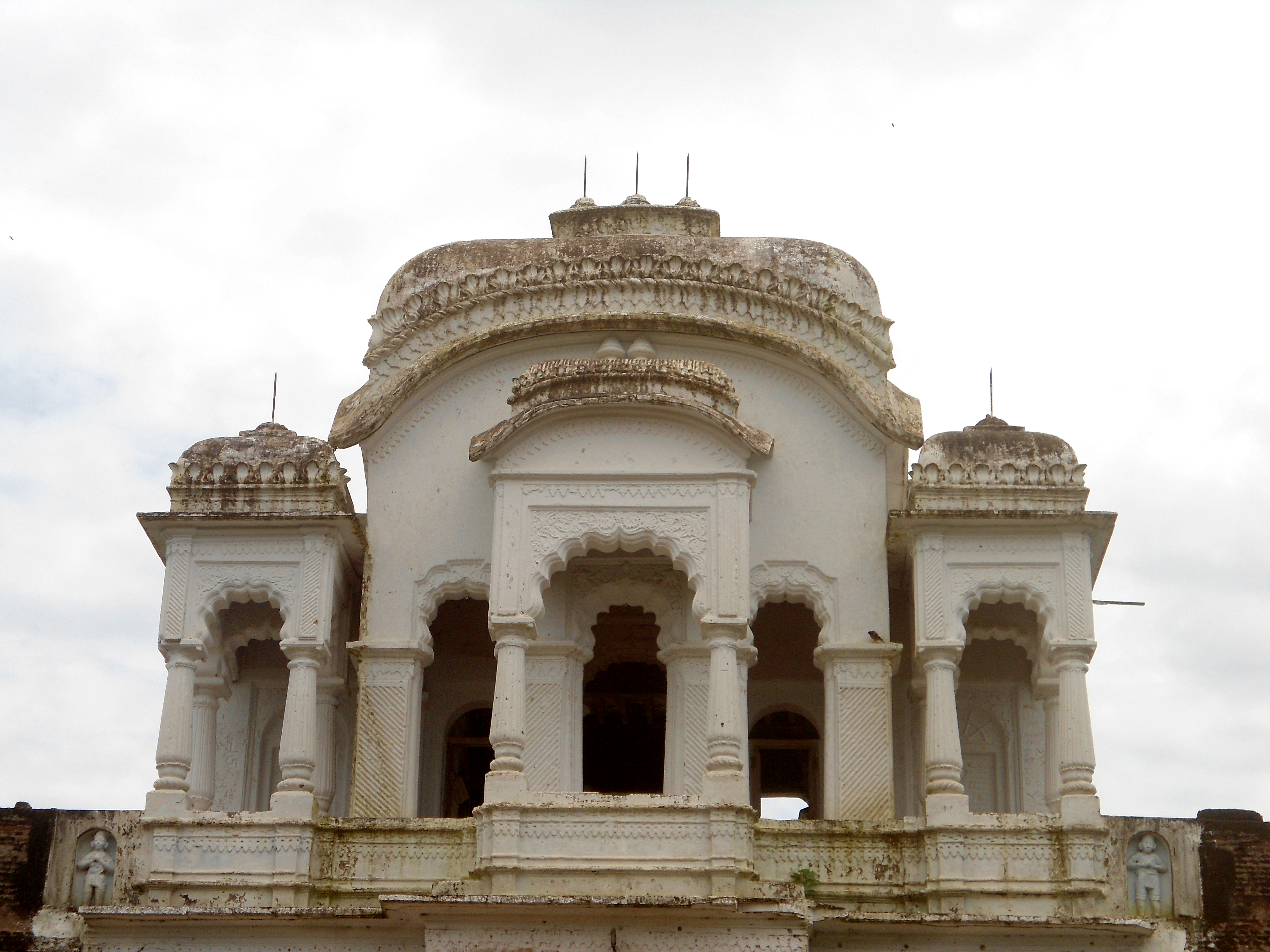
Vizianagaram Fort
A Muslim saint doing penance in a forest suggested the spot. A Hindu calendar aligned every possible omen. And a maharaja who believed in the power of naming built his fortress there in 1713, calling the place Vizianagaram -- "city of victory" -- because five vijayas had converged on the site at once. Vizianagaram Fort, the square-walled stronghold of the Pusapati dynasty in northeastern Andhra Pradesh, was not simply constructed. It was conjured into being through an elaborate choreography of faith and calculation, its very foundation stones laid on the day of Vijayadasami during the Dasara festival, in a Hindu calendar year also named Vijaya, on a Tuesday -- Jayavaram, "victory day" in Telugu. Three centuries later, the fort still stands in the heart of the city it spawned, 40 kilometers northwest of Visakhapatnam and 18 kilometers from the Bay of Bengal.
Through the Nagar Khana
The fort is square in plan, with two main gates. The principal entrance, called the Nagar Khana, features the most elaborate architectural treatment -- an ornate gateway that announced the power and ambition of the Pusapati maharajas to anyone approaching. Inside the walls, the fort contained not just military infrastructure but an entire royal ecosystem: temples, palaces, administrative quarters, and a victory tower. The Phool Bagh Palace, now functioning as a women's college on its upper floor, houses a museum displaying artifacts from the succession of kings who ruled from within these walls. Adjoining the palace is one of the fort's most curious features -- an octagonal stone bathroom built exclusively for the rajas. Standing 50 feet tall, it contains a spiral stairway leading to a rooftop water tank fed by pumps drawing from a nearby well, an ingenious piece of hydraulic engineering that gave the rulers running water centuries before modern plumbing arrived.
A Clock Tower After Big Ben
Just outside the fort walls stands the Ganta Stambham, a clock tower built in 1885 from sandstone in an octagonal design that reaches 68 feet. Its inspiration is unmistakable: the rajas of Vizianagaram, who traveled frequently to London during the British Raj, modeled it after Big Ben. The tower was originally painted white at the top but now wears cream and red. It sits at the heart of the modern city, a reminder that the Pusapati rulers looked outward even as they governed inward, importing European aesthetics alongside their traditional authority. Nearby, Perla Home -- known locally as Perla Vari -- was constructed in 1895 and became the first building in the region to receive an electricity connection. Its bedroom once held bedsteads made of silver. A library within the building remains functional, and European furniture and chandeliers from its heyday are still on display.
Palaces Beyond the Walls
The Pusapati dynasty's architectural ambitions extended well beyond the fort itself. The Alakananda Palace was built as a royal guest house, set within formal gardens and walkways, lavish enough to receive dignitaries in appropriate style. Within its grounds, the royalty later constructed a private airstrip -- a distinctly 20th-century addition to an 18th-century estate. Today, the palace serves a very different purpose: it houses the 5th Battalion of the Andhra Pradesh Armed Reserve Police. Nearby stands the Korukonda Palace, surrounded by roughly 1,000 acres of land that now hosts educational institutions and well-tended gardens. The palace itself has been repurposed as Sainik School, Korukonda, a military boarding school. These transformations -- from royal pleasure grounds to police barracks and schools -- trace the broader arc of Indian history, where princely estates became public institutions after independence.
The Goddess Found on Victory Day
Outside the fort walls, an ancient temple dedicated to the goddess Pydithalli Ammavaru draws deep reverence from the people of Vizianagaram. Local belief holds that the deity is the reincarnated form of a daughter of the royal family. The image worshipped in this temple was discovered on Vijayadashami day in 1752 -- yet another convergence of this place with the symbolism of victory. Each year on October 21 and 22, the discovery is commemorated with a jatra, a religious fair that fills the streets around the temple. Inside, a Shiva linga rendered in two colors is said to represent the union of Shiva and Parvati. The temple binds the secular history of the fort to the devotional life of the city, a reminder that Vizianagaram's identity was never purely military or political. It was also, from the beginning, a place where the divine and the dynastic were understood to be the same thing.
From the Air
Located at 18.11°N, 83.41°E, approximately 40 km northwest of Visakhapatnam and 18 km from the Bay of Bengal. The fort is a square-shaped structure in the center of Vizianagaram city, with the Ganta Stambham clock tower visible nearby. The Korukonda Palace and Sainik School campus are visible to the northeast with their extensive grounds. Nearest major airport is Visakhapatnam (VOVZ/VTZ), about 40 km southeast. The flat terrain of the coastal plain makes the fort and clock tower relatively easy to spot from low altitude. Best viewed at 1,500-3,000 feet in clear weather.