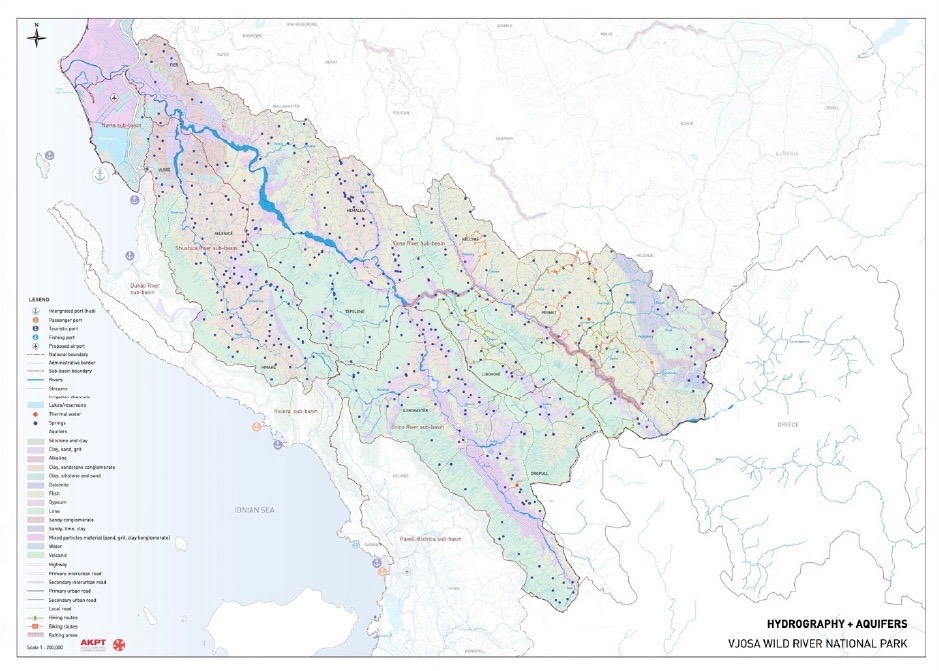
Vjosa Wild River National Park
Only about 15 Balkan lynx are estimated to remain. That number alone would justify protecting the river valley they depend on, but the Vjosa earned its designation for something larger: on 15 March 2023, Albania declared Europe's first Wild River National Park along the Vjosa's course, preserving one of the continent's last major free-flowing rivers from source to sea. No dams interrupt it. No gravel extraction reshapes its bed. The Vjosa simply does what rivers did before humans decided they knew better -- it meanders, floods, carves islands, and sustains an ecosystem that has been assembling itself for millennia.
The Last Wild River
The distinction matters because it is so rare. Across Europe, rivers have been dammed, channeled, and diverted for centuries. The Vjosa resisted this fate through a combination of geography, economics, and sustained advocacy. For years, the Albanian government considered hydropower projects along the river. Environmental organizations, working alongside the outdoor clothing company Patagonia and the International Union for Conservation of Nature (IUCN), mounted a campaign to protect the Vjosa instead. The effort culminated in a ceremony in Tepelene on 15 March 2023, with Prime Minister Edi Rama in attendance, granting the river and its main tributaries -- the Drino, Kardhiq, Bence, and Shushice -- full national and transboundary protection. In 2025, UNESCO further recognized the park as a biosphere reserve.
A River's Geography
The Vjosa stretches 270 kilometers in total, 190 of which flow through Albanian territory before discharging into the Adriatic Sea. Along this length, the river passes through narrow canyons, splits around islands, bends into meanders, and rushes over rapids, creating a diversity of aquatic habitats within a single watercourse. The national park encompasses 12,727 hectares with an IUCN Category II designation, the same classification applied to iconic parks like Yellowstone, aimed at preserving ecological integrity while allowing natural processes to continue undisturbed. From the air, the Vjosa's braided channels and seasonal flood patterns are clearly visible against the surrounding Albanian landscape, a ribbon of wildness threading through cultivated valleys and mountain passes.
The Inhabitants
The park harbors over 1,100 species of wildlife. Among them are 257 species of birds, 31 species of fish, 70 species of mammals, and 150 species of winged insects. Thirteen species found within the park appear on the IUCN Red List of Threatened Species. Otters hunt along the banks. The endangered Egyptian vulture circles overhead, its white plumage and wedge-shaped tail unmistakable against the canyon walls. And somewhere in the surrounding forests, the Balkan lynx persists in numbers so small that each individual matters to the survival of the subspecies. The river valley functions as Albania's biodiversity hotspot, its free-flowing water creating the kind of varied habitat -- riffles, pools, gravel bars, floodplain forests -- that regulated rivers cannot sustain.
What Preservation Means Here
The Vjosa's protection is not a return to some imagined pristine state. People live along the river, farm its floodplain, and fish its waters. The park designation under Albanian Law 81/2017 was designed to balance ecological protection with the needs of local communities, preventing industrial-scale extraction and dam construction while permitting the relationship between river and residents to continue. The collaboration that produced the park -- Albanian government, international conservation bodies, corporate sponsors, local NGOs -- represents a model that conservationists elsewhere are watching closely. Whether a river can remain truly wild while a national park boundary runs along its banks is a question the Vjosa will answer over decades, not years. For now, it flows freely, and 1,100 species depend on that freedom continuing.
From the Air
Located at 40.12N, 20.43E in southern Albania. The Vjosa River is visible as a braided, meandering watercourse flowing generally westward toward the Adriatic Sea. The river's free-flowing character creates distinctive braided channels and gravel bars visible from altitude. The Nemercka mountain range flanks the river to the south. Nearest airport is Tirana International Airport Nene Tereza (LATI), approximately 150 km to the north. Ioannina Airport (LGIO) in Greece is roughly 80 km to the southeast. Best viewed at 5,000-8,000 ft AGL to appreciate the river's full course through canyons and meanders.