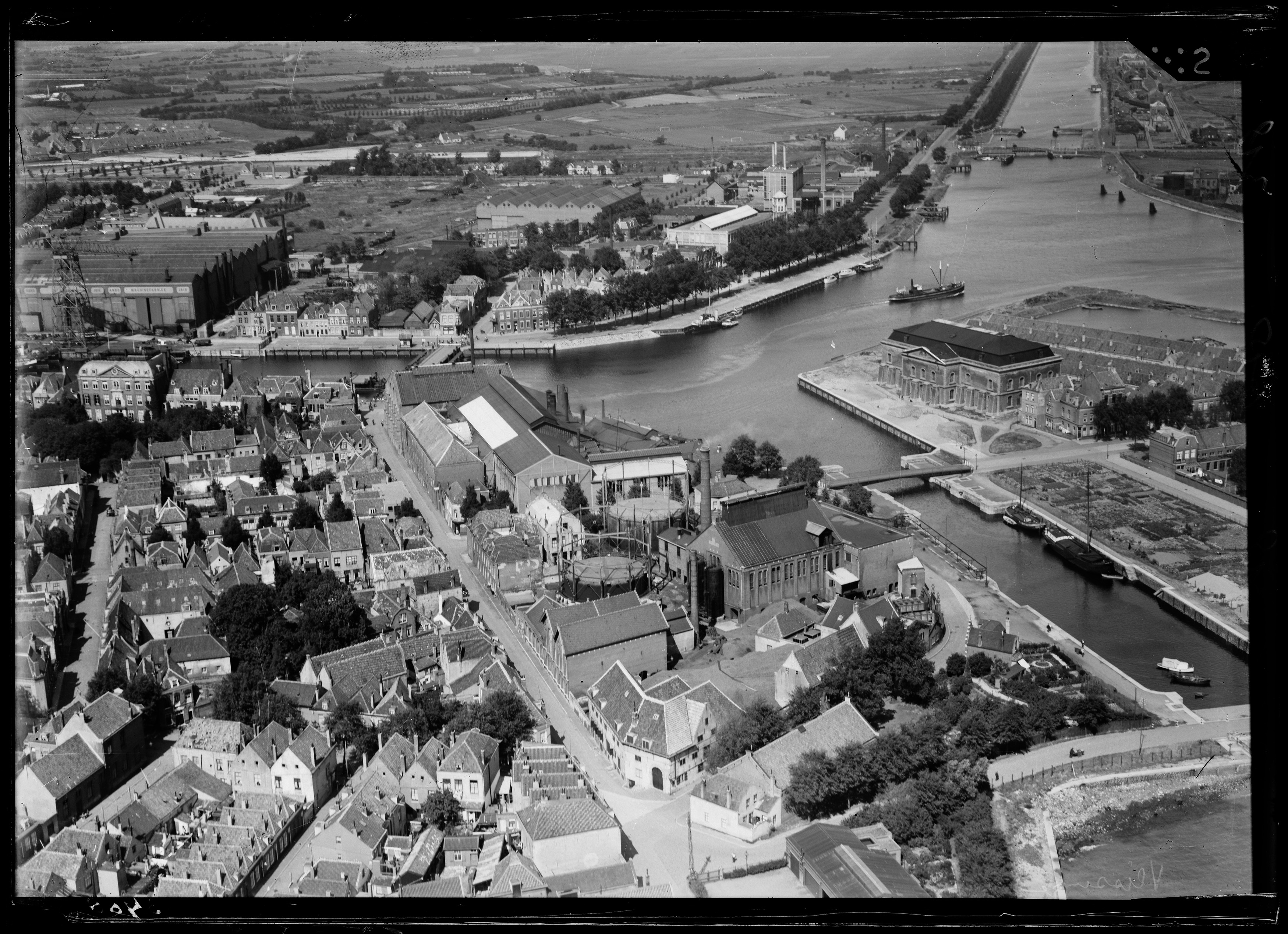
Vlissingen Naval Base
In 1697 an English engineer named John Perry, later famous for writing the first detailed Western account of life under Tsar Peter the Great, sketched a dry dock for the Dutch Admiralty of Zeeland. They built it in Vlissingen between 1704 and 1705. Sailors immediately nicknamed it Perry's dokje, the little Perry dock. It was the first dry dock ever built in the Netherlands. A horse mill pumped out the residual water. The hull-shaped basin between the wet dock on one side and the sea on the other gave Vlissingen something almost no other northern European port had: the ability to put a warship completely out of water to scrape its hull, replace planking, and do the kind of structural repair that decided whether a ship sailed home from battle or sank.
Why Vlissingen
The geography was the foundation of everything. Vlissingen sits at the mouth of the Schelde, the river estuary that reaches inland to Antwerp. Even the largest sailing warships could approach the port directly from the sea without lightering cargo or being craned onto ship camels the way Amsterdam-built ships had to be to clear the Pampus shoals. From 1609 to 1614 the city dug out its first wet dock, the Oosterhaven, behind newly expanded city walls. From 1687 to 1693, under permission Stadtholder William III had to extract from a reluctant local government with the threat that he would otherwise build the dock at Veere, the Zeeland Admiralty enlarged it into the main dock that still defines the city. Total cost: 598,000 guilders. A fleet could lie in ordinary inside the wet dock indefinitely, masts and rigging unstepped, hulls preserved in still water rather than slowly destroyed by the tidal grinding that ate ships moored in open harbors.
The Sea Lock and the Shipworm
The Achilles' heel of the whole installation was the sea lock that closed off the dock from the Schelde. The unstable subsoil shifted. Water welled up under the foundations. And the naval shipworm, Teredo navalis, that scourge of every wooden marine structure in northern Europe, chewed through pilings and gate timbers. The first sea lock collapsed in 1744. A second was built between 1745 and 1753, almost forty meters long, fourteen and a half wide, and lasted nearly thirty years before it needed serious repair. French engineers under Napoleon enlarged it again in 1810, finishing in 1812. In the 1840s, divers worked on it from within diving bells by candlelight, an image that captures both the technical ambition and the discomfort of nineteenth-century underwater repair. Between 1847 and 1848 the entire structure was drained and rebuilt at the cost of 243,000 guilders.
Fire, English Cannon, and the French
The base accumulated history the way working ports accumulate scorch marks. A fire in 1749 burned the Admiralty shipyard's buildings except the equipagemeester's house. A piece of flaming sailcloth blew from one warehouse to the small tower of the nearby Oostkerk and burned the church down in minutes. The Admiralty rebuilt: the great Zeemagazijn or arsenal had its first stone laid on 12 October 1767, a building that would eventually carry a time ball on its roof to let sailors set their marine chronometers. Then in 1809 an English expeditionary force, the Walcheren Campaign, captured two ships under construction, destroyed two others, and burned almost every naval facility in the city to the walls. The French rebuilt from 1810 onward with thick buttressed walls intended to be bomb-proof. The arsenal walls came out between one and a half and one point nine meters thick.
Rijkswerf Vlissingen, 1814 to 1868
After Napoleon fell, the new Kingdom of the Netherlands re-established the yard as the Rijkswerf Vlissingen. Rear Admiral Otto Wilem Gobius took over as director in July 1814 with the dual responsibility of running the shipyard and commanding the naval area. The Rijkswerf split in two: an equipment yard near the sea, on the site of the old Admiralty yard, where ships were rigged, armed, and supplied; and a new construction yard built from 1817 onward at the inland end of the dock. The construction yard's first big slipway laid down the warship Zeeuw in August 1819. The smithy that opened in 1818 had twenty-two fireplaces, with much of its tooling stripped from a closed yard at Antwerp; it would eventually drive steam hammers, steam-powered lathes, and the planing equipment needed for the iron and armor plating of the steam navy. From the 1850s onward, screw-propelled steam frigates too large for Amsterdam slid into the Schelde from these slipways.
What Came After
In 1867 the Dutch government moved the armoring facilities to Amsterdam. The Rijkswerf Vlissingen finished the last two Groningen-class steam corvettes, towed the Citadel van Antwerpen out of the dock in August 1868, and shut its gates. The grounds did not go quiet. The private shipyard Koninklijke Maatschappij De Schelde bought the construction-yard land and rebuilt the warship industry on private capital, becoming so important to the Dutch navy that historians routinely call it the practical successor of the Rijkswerf. De Schelde survives today as Damen Schelde Naval Shipbuilding, the only yard in the Netherlands that still builds major warships and one of the few in Europe still launching frigates for foreign navies. The eighteenth-century arsenal was finally demolished in 1968. The Oostkerk warehouse came down too. A short buttressed section of its wall, in the Onderstraat, may be the only fabric of the Rijkswerf still standing.
From the Air
Located at 51.44 degrees north, 3.58 degrees east, on the Vlissingen waterfront where the city meets the Schelde estuary at the mouth of the Western Scheldt. The historic dock, visible from low altitude as a rectangular basin parallel to the shore, and the modern Damen Schelde yards to the east form the working naval corridor. Best viewed from 2,000 to 4,000 feet. Nearest airports: Midden-Zeeland (EHMZ) 8 km north, Antwerp (EBAW) 75 km east, Ostend-Bruges (EBOS) 35 km south. The Schelde channels carry heavy commercial traffic; the entry to Antwerp passes immediately offshore.