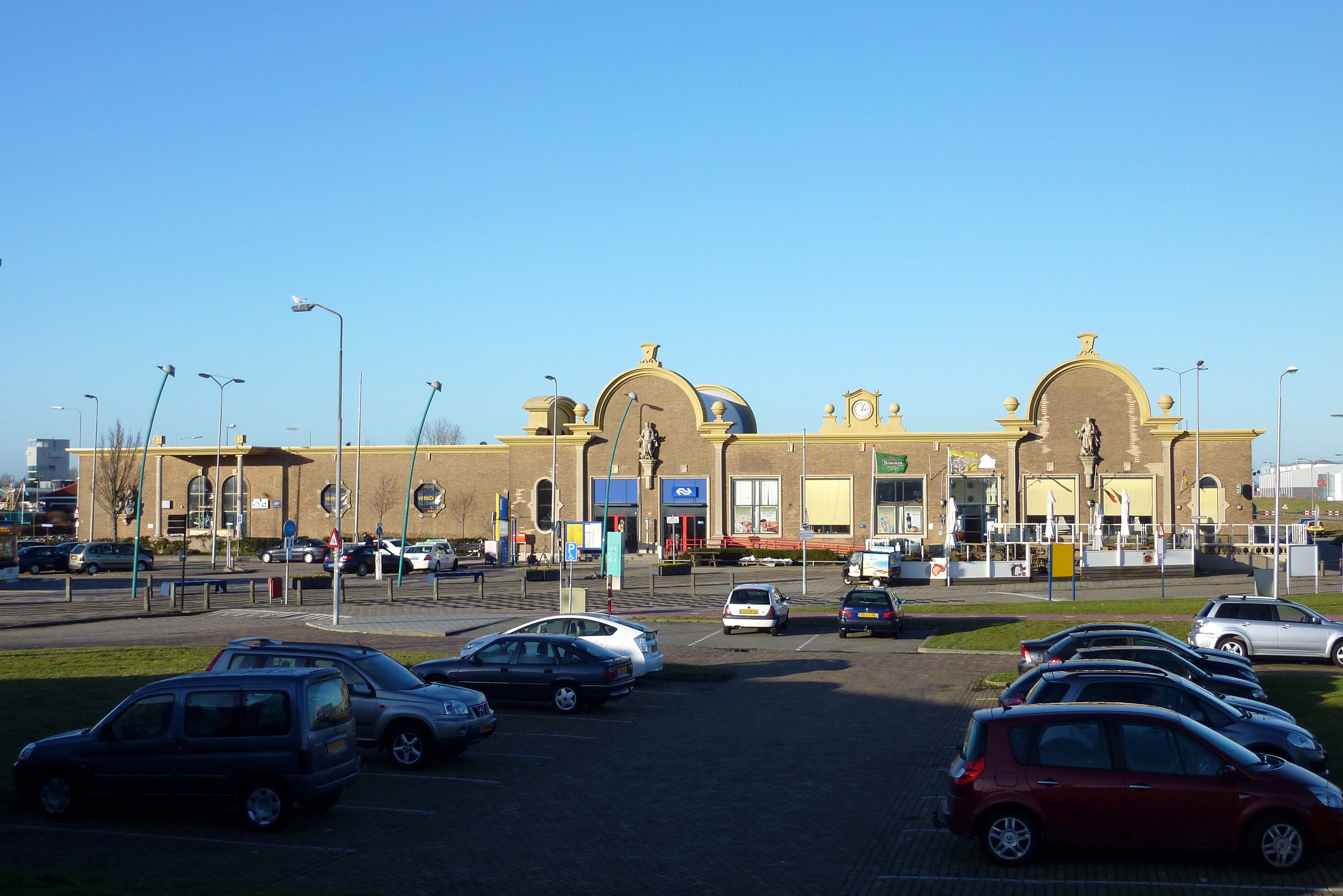
Vlissingen Railway Station
Step off the train at Vlissingen and you have officially run out of Netherlands. Walk a hundred meters further west and you would be standing in the harbor, watching the ferries to Breskens churn the water. The track simply ends. This is a terminus station in the most literal sense - the steel rails of the Roosendaal-Vlissingen line stop here, 150 kilometers from where they started near the Belgian border, and for a brief, glamorous decade before the First World War, a passenger boarding a D-train at this platform in the evening could be in Berlin by the next afternoon, with a steamer crossing to England waiting at the quay alongside.
The London-Berlin Years
The station opened on 1 September 1873 as Vlissingen Port, a simple wooden affair built mainly to feed passengers onto the Stoomvaart Maatschappij Zeeland ferries that ran across the North Sea to Queenborough and later Folkestone. From 1881 until the outbreak of the First World War, D-trains - the international express services - ran straight onto this platform from Berlin via the Zeeland Line. The connection ran like clockwork: ferry from Sheerness or Folkestone, train to Vlissingen, sleeping carriage east through the night, breakfast in Berlin. A grand Renaissance-style station building replaced the original in 1894, complete with a royal waiting room for the Dutch monarchy. Five years later, an Amsterdam locomotive with faulty brakes failed to stop at the buffers, smashed through the platform end, and crashed into the station buffet. Two conductors died.
Bombed and Reborn
The Renaissance station did not survive the Second World War. In 1944 Vlissingen Port was hit during a bombing raid and damaged beyond repair. Reconstruction began in October 1949 to a design by Sybold van Ravesteyn, the Dutch architect whose curling neo-baroque was already controversial and would later become beloved. Ravesteyn kept some of the old platform canopies and pillars, but the new building was unmistakably his: round tilted windows, decorated cornices, statues on the facade, and a careful, theatrical asymmetry. The station opened on 18 December 1950. Four ceramic panels by Jo Uiterwaal, mounted on the outer walls, depict scenes from the railway and the province of Zeeland. A statue commemorating the electrification of the Zeeland line, by sculptor Philip ten Klooster, was unveiled in the booking hall on 17 April 1957.
Almost the Westernmost
The station holds an oddly precise distinction. It is less than 100 meters short of being the westernmost railway station in the Netherlands - the title goes instead to Vlissingen Souburg, the second station in the same town, which sits a few football fields further west. There have been suggestions, made and unmade over the decades, to move the station north toward the HZ University of Applied Sciences and the city center. The proposals always founder on the same objection from the south: people in Zeelandic Flanders, who reach the rest of the Netherlands by walking off the foot-and-bicycle ferry from Breskens directly onto the platform, do not want to lose the seamless transfer that makes Vlissingen worth changing trains for at all.
A Surviving Ravesteyn
Most of Sybold van Ravesteyn's railway stations have been demolished. The architect built across the Netherlands in a style that often baffled his contemporaries - too playful for the modernists, too modern for the traditionalists - and the postwar wave of station rebuilding gradually erased his work. Vlissingen is one of the few that survived. On 18 March 2010 it was designated a national monument. The booking hall still has a small kiosk where the ticket counters used to be. The terrace in front of the station buffet looks across to the ferry terminal, and in the evenings the long intercity service from Amsterdam pulls in, having traveled six and a half hours from the capital, only to stop because there is simply nowhere further left to go.
From the Air
Vlissingen Railway Station sits at 51.444 N, 3.596 E, in the harbor district just inland from the ferry terminal on the Westerschelde. The station building is a low neo-baroque structure with three platforms and a free-standing bicycle facility; visible from low altitude as a distinctive pale building among the dockside warehouses. The Roosendaal-Vlissingen rail line runs east through Middelburg and Goes toward Roosendaal. Nearest airfields are Midden-Zeeland (EHMZ, 13 km northeast) and Antwerp International (EBAW, 75 km east). Vlissingen lies on the major shipping approach to Antwerp and the seaplane bombing of 1940-1944 left scattered surface damage still visible in the harbor pattern. Best viewed in clear coastal weather; haze common in summer.