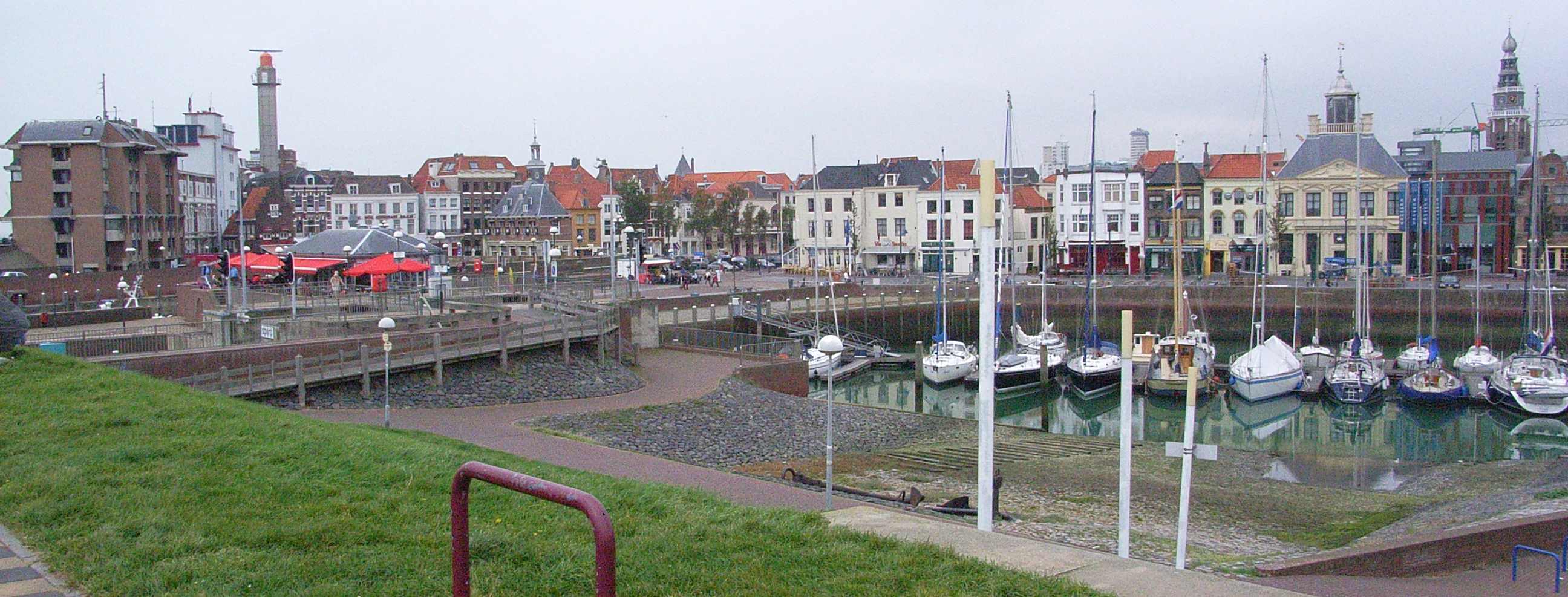
Vlissingen
Walk through Queens, New York and you eventually reach Flushing. Walk through Cornwall and you find another Flushing. There's a Flushing in Michigan and a Flushing in Ohio. The eastern cape of Novaya Zemlya, off the Arctic coast of Russia, is Cape Flissingsky. They all trace back to one small Dutch port on the island of Walcheren whose Dutch name is Vlissingen and whose seventeenth-century English name was Flushing. The town that exported its name to four continents also exported the man who is still arguably the greatest naval commander in Dutch history, lost three quarters of its population during the Second World War, and was the place British commandos came to retake on a cold November day in 1944.
Saint Willibrord's Bottle
Nobody quite knows where the name Vlissingen comes from. The most affectionate story dates the founding to the seventh century, when the missionary Saint Willibrord supposedly landed here with a bottle of wine, tried to convert the local beggars by sharing it, watched the bottle miraculously refill itself, and finally gave up and gave them the bottle, naming the settlement Flessinghe, of the bottle. Another version puts the origin in a tenth-century ferry house at the mouth of the Schelde marked with a bottle as its sign. A third derives the name from a Danish word for tides. The reliable history is that a fishermen's hamlet existed at the estuary by around AD 620, the town's first surviving charter is from 1247, and Floris V, Count of Holland, bought the place in 1294 and began turning a fishing village into a serious port. City rights followed in 1315.
Rebellion, English Garrisons, and Golden Age Ships
The sixteenth century broke Vlissingen and remade it. The Dutch Revolt against Spanish rule landed here with particular force; in April 1572 the townspeople rose up, drove out the Flemish garrison, fired on Spanish reinforcement ships in the roads, and hanged a Spanish nobleman in front of the town hall. Under the 1585 Treaty of Nonsuch, English Queen Elizabeth I stationed garrisons here and at Brielle as security for her loans to the Dutch rebels, a deal that lasted until 1616 when the Dutch bought the towns back. In the Dutch Golden Age that followed, Vlissingen ships sailed for every outpost of the Dutch colonial empire. The same harbors fitted out fishing fleets for herring, privateers preying on Spanish and French shipping, and slavers running the African and Caribbean trades, an ugly part of the same prosperity that should not be sanitized in a port's story.
The Admiral the Sailors Called Granddad
Michiel de Ruyter was born in Vlissingen in 1607, the son of a beer porter. He went to sea at eleven, worked his way through the ranks of merchantmen, took command of his first ship in his twenties, and rose to become the most respected naval commander in seventeenth-century Europe. His own crews called him Bestevaer, Granddad. He fought the English to a standstill in three Anglo-Dutch wars, raided the Medway in 1667 in one of the most humiliating defeats the Royal Navy ever suffered, and beat back an Anglo-French invasion fleet off the Zeeland coast at the Battle of Schooneveld in 1673. He died in 1676 of wounds taken fighting the French off Sicily. A statue of him on the Vlissingen boulevard looks out over the Schelde he learned to sail on. He is not the only admiral the town produced; the lists run long, including the Banckert brothers, the Evertsen dynasty, and Joos de Moor, who beat Federico Spinola's galleys off Sluis in 1603. But de Ruyter is the one whose name carries.
Operation Infatuate
On 1 November 1944, British commandos of No. 4 Commando and the 4th Special Service Brigade landed at Vlissingen as part of Operation Infatuate, the assault to clear German garrisons from Walcheren and open the Scheldt to Allied shipping bound for Antwerp. Allied bombers had already breached the dikes in October, flooding most of the island to drown the German defenders out of their pillboxes. Vlissingen itself was heavily damaged by shelling and inundation. The fighting in the streets was brutal and house by house, and many of the people of Vlissingen, already malnourished and exhausted by four years of occupation, died in the bombing, the flooding, or the battle. The Forgotten Battle, a 2020 Netflix film, took its name from how thoroughly this campaign has been overshadowed in popular memory by D-Day and Market Garden. The Scheldt was finally cleared on 8 November 1944. The port of Antwerp opened to Allied supply ships three weeks later. The war in Europe ended six months after that.
After the Tide
Vlissingen rebuilt slowly. The Walcheren dikes were repaired and the seawater pumped out. The De Schelde shipyard, the practical successor of the old Rijkswerf Vlissingen, kept building warships and now continues as Damen Schelde Naval Shipbuilding, the last yard in the Netherlands still launching major naval vessels. The deepwater port east of the city, Vlissingen-Oost, grew into the engine of central Zeeland's economy after the 1960s. About fifty thousand ships a year pass through the Schelde now on their way to and from Antwerp. The Olau Line ferry to Sheerness ran until 1994. The Breskens ferry across the Westerschelde, since the 2003 opening of the Westerschelde Tunnel near Terneuzen, carries only pedestrians and bicycles. Vlissingen sits where it has always sat, between the river and the sea, the bottle-shaped town that gave its name to half the world.
From the Air
Located at 51.45 degrees north, 3.58 degrees east, on the southern tip of the island of Walcheren in Zeeland, at the mouth of the Western Scheldt. The city core is east of the working port; the Damen shipyards line the Schelde to the east, and the modern Vlissingen-Oost industrial harbor is further east still. Best viewed from 2,000 to 5,000 feet to see the relationship of Vlissingen, Middelburg, and the canal that connects them. Nearest airports: Midden-Zeeland (EHMZ) 6 km north, Antwerp (EBAW) 80 km east, Ostend-Bruges (EBOS) 35 km south. The Schelde is one of the busiest commercial waterways in Europe; expect heavy ship traffic in the channels offshore.