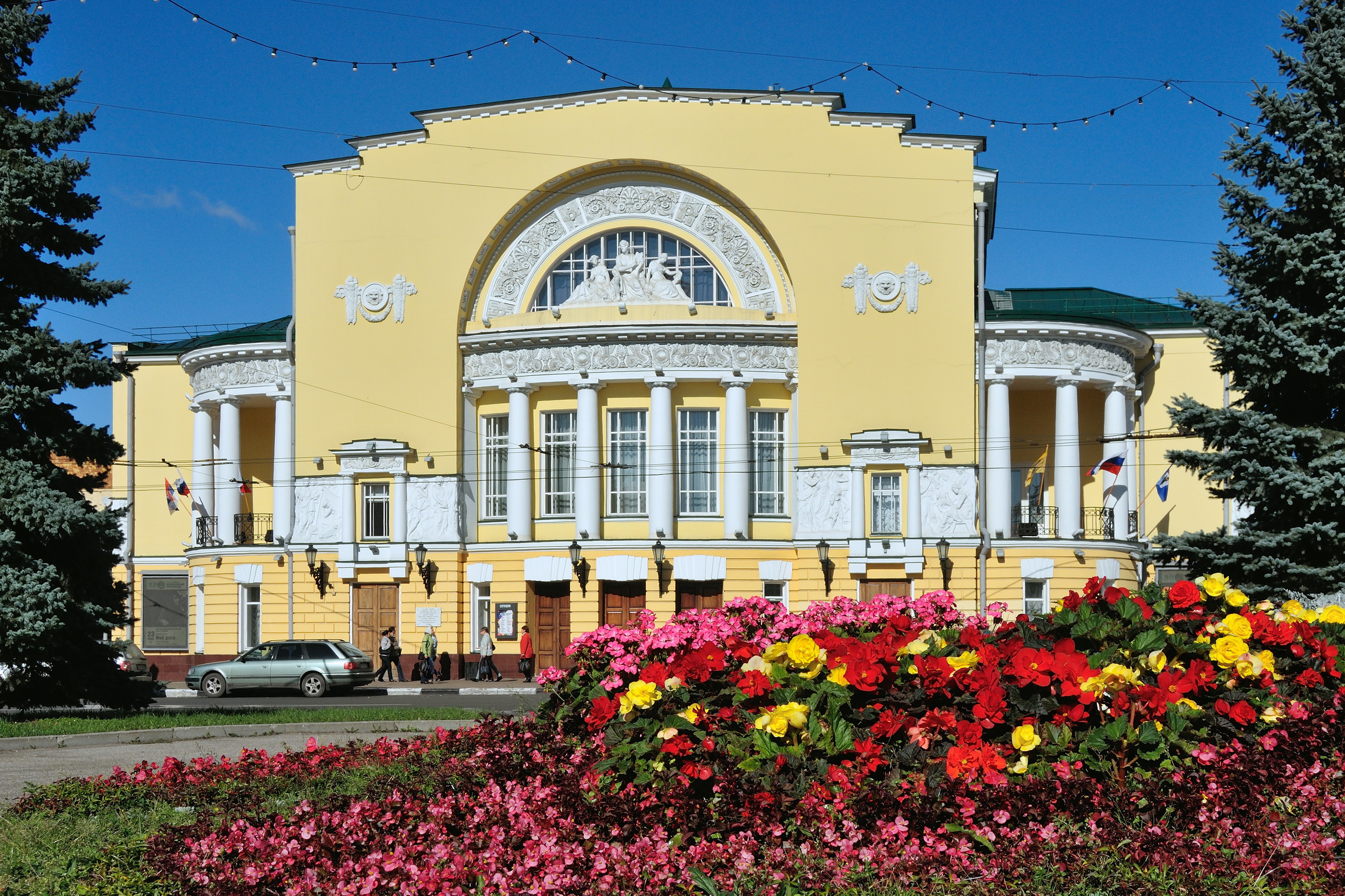
Volkov Russian State Academic Theatre
It started with the smell of hides. In 1750, in the tannery belonging to his stepfather, the merchant Polushkin, a young man named Fyodor Volkov staged Jean Racine's Esther for an audience of brothers and friends in Yaroslavl. He had translated the play himself. Within months he had outgrown the tannery, built a proper "theatrical chamber" on Nikolskaya Street, mounted Alexander Sumarokov's tragedy Khorev with costumes and scenery, and assembled a permanent repertoire. Word reached Empress Elizabeth Petrovna in Saint Petersburg. In January 1752, she summoned the Yaroslavl players to the capital by imperial decree. Fyodor Volkov never came back.
The Tannery and the Decree
The first documented performance took place on July 10, 1750. What made it remarkable was not the quality -- we have no reviews from a tannery audience -- but the ambition. Volkov was the son of a Kostroma merchant, raised in Yaroslavl, and he chose to stage not a folk entertainment but a French neoclassical tragedy in translation. The theatrical chamber that followed on Nikolskaya Street was Russia's first purpose-built provincial playhouse, with a permanent company and rotating repertoire. Elizabeth Petrovna's court had its own theatrical traditions, but the news of a self-organized troupe performing serious drama in a provincial city caught imperial attention. The decree summoning Volkov's company to Saint Petersburg effectively ended the Yaroslavl experiment. His brothers Alexei and Gavriil tried to keep the theatre running, but without Fyodor's organizational talent and, apparently, his ability to fund the enterprise, the company folded by 1756. The original building burned in a city fire.
Dancing in a Circle
The theatre Yaroslavl has today owes its existence to a 1909 architectural competition. Nikolai Spirin won with a design he called "Dancing in a Circle," inspired by the Gilardi Pavilion in the Kuzminki estate near Moscow. Construction was completed in 1911, and the building was immediately named after Volkov, honoring the founder of Russian professional theatre more than a century and a half after his departure. The neoclassical structure stands at 1 Volkov Square in the center of Yaroslavl, anchoring the city's cultural district. It was municipalized in October 1918 following the revolution, but unlike many cultural institutions that were dismantled or repurposed in the Soviet era, the Volkov Theatre continued operating without interruption. The building itself became a kind of monument to continuity, a theatre that kept performing through world wars, revolution, and ideological upheaval.
The Provincial Stage as National Stage
During the Soviet decades, the Volkov Theatre earned a reputation as one of the strongest provincial companies in Russia. Its peak came in the 1960s and 1970s under artistic director Firs Shishigin, a People's Artist of the USSR and State Prize laureate. Shishigin assembled a remarkable ensemble: Alexandra Chudinova, Klara Nezvanova, Sergei Romodanov, Grigory Belov, Valery Nelsky, all recognized with the highest Soviet artistic honors. The theatre accumulated its own decorations. In 1950, on its 200th anniversary, it received the Order of the Red Banner of Labor. In 1966, the Soviet Ministry of Culture awarded it the honorary title of "academic," a distinction reserved for companies of exceptional artistic achievement. Nine years later, marking its 225th anniversary, it received the Order of the October Revolution. In 1970, control transferred from regional authorities to the Ministry of Culture of the Russian Soviet Federative Socialist Republic, a bureaucratic shift that signaled national importance.
250 Years of Russian Theatre
In May 2000, the Volkov Theatre hosted a celebration that claimed something larger than itself: the 250th anniversary of Russian professional theatre, dating the tradition to Volkov's 1750 tannery performance. The country's leading companies arrived for the first Volkov Theatre Festival. The Bolshoi Drama Theatre, the Alexandrinsky, the Maly, both Moscow Art Theatre companies -- the roster read like a history of Russian dramatic art. Russian President Vladimir Putin attended the gala evening and presented state awards to the theatre. The festival framed Yaroslavl not merely as a provincial city with a good theatre but as the birthplace of an entire national tradition. Whether that origin story is precisely accurate -- court theatricals existed before Volkov -- it captures something true about what happened in that tannery: the democratization of dramatic art, theatre created not by royal command but by a young man's initiative in a provincial city far from the capital.
From the Air
Located at 57.63N, 39.88E in central Yaroslavl, at the confluence of the Volga and Kotorosl rivers. The theatre building sits on Volkov Square in the city center. Yaroslavl's historic center is a UNESCO World Heritage Site, visible as a dense cluster of churches and historic buildings along the rivers. Best viewed at 3,000-5,000 ft AGL. Tunoshna Airport (UUDL) is approximately 18 km south of the city. Yaroslavl is a major stop on the Golden Ring route northeast of Moscow.