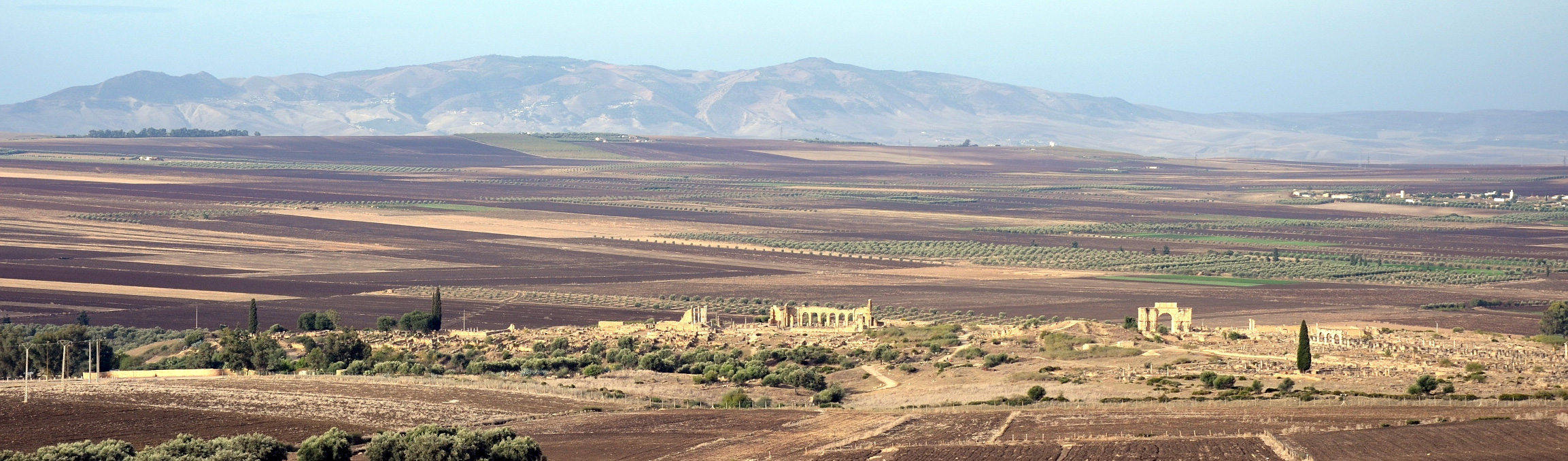
Volubilis
The mosaic floors are what stop you first. Bacchus rides a chariot pulled by leopards. Diana bathes while Actaeon sprouts horns from his skull. Orpheus plays his harp for an audience of animals that face every direction at once, as if the ancient mosaicist copied each creature from a pattern book without worrying about composition. These images have been open to the Moroccan sky for centuries, their colors faded but their outlines sharp, lying exactly where Roman craftsmen laid them nearly two thousand years ago. Volubilis, set on a shallow ridge between two streams below the Zerhoun mountain, is not the most famous Roman ruin in the world. But it may be the most revealing -- a place where Rome's ambitions, and their limits, are written into every crumbling wall.
Where Africa Met Rome
Long before legions arrived, a Berber settlement occupied this fertile ridge overlooking the alluvial plain north of modern Meknes. Carthaginian traders followed, leaving behind the magistrate's title of suffete that local officials would keep using long after Punic rule ended. When Augustus placed Juba II of Numidia on the Mauretanian throne in 25 BC, the king chose Volubilis as a second capital. Juba was Berber by ancestry but Roman by education, married to Cleopatra Selene II, daughter of Mark Antony and Cleopatra herself. His taste for Roman architecture reshaped the city. After Emperor Claudius annexed Mauretania in 44 AD, wealth from olive oil, grain, and wild animals destined for gladiatorial spectacles swelled the population to roughly 20,000 -- enormous for a provincial town at the empire's southwestern fringe.
Olive Oil and Ambition
Fifty-eight olive-pressing complexes have been uncovered so far, and the numbers hint at an economy built almost entirely on a single crop. Olive oil was not merely food here; it fueled lamps, lubricated baths, and served as medicine. Even the wealthiest mansions had their own presses. One workshop has been restored with a full-size replica of a Roman press, showing how olives were crushed into paste, packed into woven baskets, and squeezed until the oil ran into decantation basins where water floated it to the surface for scooping into amphorae. Beyond oil, at least 121 shops have been identified in the city, many of them bakeries. The volume of bronze statues found suggests Volubilis was also a center for their production or trade -- among them a bust of Cato the Younger of such quality that it remains one of Morocco's most celebrated ancient artifacts.
The Architecture of a Frontier
Walking the Decumanus Maximus, the paved main street lined with arcaded porticoes, you pass through two distinct cities. The older, pre-Roman settlement lies to the southwest; the grand Roman expansion stretches northeast. The Arch of Caracalla marks where they merge, built in 217 to honor the emperor who extended citizenship to all provincial inhabitants. It was originally topped by a bronze chariot drawn by six horses, with nymphs pouring water into marble basins at its base. Behind the arch stands the basilica, one of the finest in Roman Africa, its twin rows of columns framing the apses where magistrates once sat. The Capitoline Temple rises behind it, dedicated to Jupiter, Juno, and Minerva. Marcus Aurelius ordered 2.5 kilometers of defensive walls with 34 towers when tensions with neighboring Berber tribes escalated in the late 2nd century -- a signal that Rome already sensed its grip loosening.
Empires in Layers
Around 280, Roman control collapsed. The empire was tearing itself apart in civil wars, and Volubilis was simply too remote and too expensive to reconquer. But the city did not die. People kept living here for seven more centuries, speaking Latin into the 6th and 7th centuries, their names preserved in inscriptions dated by the old provincial calendar. When Arab forces arrived in 708, they found the Awraba Berbers occupying a reduced city behind a new wall built from salvaged Roman stone. In 788, a descendant of the Prophet Muhammad named Moulay Idriss fled Syria after the Battle of Fakhkh and was proclaimed imam here, founding the Idrisid dynasty that would create Morocco as a nation. His son Idris II moved the capital to Fez, and Volubilis slowly emptied. By the 14th century, the city was nearly deserted. Its stones were carted off by Sultan Moulay Ismail to build his imperial capital at Meknes, and the great Lisbon earthquake of 1755 toppled much of what remained.
A View Across the Valley
From the air, Volubilis is a geometric tracery of grey-blue limestone against red-brown earth, the Arch of Caracalla casting its shadow across the Decumanus Maximus. Across the valley rises the white hilltop town of Moulay Idriss Zerhoun, where the dynasty founder's mausoleum still draws pilgrims. The two places have stared at each other for twelve centuries -- one a ruin that UNESCO recognized in 1997 as an exceptionally well-preserved example of a large Roman colonial town on the fringes of the empire, the other a living city whose faith helped build a nation. The mosaics remain open to the sky, their tesserae holding fast in the earth. Venus rides her chariot through a hippodrome pulled by peacocks and geese, frozen in a race that will never finish. Rain falls on them, sun bleaches them, and still they endure -- small squares of stone outlasting every empire that laid claim to this ridge.
From the Air
Coordinates: 34.07N, 5.55W. The ruins sit on a low ridge between two wadis below Jebel Zerhoun, clearly visible from 3,000-5,000 ft AGL. The white town of Moulay Idriss Zerhoun is 5 km to the east. Nearest major airport: Fes-Saiss (GMFF), approximately 60 km east. Meknes lies about 30 km south. The Roman street grid and Arch of Caracalla are identifiable landmarks from moderate altitude.