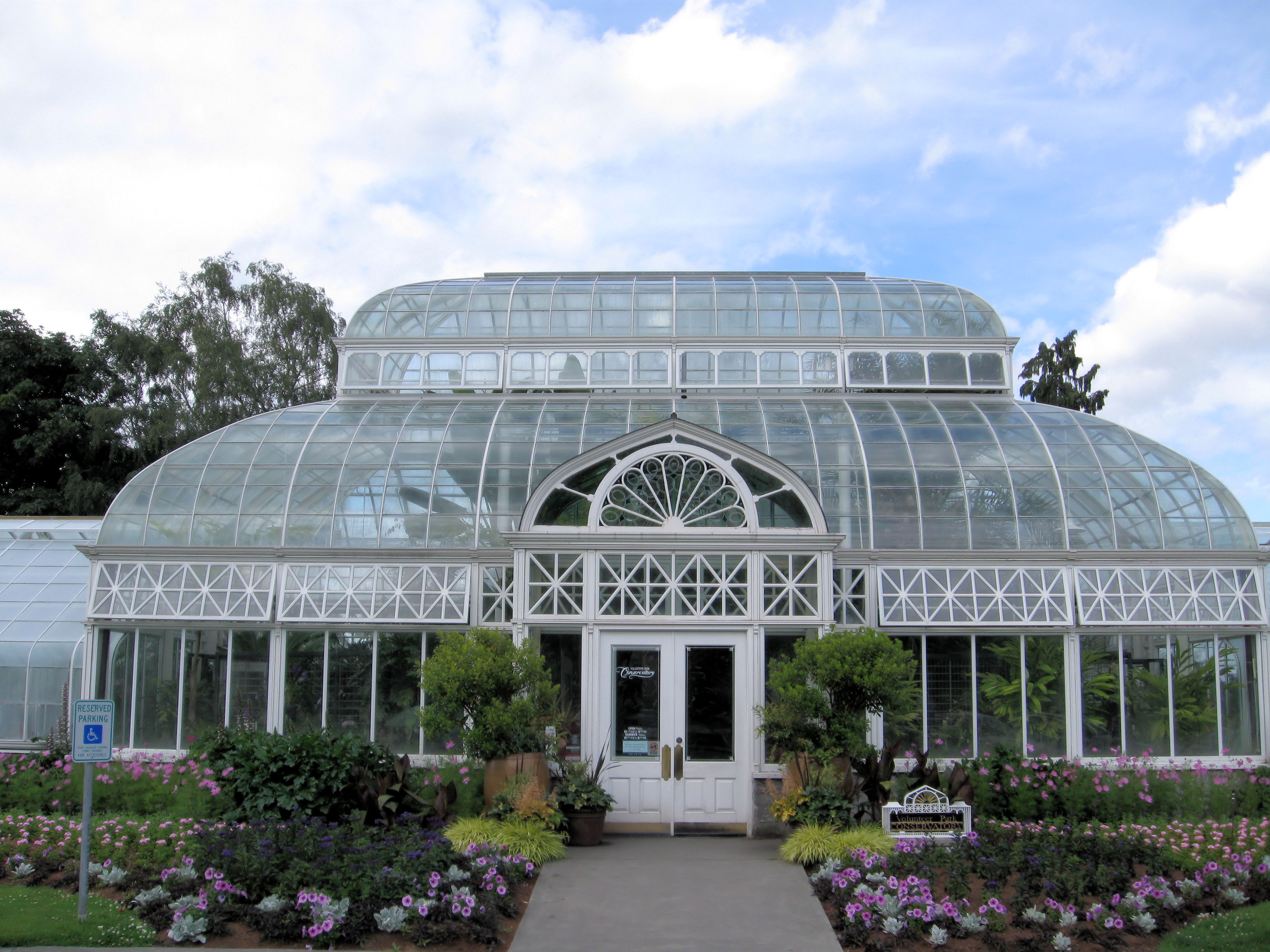
Volunteer Park Conservatory
Step through the entry vestibule and the air changes instantly, warm and heavy with moisture, carrying the faint sweetness of tropical decay. Outside, it is Seattle: gray skies, drizzle, temperatures in the low fifties. Inside the Volunteer Park Conservatory, you are somewhere equatorial. The building itself is the first exhibit, a Victorian-style greenhouse made of 3,426 glass panes fitted into a framework of wood and iron, modeled on London's Crystal Palace. The Hitchings Company of New York sold the design and the framework to the City of Seattle in the 1890s, and the city's own Parks Department staff assembled the structure, completing it in 1912. More than a century later, the conservatory still stands at the north end of Volunteer Park on Capitol Hill, its five display houses holding thousands of living specimens beneath a canopy of beveled glass and Pacific Northwest rain.
Five Rooms, Five Climates
The conservatory divides its interior into five distinct worlds. The Bromeliad House features a wrought iron display tree, designed by Randy Benson and crafted by local ironworkers, from which dozens of Tillandsia species hang like aerial sculptures. The Fern House contains not only ferns but also a collection of carnivorous plants, Venus fly traps, sundews, and pitcher plants arranged in bog gardens that replicate the acidic wetlands these predators call home. The Seasonal House reinvents itself six times a year, cycling through poinsettias, azaleas, hydrangeas, fuchsias, and other flowers matched to the calendar. The Palm House shelters a Windmill Palm donated from the Hiram Chittenden Locks around 1953 and a Sago Palm that was roughly 80 years old as of 2009. And the Cacti and Succulent House holds a Jade Tree grown from a cutting taken in 1916, making it one of the oldest living residents of the building.
Orchids Seized at the Border
The conservatory holds a quiet distinction: it is a registered United States Fish and Wildlife Service repository for confiscated plants. When federal agents intercept illegally transported orchids, cycads, or other protected species at ports and borders, the specimens can end up here. The orchid collection itself dates to 1921, when Mrs. Anna H. Clise donated the founding specimens. It has grown to include representatives of the largest orchid genera, Bulbophyllum, Epidendrum, and Dendrobium, alongside popular cultivated varieties like Cattleya and Phalaenopsis. Transporting endangered orchids across international lines violates the Convention on International Trade in Endangered Species, and over the years, many confiscated specimens have found a second life behind these glass walls. The conservatory quietly serves as both a botanical garden and a kind of witness protection program for plants.
When Waldo Bloomed
In 2005, 2008, and again in 2014, the conservatory became the center of citywide fascination when its corpse flower bloomed. The corpse flower, Amorphophallus titanum, is one of the largest flowering plants on earth and one of the rarest to see in bloom, typically flowering only two to three times within its 40-year lifespan. The conservatory's specimen, nicknamed Waldo, drew enormous crowds. Before its 2008 bloom, Waldo measured 47 and a half inches tall, 30 inches wide, and 52 and a half inches long. The 2014 flowering prompted Seattle Mayor Ed Murray to officially proclaim "Corpse Flower Week." The bloom lasts only a day or two, and the plant's signature smell, the stench of rotting flesh designed to attract pollinating beetles and flies, made each event as viscerally memorable as it was botanically significant. More than 150,000 people visit the conservatory in a typical year, but during corpse flower events, the lines stretched down the park paths.
Saved by Citizens, Sustained by Volunteers
By 1978, the conservatory was falling apart. Its glass panes and wood-and-iron framework had deteriorated to the point that the building had to close during high winds. Seattle citizens campaigned to save the structure, and the Friends of the Conservatory formed as a nonprofit in 1980. Working with Seattle Parks and Recreation, the group funded an architectural restoration between 1980 and 1985 that preserved the original Victorian character while making the building structurally sound. In 2004, when the city proposed a mandatory five-dollar admission fee, the Friends organized a community drive that defeated the measure. The conservatory remains free to enter. The original beveled glass lunette window above the main entry, the only surviving wood-and-glass element from 1912 after two major renovations, was restored in 2000. In 1981, artist Richard Spaulding added a hand-blown stained glass canopy called "Homage in Green" to the vestibule, blending contemporary craft with the building's Victorian bones. Over 100 volunteers contribute more than 2,500 hours of service annually, keeping this glass cathedral of plants alive.
From the Air
The Volunteer Park Conservatory sits at 47.632N, 122.316W on the northern end of Volunteer Park atop Capitol Hill in Seattle. From the air, look for the distinctive Victorian greenhouse structure, a long glass building with a peaked roof, set among the mature trees and lawns of Volunteer Park. The nearby water tower with its observation deck is a useful visual reference. The park's reservoir is visible as a large rectangular water body to the south. Nearest airports: Boeing Field/King County International (KBFI) 5nm south, Seattle-Tacoma International (KSEA) 11nm south, Renton Municipal (KRNT) 10nm southeast.