Volunteer Park
Before it was a park, it was a graveyard. The land atop Capitol Hill that would become Volunteer Park first served as Washelli Cemetery, receiving bodies relocated from downtown's Seattle Cemetery when that burial ground was converted into Denny Park in 1884. The dead were moved a second time, this time to Lake View Cemetery next door, and the city renamed the cleared ground Lake View Park. That name caused confusion with the adjacent cemetery, so officials tried again: City Park. It took J. Willis Sayre, a theatre critic, journalist, and Spanish-American War veteran, to lobby the city into the name that stuck. In 1901, the land was rechristened Volunteer Park to honor the war's volunteers. Four names in 25 years. Seattle was still figuring out what this hilltop could be.
The Olmsted Vision on a Ridgetop
In 1903, the Board of Park Commissioners brought John Charles Olmsted to Seattle. The stepson of Frederick Law Olmsted and a principal in the Olmsted Brothers firm, he was hired to design a park system for a city growing faster than its infrastructure could handle. In Olmsted's comprehensive plan, Volunteer Park was the centerpiece, chosen for its ridgetop location near downtown. He studied the terrain and built his design around its natural contours, running one axis along the hilltop with a concourse lined by an allee of chestnut trees stretching north to south. A second axis cut through the municipal reservoir, built in 1901. Where the two axes crossed, Olmsted placed a concert grove, a pergola, and terraced planting beds flanked by lily ponds. Multi-layered plantings along the east, south, and west edges screened the park from the surrounding city. Carriage drives looped down the hillside and around the reservoir, connecting back to the main concourse at both ends.
The Museum Olmsted Tried to Stop
When the Washington State Art Association proposed building a museum in Volunteer Park in 1910, Olmsted fought the idea fiercely. "Volunteer Park is obviously a landscape park," he argued. The museum, he wrote, would "completely dominate a large part if not the whole of the park, destroying much of the landscape value." The Park Department agreed, and the proposal died. But in the 1930s, the Fuller family offered to fund construction of a museum for the Seattle Art Institute, and this time the city accepted. The Seattle Art Museum opened in 1932 in a striking Art Deco building. It served as the museum's home until 1991, when SAM moved to a larger facility downtown. The Volunteer Park building then became the Seattle Asian Art Museum, housing SAM's Asian art collections. Olmsted's prediction came partially true: the bold geometric structure does command attention within the park's softer landscape. But the building has also become a beloved landmark in its own right, its Art Deco facade now inseparable from the park's identity.
The Doughnut, the Water Tower, and the Dahlias
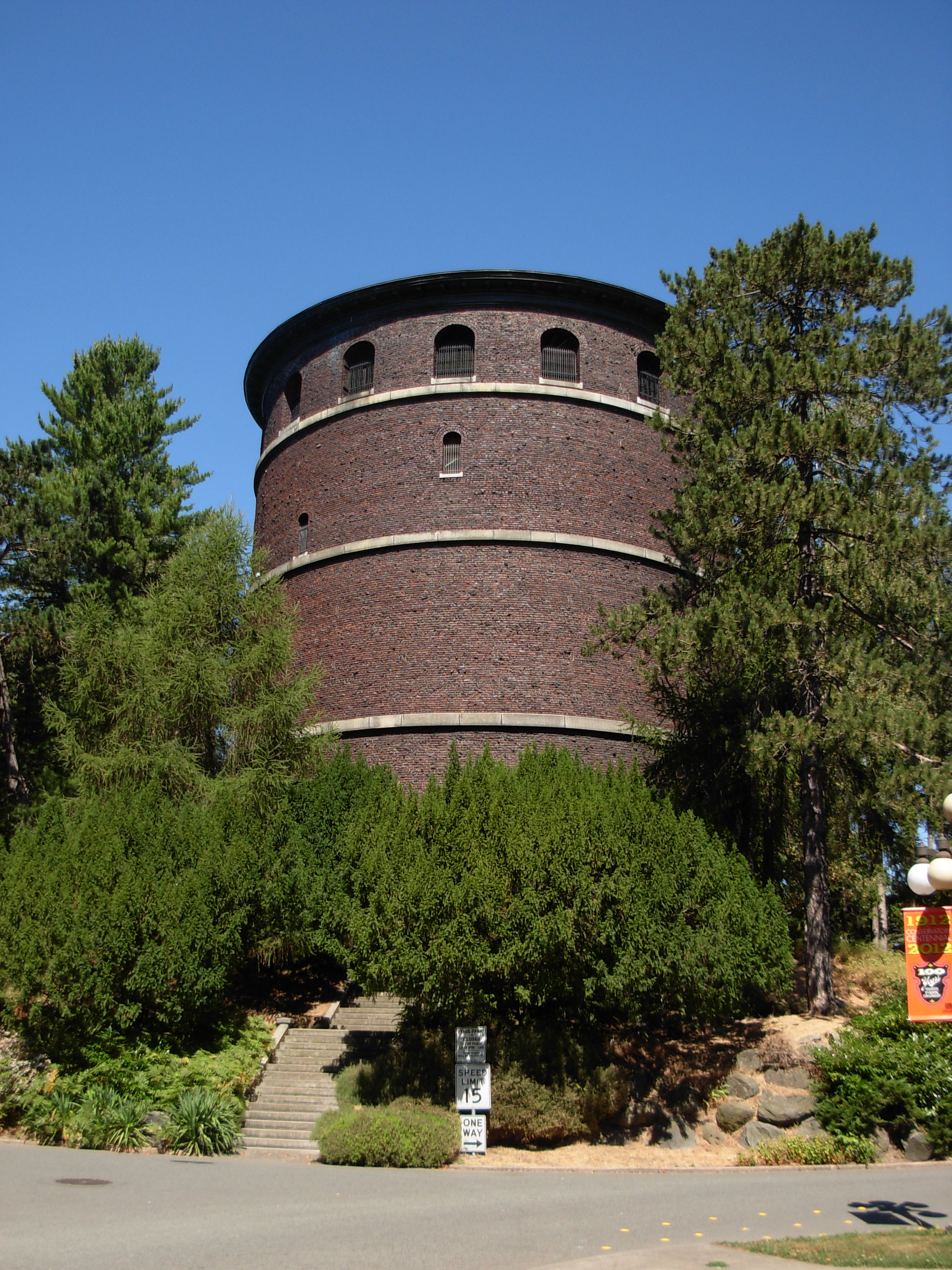
Volunteer Park collects landmarks the way old houses collect rooms. The 1906 water tower, built by the Water Department, offers an observation deck with panoramic views of the city and mountains. The Victorian conservatory, completed in 1912 from a kit purchased from the Hitchings Company of New York, houses tropical plants behind 3,426 glass panes. A statue of William H. Seward stands on the grounds, along with a memorial to Judge Thomas Burke. But the park's most photographed feature may be Isamu Noguchi's Black Sun, a large circular sculpture that Seattleites have affectionately dubbed "The Doughnut." Framed within its open center, the Space Needle appears in perfect alignment, a composition that has launched a thousand Instagram posts. In summer, the park's extensive dahlia gardens blaze with color, koi ponds shimmer with fish, and the wading pool draws neighborhood children from morning until its 8 p.m. closing.
Concerts, Bandshells, and the Great Lawn
Music has been part of Volunteer Park almost as long as the Olmsted plan itself. The pergola on the concourse originally featured a concert grove on its east side, a cluster of trees with a covered shelter. In 1915, the Park Department built a bandshell designed by prominent Seattle architect Carl Gould on the lawn north of the reservoir. Olmsted objected. He felt the structure intruded on the greensward, the great open lawn he considered essential to the park's character. But the bandshell better served the popular musical performances of the era, and it stayed until rotted timbers forced its demolition in 1947. A replacement stage, designed by landscape architect Rich Haag, was built in 1971. Today the park hosts free concerts and outdoor theater events throughout the year, continuing a tradition that predates every building on the grounds. Picnic tables scatter across the lawns, and on warm weekends, the open spaces fill with touch football games, frisbee players, and families spreading blankets on the grass Olmsted fought so hard to protect.
From the Air
Volunteer Park sits at 47.630N, 122.316W atop Capitol Hill in Seattle. From the air, the park is identifiable by the large rectangular reservoir at its center, the distinctive water tower on the grounds, and the Art Deco Seattle Asian Art Museum building. The Victorian glass conservatory is visible at the northern end. The park's allee of chestnut trees creates a visible north-south axis. Lake View Cemetery lies immediately to the north. Nearest airports: Boeing Field/King County International (KBFI) 5nm south, Seattle-Tacoma International (KSEA) 11nm south, Renton Municipal (KRNT) 10nm southeast.