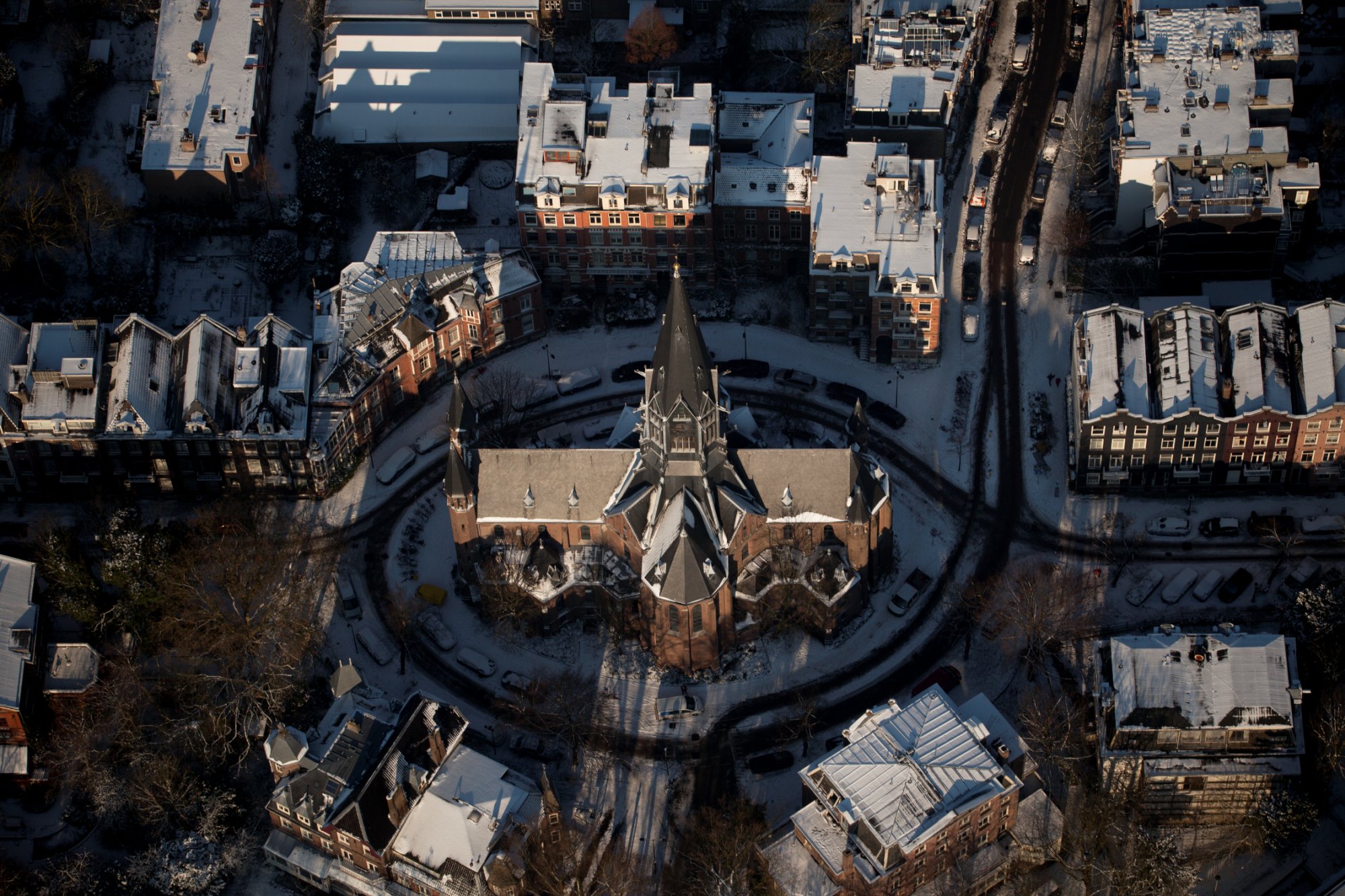
Vondelkerk
Around 12:50 on New Year's morning 2026, fireworks or embers - the exact cause was still being established - lit the tower of the Vondelkerk on Amsterdam's Vondelstraat. Within hours the spire fell, parts of the central nave collapsed, and water pumped out of the Vondelpark itself was being sprayed onto a building that had stood for one hundred and forty-five years. By dawn the church was a roofless shell, only the outer brick walls still upright. By the following day, surveyors had walked through the ruin and announced what nobody quite dared hope: it could be rebuilt. A crowdfunding campaign was launched within the week. This was not the first time the Vondelkerk had burned, and the city had answered the same question the same way before.
Cuypers's Octagon
Pierre Cuypers designed the Vondelkerk in the 1870s, in the middle of the working life that would also produce the Rijksmuseum and Amsterdam's Centraal Station. The building opened on 16 June 1880 as the Church of the Most Sacred Heart of Jesus - the first church in the world dedicated to that devotion. Cuypers gave it an unusual octagonal plan, drawing on medieval precedent but building it with thoroughly modern technique, including a steel ring construction inside the original tower. The brickwork was deliberately polychrome: dark and light red on the pillars, yellow fields in the vaults laced with green-and-white ribs. "A tower must be tall," Cuypers reportedly said. "A low tower is an abomination." His tower rose fifty metres above Vondelstraat. Stained glass set the four Evangelists into the windows. A shield depicting the heavenly Jerusalem hung in the centre of the vault.
1904: The Steel Ring Holds
In November 1904 the original tower caught fire and was lost. The rest of the church survived, and the reason it survived is buried in the engineering: Cuypers's steel ring at the tower's base failed in a way that let the spire collapse onto itself rather than into the building below. The reconstruction was designed by Pierre's son Joseph Cuypers. Donations came from across the city, including from people who were not Catholic. The tower came back. The Vondelkerk had absorbed the kind of catastrophe most buildings do not survive, and its life simply continued.
Decline and Squatters
By the late 1960s the parish was shrinking. On 23 October 1969 the Society of Dutch Literature held a controversial television broadcast inside the church to celebrate the writer Gerard Reve, who had just won the P. C. Hooft Award - Reve was openly gay and openly Catholic at a time when neither sat easily with the institutions of the Netherlands. The image of him under the polychrome vault, framed by Catholic iconography, helped define a cultural moment. Less than a decade later, in August 1978, the diocese closed the building for structural reasons. On 12 October 1979 the Diocese of Haarlem-Amsterdam sold the church to an investor for one symbolic guilder. Squatters moved in. For a few years the great Cuypers octagon hosted nothing official and almost everything unofficial.
Saved by a Foundation
The Stichting Vondelkerk was founded on 2 October 1980 specifically to save the building. In November 1984 the Foundation succeeded in buying it back. Ownership later passed to the Amsterdam Monuments Fund, which merged with the heritage organisation Stadsherstel Amsterdam in 1999. The church was restored, deconsecrated, and reinvented as a multifunctional venue - concerts in the central nave, offices in the surrounding rooms, weddings, lectures, the former choir and altar area awkwardly converted into a cloakroom. On any given evening you might walk in for a recital and stand under Cuypers's vault as it filled with sound. The cycle that had run since 1880 - dedication, fire, decline, rescue - had settled, by the early 21st century, into apparent equilibrium.
After the New Year's Fire
Then came New Year's Day 2026. The fire began in the tower, spread across the roof, and consumed almost everything that 1904 had spared. Residents nearby were evacuated. The Amsterdam Safety Region pumped water from the Vondelpark for hours. When the smoke cleared, the exterior walls were still standing - Cuypers's red brick mass had held its shape even as the interior fell out. The first surveyors who entered the ruin expected to recommend demolition. Instead they reported that a full reconstruction was technically possible, and Stadsherstel announced its intention to rebuild. A century and a quarter after the first fire, the same answer came back from the city: rebuild it. The tower will rise again.
From the Air
Coordinates 52.361 N, 4.874 E. The Vondelkerk sits on the northeastern edge of the Vondelpark in Amsterdam-Zuid, with Vondelstraat running along its south side. After the January 2026 fire the tower has been lost and the roof is gone, leaving only the polygonal brick footprint and standing exterior walls visible from the air. Vondelpark itself - long, green, kite-shaped - is the dominant landmark. Recommended viewing altitude 1000-2000 feet AGL. Nearest airport: Amsterdam Schiphol (EHAM) is roughly 8 km southwest. Low cloud and rain are routine in this stretch of the Dutch coast.