Vorbunker
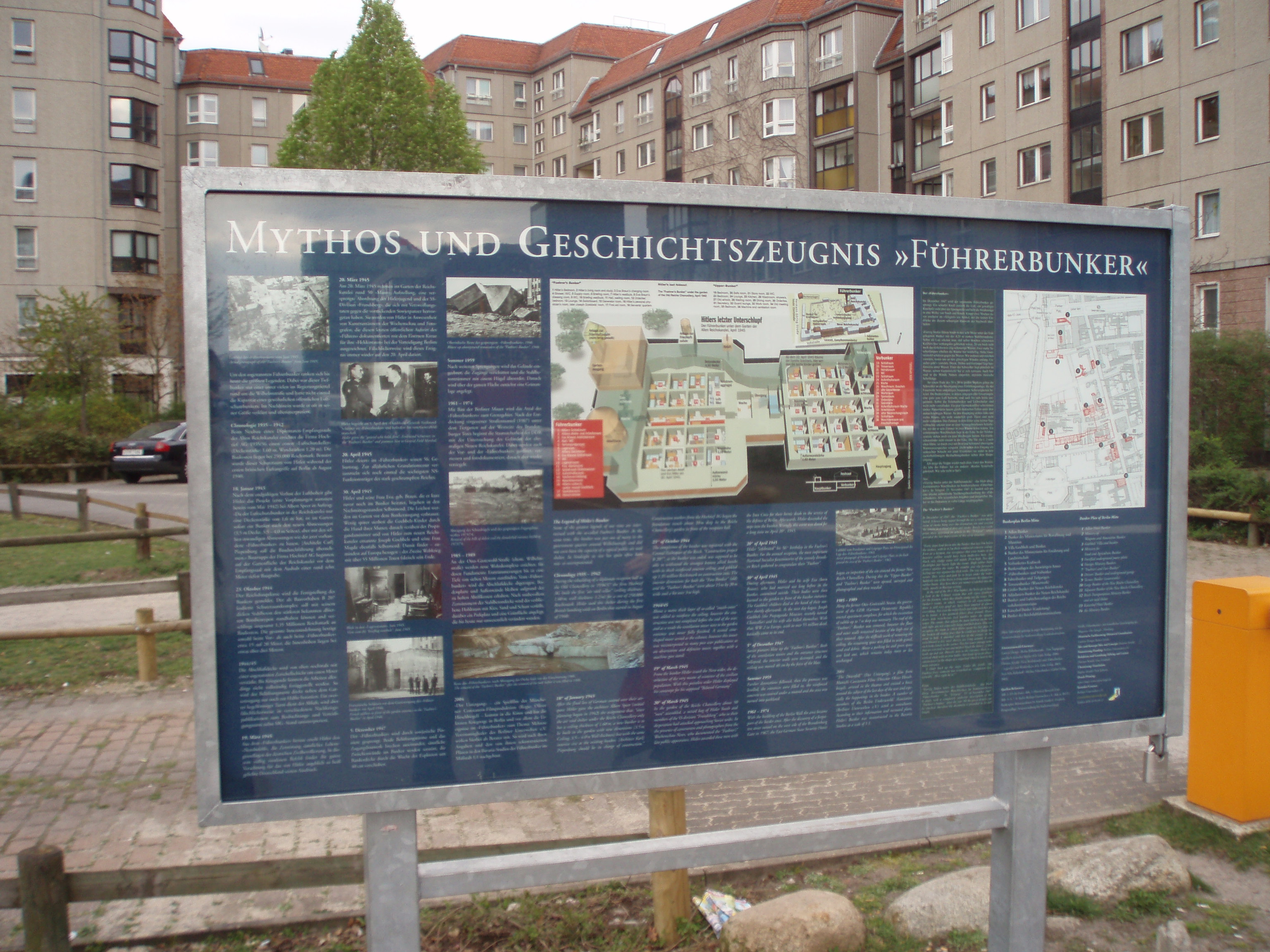
There is a small information board at the corner of In den Ministergärten and Gertrud-Kolmar-Straße, three minutes' walk from Potsdamer Platz. It was installed on 8 June 2006, in the run-up to the World Cup that summer, and it is the only marker that anything happened here. Below the asphalt and the apartment blocks lies what is left of the Vorbunker — the forward bunker — and a few meters deeper and to the southwest, the remnants of the Führerbunker. The German government wanted nothing here that could become a shrine. They very nearly succeeded.
The Reception Hall and the Cellar Beneath
In 1933, Adolf Hitler decided the Reich Chancellery was too small. On 21 July 1935, the architect Leonhard Gall submitted plans for a large reception hall — a ballroom — to be built onto the old Chancellery on Wilhelmstraße. What was unusual about the drawings was the cellar: a deep one, with another one-and-a-half meters of concrete dropping below it to a bunker. Construction was completed in 1936. The bunker had a 1.6-meter-thick roof, twice as thick as the bunker beneath the Air Ministry next door. It had three entrances, twelve rooms branching off a single corridor, and a name that was not yet famous: the Reich Chancellery Air-Raid Shelter. Almost a decade later it would be officially renamed the Vorbunker, the forward bunker, when the deeper Führerbunker was built one level below in 1944 by the Hochtief construction company.
January to April 1945
Hitler moved underground on 16 January 1945. The senior staff went with him — Martin Bormann, the secretaries, the personal physicians. By February the Führerbunker had been furnished with high-quality pieces and oil paintings looted from the Chancellery upstairs. Eva Braun arrived in March. Joseph Goebbels followed in April, occupying a room recently vacated by Hitler's quack physician Theodor Morell. Magda Goebbels and the six Goebbels children moved into the upper Vorbunker, where two rooms were converted to food storage and Hitler's personal dietitian Constanze Manziarly cooked from a small kitchen with a refrigerator and a wine store. Above ground, the Battle of Berlin was reducing the city to rubble. Below ground, the senior leadership of the Third Reich played cards, took dictation, and waited.
The Children
On the evening of 1 May 1945, the day after Hitler and Eva Braun killed themselves in the Führerbunker, Magda Goebbels arranged for an SS dentist named Helmut Kunz to inject her six children with morphine. Their names were Helga, Hildegard, Helmut, Holdine, Hedwig, and Heidrun. They ranged in age from four to twelve. Once they were unconscious, Magda Goebbels and SS-Obersturmbannführer Ludwig Stumpfegger crushed cyanide ampules in their mouths. Their bodies were found in their beds in the Vorbunker on 3 May, when Soviet troops searched the complex. The cyanide had left visible marks on their faces. Joseph and Magda Goebbels died upstairs, in the Chancellery garden, by means that have been described differently by different witnesses — gunshot, cyanide, or both. Their adjutant Günther Schwägermann doused the bodies with petrol and tried to burn them. The fire did not finish the job.
What Was Buried, What Was Built
The Soviets levelled the Chancellery between 1945 and 1949. The bunkers below survived. In December 1947 the Soviets tried to blow them up; only the separation walls were damaged. East Germany finished the demolition in stages — most aggressively during construction of residential buildings in 1988-89, when the bunker complex was systematically broken up and the rubble reburied. Photo-journalists were allowed in for a brief inspection in April 1988. They found old wine bottles on the floor of the Vorbunker kitchen and the broken frames of the bunk beds the Goebbels children had used. The water in the lower Führerbunker was still high; they could only descend to the mid-landing. After the inspections, the demolition continued. The emergency exit point for the Führerbunker, where the petrol-soaked bodies of Joseph and Magda Goebbels had been left, became a parking lot. The strategy was deliberate: build apartment blocks and street furniture over the site so it remained anonymous, unremarkable, unvisitable. For sixty years, the West kept it that way. The 2006 information board was the first compromise — enough to inform, not enough to commemorate. In Berlin, that distinction matters.
From the Air
The Vorbunker site sits at 52.51°N, 13.38°E in the Mitte district of Berlin, Germany, three minutes' walk from Potsdamer Platz. Above the buried bunker complex is a residential neighborhood of late-1980s apartment blocks; the only marker is a small information board at the corner of In den Ministergärten and Gertrud-Kolmar-Straße. The Brandenburg Gate is roughly 500 m to the north and the Holocaust Memorial 200 m to the northeast. Nearest airport is Berlin Brandenburg (EDDB), 18 km southeast. Recommended viewing altitude 1,500-3,000 ft to take in the layered geography of historical Berlin: the Tiergarten to the west, Unter den Linden to the north, the Spree to the east.