Voskhod 2
Alexei Leonov looked down and saw the Earth from the Straits of Gibraltar to the Caspian Sea. He was floating at the end of a 5.35-meter umbilical cord, 500 kilometers above the planet, the first human being ever to walk in open space. It was March 18, 1965, and everything about the Voskhod 2 mission had been improvised -- the inflatable airlock designed and built in nine months, the spacecraft so cramped that both cosmonauts could not reach their seats during reentry. What Soviet state media reported as a triumph of engineering was, behind the propaganda, a twelve-minute brush with death that nearly stranded Leonov in orbit with a suicide pill as his last option.
Twelve Minutes Outside
Liftoff from Baikonur occurred at 07:00 GMT. Ninety minutes later, at the end of the first orbit, Leonov depressurized the Volga inflatable airlock and opened the outer hatch. He pushed out over north-central Africa, somewhere above the border of Sudan and Egypt, tethered to the spacecraft by his umbilical. For twelve minutes and nine seconds, he drifted in the vacuum, the Earth turning slowly beneath him. The Berkut spacesuit worked. The umbilical held. The cameras -- two inside the airlock and one mounted on an exterior boom -- recorded the historic moment. Soviet state radio and television broadcast the spacewalk live, at least until things went wrong. Then the broadcasts stopped.
The Suit That Swelled
In the vacuum of space, Leonov's Berkut spacesuit ballooned. The internal pressure, no longer countered by atmospheric pressure, inflated the suit until it stiffened beyond the point where Leonov could bend his joints. He could not reach the shutter switch on his thigh for his chest-mounted camera. More critically, he could not fit back through the 65-centimeter-wide airlock hatch. Without telling mission control -- to avoid alarming anyone, he later explained -- Leonov bled pressure from his suit, dropping below safety limits and risking decompression sickness. He entered the airlock headfirst, violating procedure, then became wedged sideways when he turned to close the outer hatch. He reduced suit pressure further to free himself. Leonov later revealed he carried a suicide pill in case he could not reenter the spacecraft and Belyayev had to leave him behind.
A Landing Nobody Expected
The problems did not end with the airlock. The automatic landing system malfunctioned, forcing Belyayev to use the manual backup. The spacecraft was so small that both cosmonauts, still in their spacesuits, could not reach their seats for 46 seconds after orienting for reentry -- throwing off the center of mass and landing calculations. The orbital module failed to separate cleanly, sending the capsule into a wild spin until the modules finally disconnected at 100 kilometers altitude. The 46-second delay pushed the landing 386 kilometers from the intended zone, into the dense taiga forests of the Upper Kama Upland, west of Solikamsk. Flight controllers had no idea where the capsule had come down. The cosmonauts' families were told they were resting after recovery -- a lie that held for hours.
Two Nights in the Taiga
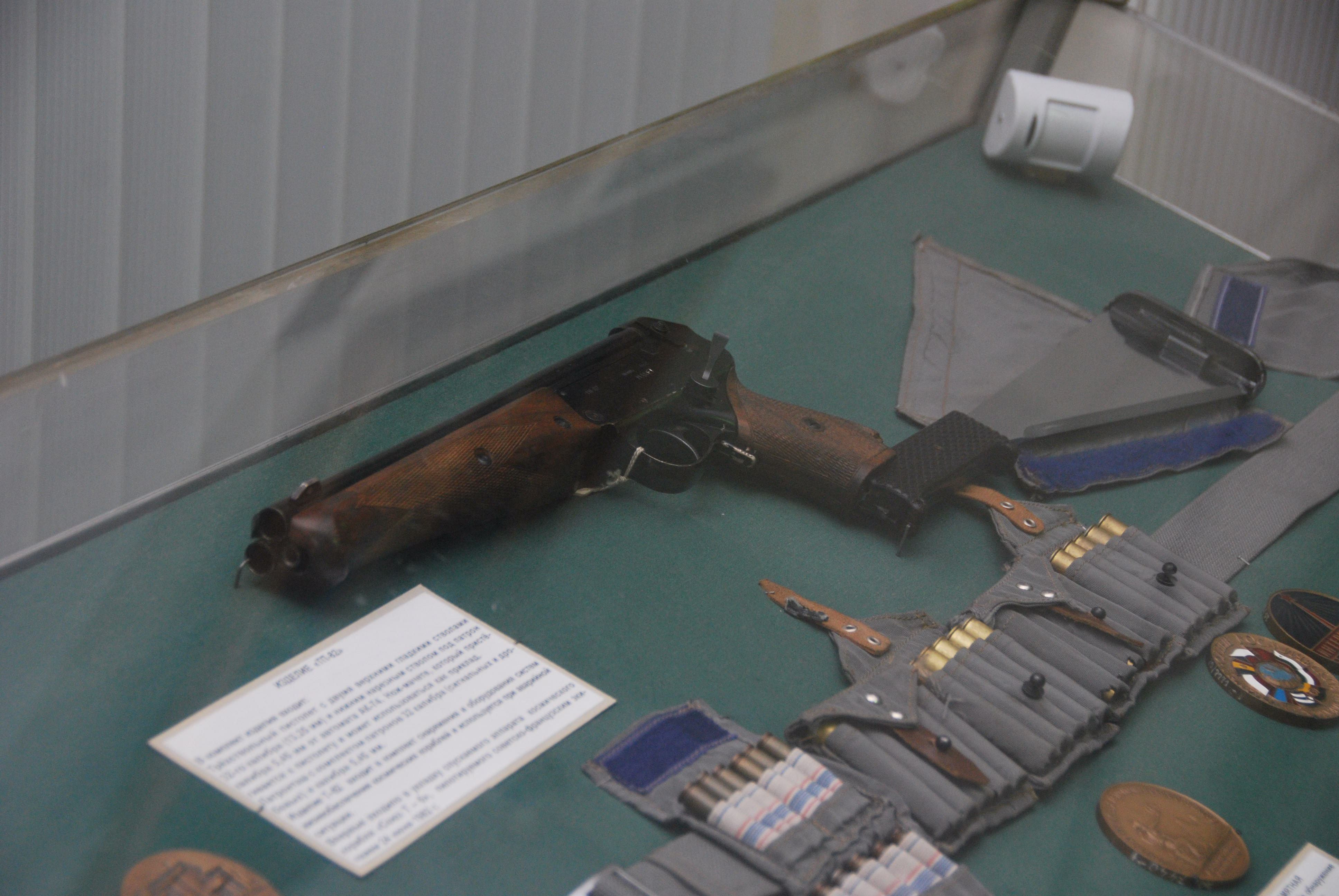
A helicopter spotted the capsule about four hours after touchdown, but the forest was too dense to land. The hatch had been blown open by explosive bolts, and the heating system had failed while the fans ran at full blast. Warm clothes and supplies were dropped from the air. That first night, temperatures plunged below minus 20 degrees Celsius. Both cosmonauts knew that bears and wolves, aggressive during mating season, lived in the taiga around them. They had a pistol and ammunition -- the incident would later drive development of the TP-82 cosmonaut survival pistol. A rescue party arrived on skis the next day, too cautious to attempt a helicopter airlift from such dense forest. The advance team chopped wood, built a log cabin, and lit an enormous fire. After a second night -- considerably more comfortable than the first -- Leonov and Belyayev skied nine kilometers to a helicopter clearing and flew to Perm, then on to Baikonur for debriefing. Today, a plaque marks the landing site, reached by a 400-meter wooden walkway built by volunteers through the forest.
From the Air
Landing site located at approximately 59.567N, 55.467E in the Upper Kama Upland of Perm Krai, about 75 km from the city of Perm, west of Solikamsk. This is dense taiga forest in the western Ural foothills. Nearest significant airport is Perm International (USPP). The landing site is marked by a plaque accessible via a 400-meter wooden walkway. From altitude, the area is characterized by unbroken boreal forest with no significant clearings -- exactly the problem the rescue teams faced in 1965.