Ovre Dividal National Park
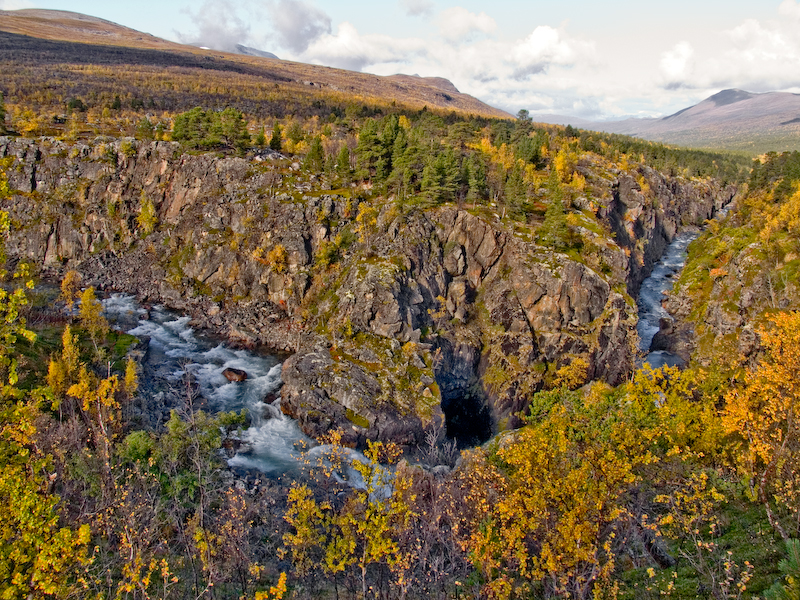
The Sami word dievva means a round, dry hill -- and dry is the defining fact of Dividalen. At 228 meters above sea level, this valley in Troms county receives just 282 millimeters of precipitation annually, making it the second-driest valley in Norway. That aridity shapes everything: the sparse pine forests at the valley floor, the mountain birch clinging to the slopes above, the open alpine tundra where Arctic rhododendron blooms purple against grey rock. Ovre Dividal National Park protects 750 square kilometers of this landscape, established in 1971 to preserve what the Norwegian government described as a largely undisturbed inland valley and mountain area. It has stayed that way.
A Valley of Predators
Few places in Scandinavia can claim all four of mainland Norway's large predators within their borders. Ovre Dividal can. Brown bear, wolf, wolverine, and lynx all inhabit the park, though wolf is rare and likely has no permanent population. The wolverine is the standout -- especially numerous here, thriving in the rugged terrain between the birch line and the alpine zone. Sami-owned reindeer move through the park in seasonal patterns that predate the national boundary, and moose browse the lower valleys. The Arctic fox once lived here too, though its presence has diminished as climate change pushes the red fox into higher elevations. What makes the predator population notable is not any single species but the completeness of the assemblage: this is one of the last places in Norway where the full suite of native large carnivores still overlaps.
From Pine to Permafrost
The park rises from roughly 300 meters at its lowest to 1,600 meters at its peaks, and every hundred meters of elevation changes the character of the land. Pine forests dominate the valley floor, where grey alder lines the banks of the Divi River. Higher up, mountain birch takes over -- stunted, wind-shaped trees that mark the transition between forest and open ground. Above the treeline, willow and dwarf birch give way to alpine tundra where 315 recorded plant species include Arctic rhododendron, Rhododendron lapponicum, blooming naturally in conditions that would kill most garden varieties. Below 700 meters, the ground thaws each summer. Above that line, permafrost grips the soil year-round, and the mean annual temperature across the park hovers at just 0.8 degrees Celsius. January averages are bitterly cold; July offers a brief 13-degree window for growth.
Stones Out of Place
The bedrock beneath Ovre Dividal is conglomerate, sandstone, and slate -- unremarkable in itself. What catches the eye are the boulders. Scattered across the landscape at seemingly random locations, these glacial erratics were carried by ice-age glaciers and abandoned when the ice retreated. Some sit perched on ridgelines where no natural process except glacial transport could have placed them. Rivers have carved ravines through the softer rock, creating corridors that concentrate wildlife movement and channel hikers along the Nordkalottruta, the long-distance trail that crosses the park on its way between Norway, Sweden, and Finland. The geology is quiet here -- no volcanic drama, no tectonic spectacle -- but it tells the story of the last ice age with unusual clarity, each misplaced boulder a footnote from a landscape written in ice.
A Wilderness Without Borders
Ovre Dividal does not end at its boundary markers. Together with adjacent protected areas in Sweden and nearly undisturbed lands along the Norwegian-Swedish border, the park forms part of a larger wilderness corridor that stretches across the Scandinavian interior. This cross-border expanse is critical for species like wolverine and bear that range widely and do not recognize national boundaries. The Nordkalottruta trail, which passes through the park, connects hikers to this larger system -- a route that can carry a walker from the Norwegian coast through the mountains and into Swedish Lapland without ever crossing a road. For a valley that receives less rain than many deserts, Ovre Dividal sustains a surprising density of life. The answer lies in snowmelt and geography: what little precipitation falls often comes as snow, lingering into late spring and feeding the rivers that keep the valley green through the brief Arctic summer.
From the Air
Located at 68.63N, 19.87E in Troms county, northern Norway, well above the Arctic Circle. The park spans from 300m to 1600m elevation, with the valley floor visible as a narrow green corridor between barren alpine slopes. The Divi River runs through the center. The Norwegian-Swedish border forms the park's eastern boundary. Nearest airport is Bardufoss (ENDU), approximately 40 km to the southwest. The E6 highway runs along the coast to the west. The landscape transitions from dense boreal forest in the valleys to treeless tundra above. Snow cover persists from October through May at higher elevations.