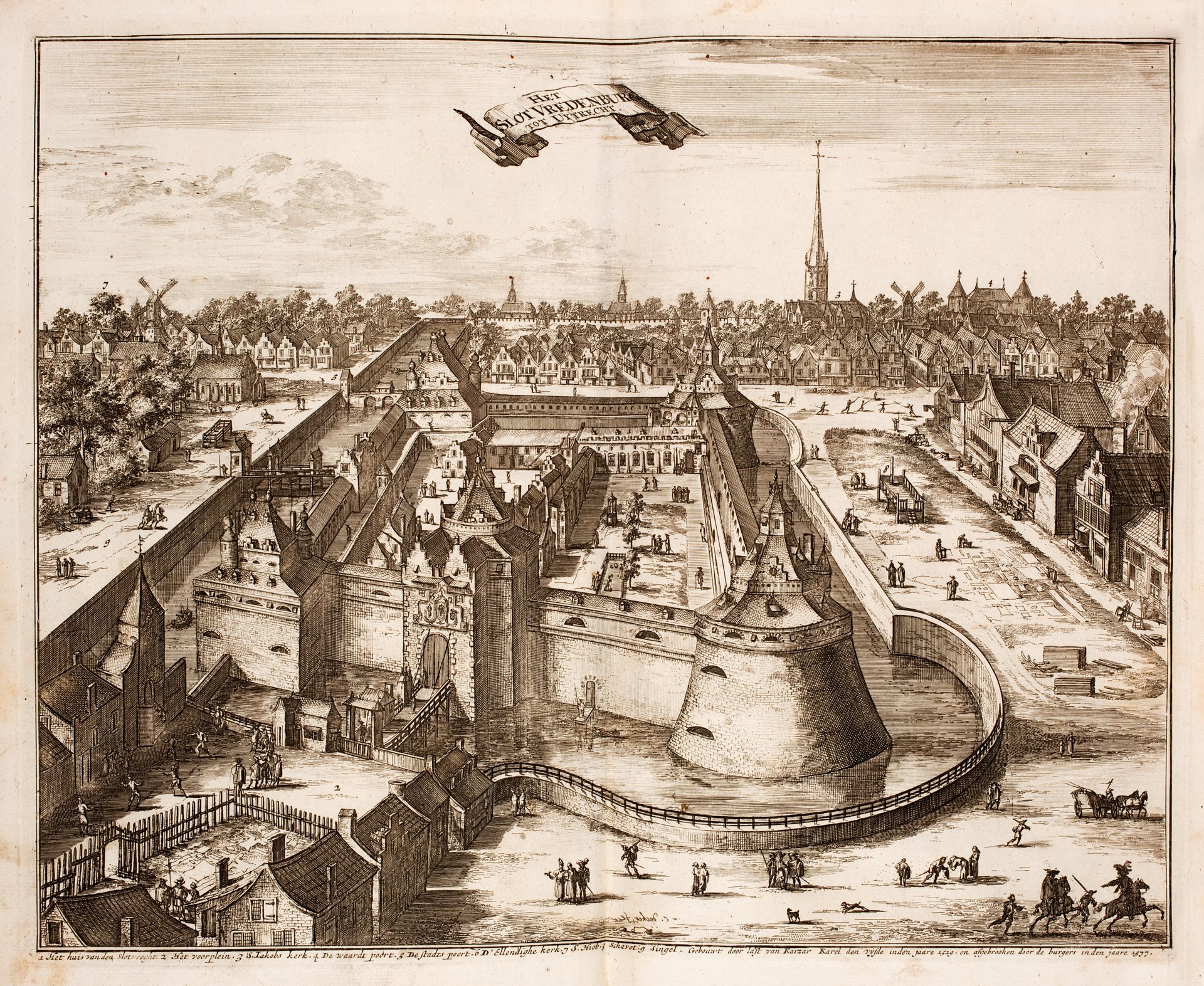
Vredenburg Castle
If you stand today in Utrecht's Vredenburg square, near the curving glass of the Hoog Catharijne shopping centre, the pavement underfoot tells you something. Pale stones trace the outline of bastions and curtain walls that have not stood in four hundred years. This is the footprint of a castle that lasted exactly half a century — a Habsburg fist clenched in the heart of Utrecht, and the only fortress in Dutch history whose demolition began, by legend, with a delegation of women.
Charles V's Iron Grip
In 1528, the Holy Roman Empire formally absorbed the old Prince-Bishopric of Utrecht. Emperor Charles V was a man who understood instruments of control, and he wasted no time. He ordered a castle built — not a fortress on the city's edge as a watchful neighbor, but a fortress *inside* the walls, dominating the streets, its cannons turned both outward against the Duke of Guelders and inward against Utrecht's notoriously unruly citizens. He gave it the name Vredenburg, *Castle of Peace*, with the dry humour of a sovereign who knows that peace is what subjects feel when they cannot fight back. Construction began in 1529 under the architect Rombout II Keldermans. By 1532 it was done: four corner bastions of brick and stone, thick walls, a moat fed by Utrecht's own canals. The cannons sat on their carriages and waited.
The Pacification and the Siege
For half a century Vredenburg did exactly what Charles had meant it to do. Then politics shifted faster than masonry. On 8 November 1576, the States General of the Seventeen Provinces signed the Pacification of Ghent, an agreement to expel the hated Spanish occupying soldiers. The garrison inside Vredenburg — Spanish troops under Francesco Fernando d'Avila — read the news and prepared to fight. They swung the cannons that had been pointed at foreign enemies and aimed them at the city outside their gate. By December, citizens were besieging their own castle. Bullets crossed the moat in both directions. The siege ground on through midwinter until 11 February 1577, when negotiations between d'Avila and Maximilien de Hénin-Liétard, the count of Bossu, ended in a quiet handover. The Spanish marched out the next day, part of a general Spanish withdrawal ordered by the new Governor-General Don Juan. Vredenburg, briefly, belonged to Utrecht.
Trijn van Leemput, with a Crowbar
And here Utrecht faced a question. The castle was empty. It was, in any practical sense, the most dangerous building in the city — because the Spanish could come back, or some other foreign power could occupy it. The citizens wanted it gone. The city government, prudent and cautious, wanted it preserved: tearing down imperial property was the kind of insult that brought armies back. So on 2 May 1577, the people of Utrecht took the question out of their government's hands. According to a legend that has hardened into folk-history, a group of women led by Trijn van Leemput marched on the castle. Trijn climbed the wall, pulled the first brick from its mortar, and gave the signal. Whether the story is literally true historians debate; that the demolition began as a popular act, not a state decision, is not in doubt. A statue of Trijn van Leemput, pick-axe in hand, was erected in Utrecht in 1955 — a long-delayed civic salute to a woman who may or may not have been there, but who stands for everyone who was.
What Stones Remember
Pulling down a brick fortress turns out to be slow work. Demolition continued until 1581. The two western towers were spared because they served double duty as part of the outer city walls — but the centuries chewed at them anyway, and by 1919 the last stone had gone. Vredenburg became a memory and then a square. Then, in 1976 and 1978, archaeologists dug down through the pavement and met the castle again: massive foundations, the curve of a bastion, vaulted cellars under what is now a tram stop. Today those foundations sit just below the surface of one of Utrecht's busiest public spaces. Walk across Vredenburg square on a market day, between flower stalls and cheese vendors and the espresso machines hissing in the cafés, and you are walking on the buried walls of the *Vredeborch* — the Peace-castle that was never about peace, demolished by a city that finally got to choose.
From the Air
Vredenburg square sits at the western edge of Utrecht's historic core, at 52.09°N, 5.11°E. From altitude the square reads as a paved gap between the medieval canal ring and the modern roof-slab of the Hoog Catharijne complex; the Dom Tower stands a few hundred meters southeast as a 112-meter reference point. Pale paving stones on the square trace the castle's outline for anyone walking through. Nearest airfield Hilversum (EHHV); Schiphol (EHAM) lies northwest.