Vrije Universiteit Amsterdam
Imagine the green collecting box. About the size of a small lunch pail, painted in the unmistakable VU green, carried door to door across the Calvinist neighbourhoods of the Netherlands by, at one count, ten thousand mostly female fundraisers. Into the slot at the top went small coins from more than 200,000 private contributors. Out of that quiet, decade-after-decade rattle of coppers and dimes came the operating budget of an entire university. The Vrije Universiteit Amsterdam was founded in 1880 by Abraham Kuyper as the first Protestant university in the Netherlands, deliberately built outside both government control and church control. The name means Free University, with the freedom understood in both directions. For nearly a hundred years, Dutch Calvinists paid for it themselves, in a kind of grassroots tithe that no Dutch institution has matched before or since.
Abraham Kuyper Starts a University
Kuyper was a theologian, journalist, politician, and eventually prime minister of the Netherlands from 1901 to 1905. His worldview, now called Neo-Calvinism, held that every domain of life - science, art, politics, education - should be pursued under God's sovereignty without state or church mediation. The Vrije Universiteit opened on 20 October 1880 in a few rented rooms in the Scottish Missionary Church on the Amstel, the building now occupied by the Kleine Komedie theatre. Kuyper and four other professors began lectures in three faculties: theology, law, and the arts. Kuyper was the first rector magnificus and chose the official seal himself: a Virgin in a Garden, pointing toward God, intended as a reference to the Reformation. In 1990, exactly 110 years later, the university adopted a mythical griffin as its common emblem - a logo for an institution that had grown up around its founder's metaphor and was now ready, gently, to update it.
The Calvinist Crowdfunding Years
Public Dutch universities are funded by the state. The VU was not. The VU Association, the lay organisation Kuyper founded alongside the university, raised the money. By the end of the 1960s the association had more than 200,000 individual contributors, many of them giving small change collected at the door. The green collecting box became a fixture in Reformed homes. The fundraisers, mostly women, walked their assigned streets month after month, year after year. They built a science faculty in 1930, a medical faculty in 1950, and bought building after building in central Amsterdam: the first acquisition was Keizersgracht 162 in 1884, picked up because the rented chapel had become too small. The university lectured in those scattered canal houses for nearly a century. By 1905 the VU had won the legal right to award degrees on the same basis as state universities. The collecting boxes kept rattling all the same.
Letting the World In
By the late 1960s the model had run out of room. To strengthen research the university applied for parity public funding, which the Dutch constitution guaranteed. The price was that the VU could no longer restrict its faculty and students to Protestants. Non-Protestant professors and students were admitted; the green collecting boxes faded, the doors stopped being knocked on. Student numbers exploded - from a small, distinctively confessional institution to a broad research university with 25,000 students by 2011. Between 1968 and the 1970s the entire campus moved out of the centre to the new Buitenveldert site on De Boelelaan, then a fairly isolated location surrounded by fields. By the end of the 1970s the VU had become unrecognisable to anyone who had carried a green box in 1955. The name kept its old meaning, but the institution it described had stepped sideways into the modern Dutch university system.
Buitenveldert and the Red Potato
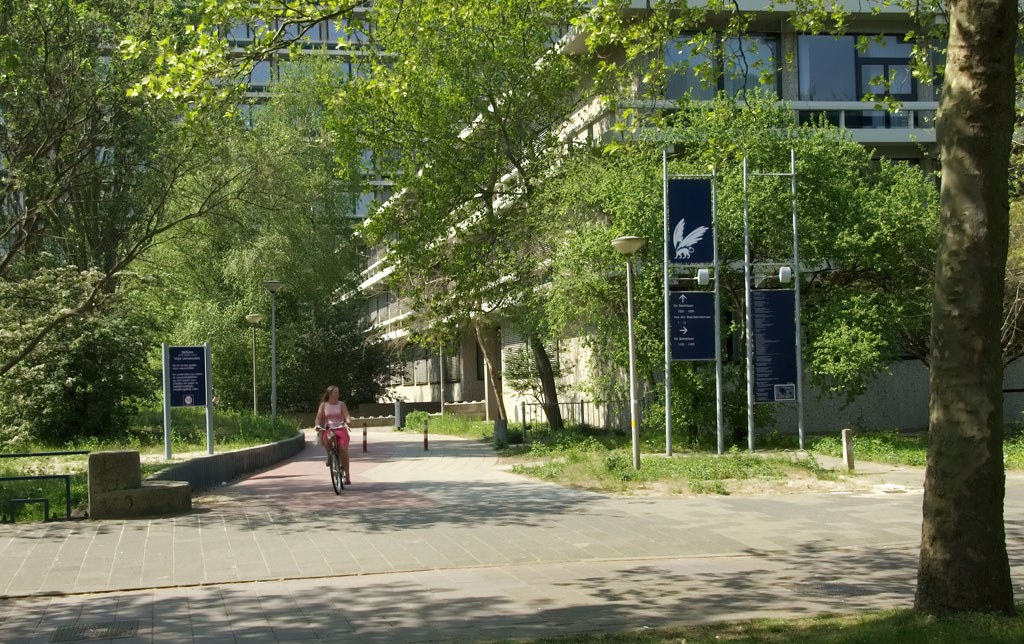
The main building on De Boelelaan opened in 1973 - a sixteen-storey slab in the modernist taste of the time, renovated in the early 2010s. It houses the faculties of Arts, Social Sciences, Philosophy, Economics and Business, and Theology, with the library on five floors and the closed stacks in the basement. To the south the Sciences Building, another 1970s box, holds the faculties of Sciences and Earth and Life Sciences. In the middle of campus square sits The Basket, the student bar, beside volleyball courts. The newest buildings show the change in architectural mood: the arch-shaped Initium Building, opened in 2010 to house the Faculty of Law, and the Institute for Health and Wellness, nicknamed the Red Potato for its colour and shape. The Buitenveldert campus is now sandwiched against the modern Zuidas business district, with its banks and law firms. Tram line 5, tram 24, and the metro all stop within walking distance. Amsterdam Zuid station is a few minutes' walk away.
What 'Free' Means Now
The VU runs more than 130 master's programmes in English. Bachelor's programmes in English include Liberal Arts and Sciences at Amsterdam University College, jointly run with the UvA. A Bachelor in History and International Studies launched in 2018. The university is part of the VU-VUmc Foundation along with the Amsterdam UMC medical centre on the western edge of campus. The 2023 Times Higher Education ranked it 121st globally; in Communications subjects the Shanghai ranking put it 12th in the world; in Psychology, 22nd. Notable alumni include Jan Peter Balkenende, four-time prime minister of the Netherlands, who studied history and law; Werner Vogels, CTO of Amazon, who took his computer science PhD here; and the comedy team Lebbis en Jansen. Across the road from the modern campus, the medical faculty continues research that ranges from social epidemiology to the molecular work of the Amsterdam Institute of Molecules, Medicines and Systems. The institution Kuyper built with copper coins is now a research university worth around 798 million euros a year. The word Vrije remains, even if no one inside the modern campus still carries a green box.
From the Air
The Vrije Universiteit Amsterdam main campus sits at 52.334 N, 4.864 E, on De Boelelaan in the Buitenveldert district of Amsterdam-Zuid, immediately east of the Zuidas business district. From the air the campus is identifiable as a tight cluster of 1970s mid-rises around an inner square, set between Amsterdam Zuid railway station to the north and the Amstelpark to the southeast. The Amsterdam UMC location VUmc occupies the western end of the campus. The satellite campus Uilenstede lies further south in Amstelveen, near tram 25. Nearest airport is Amsterdam Schiphol (EHAM), 8 km southwest; the campus sits directly under the Buitenveldertbaan approach corridor and is overflown frequently at 1,500-3,000 feet.