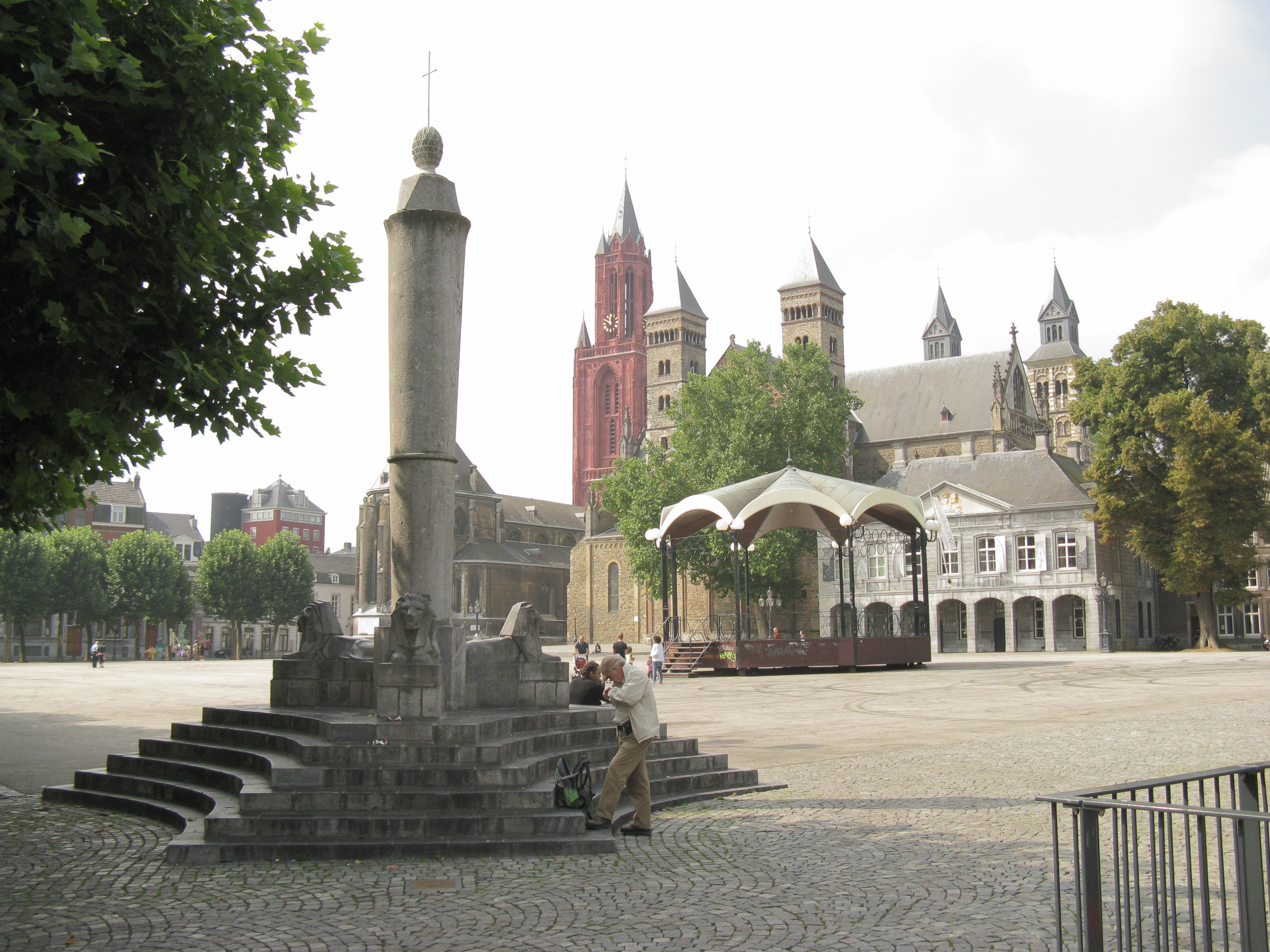
Vrijthof
Dig anywhere on Vrijthof and you will hit graves. Roman ones, then Merovingian ones layered on top, then medieval canons, then the Cemetery of the Poor, then the construction crews of the 1969 parking garage who had to halt and let the archaeologists work, then more crews in 2003 when the same garage had to be rebuilt because the first one was failing, and again the archaeologists came in and this time they found thirteen layers of the Roman road, the Via Belgica, that had run from Boulogne-sur-Mer at the English Channel all the way to Cologne on the Rhine. The square has been many things on the surface, but what it has always been, underneath, is a place where Maastricht buried what it used to be.
The Swine and the Anabaptists
In 1485 William I de La Marck, known as the Swine of the Ardennes, was beheaded in Vrijthof. He had murdered a prince-bishop and gone to war against half the local aristocracy. In 1535, fifteen Anabaptists were burned at the stake in the same square. For centuries, executions happened here because the square was a condominium, jointly ruled by the prince-bishop of Liege and the duke of Brabant, and each ruler installed his own symbol of jurisdiction at opposite corners: a perron column in the northeast for the bishop, a scaffold in the northwest for the duke. The duke's symbol of authority was an execution platform. That tells you a great deal about how the Middle Ages thought about cities and how they thought about justice. The original perron was demolished by French revolutionary troops in 1795. The one standing there now is a 1950s design by Jean Sondeyker and Jean Huysmans, set in the same northeast corner, a quiet replacement for a stone that watched eight hundred years of public life.
The Seven-Year Crowd
Every seven years, the Heiligdomsvaart begins. The Pilgrimage of the Relics. The walls and gates that once enclosed Vrijthof would be removed for the duration to handle the crowds. Tens of thousands of pilgrims would gather around the apse of the Basilica of Saint Servatius, looking up at the dwarf gallery, where the relics of Servatius and other saints were displayed for viewing. The Fountain of Saint Servatius stood in the center of the square, fed by a spring in the valley of the Jeker that pilgrims also visited. This still happens. The next procession will end at Vrijthof again, watched from a spectator stand, the medieval choreography substantially intact. In between pilgrimage years, the square has its other roles: ice rink and Christmas market in winter, central stage for Maastricht's street carnival, polo field during the TEFAF art fair, funfair around 13 May for the Feast of Saint Servatius.
Andre Rieu's Backyard
Andre Rieu was born in Maastricht. Every July and August, he and his Johann Strauss Orchestra perform open-air concerts in Vrijthof, an event that draws fans from across Europe and beyond and turns the square into one of the largest classical music venues on the continent. Audiences in the tens of thousands sit at long tables across the cobblestones, drinking wine while waltzes rise toward the floodlit basilica towers. It is the kind of thing that should feel staged, but the setting does the work. The Basilica of Saint Servatius and the Sint-Janskerk loom at the south end. The neoclassical General's House, now repurposed as the entrance to the Theater aan het Vrijthof, anchors the east. In den Ouden Vogelstruys, reportedly the oldest cafe in Maastricht, has been pouring beer on the corner of Platielstraat since 1730. The waltzes are new. Almost everything else has been here for a very long time.
Old Hickory, Always
On the square is a memorial plaque to the 30th Infantry Division of the US Army, the Old Hickory Division, which liberated Maastricht in September 1944. Frans Gast designed the plaque, installed in 1974. Nearby is his fountain Hawt uuch vas, which translates from the Maastricht dialect as Hold on tight, and a group of statues by Han van Wetering called 't Zaat Herremenieke, the Drunk Brass Band, a small monument to local musical chaos. The square these works inhabit was Place des Armes during the French occupation from 1794 to 1814, parade ground for the garrison in the seventeenth and eighteenth centuries, almshouses and a chapel for the destitute in earlier centuries, and a private semi-enclosed space of the Saint Servatius chapter before that. The transition into the public main square of the city only really happened in the nineteenth century. For a place that has been continuously inhabited since the Romans, becoming the heart of the town is its newest job.
From the Air
Coordinates 50.8492 N, 5.6884 E, in the historic core of Maastricht, Netherlands. Recommended viewing altitude 2,000 to 4,000 ft AGL for the full square and basilica complex. The twin towers of Sint-Servaasbasiliek and the slender spire of Sint-Janskerk together form the most distinctive city silhouette. Nearest airport is Maastricht Aachen Airport (EHBK / MST), about 10 km north.