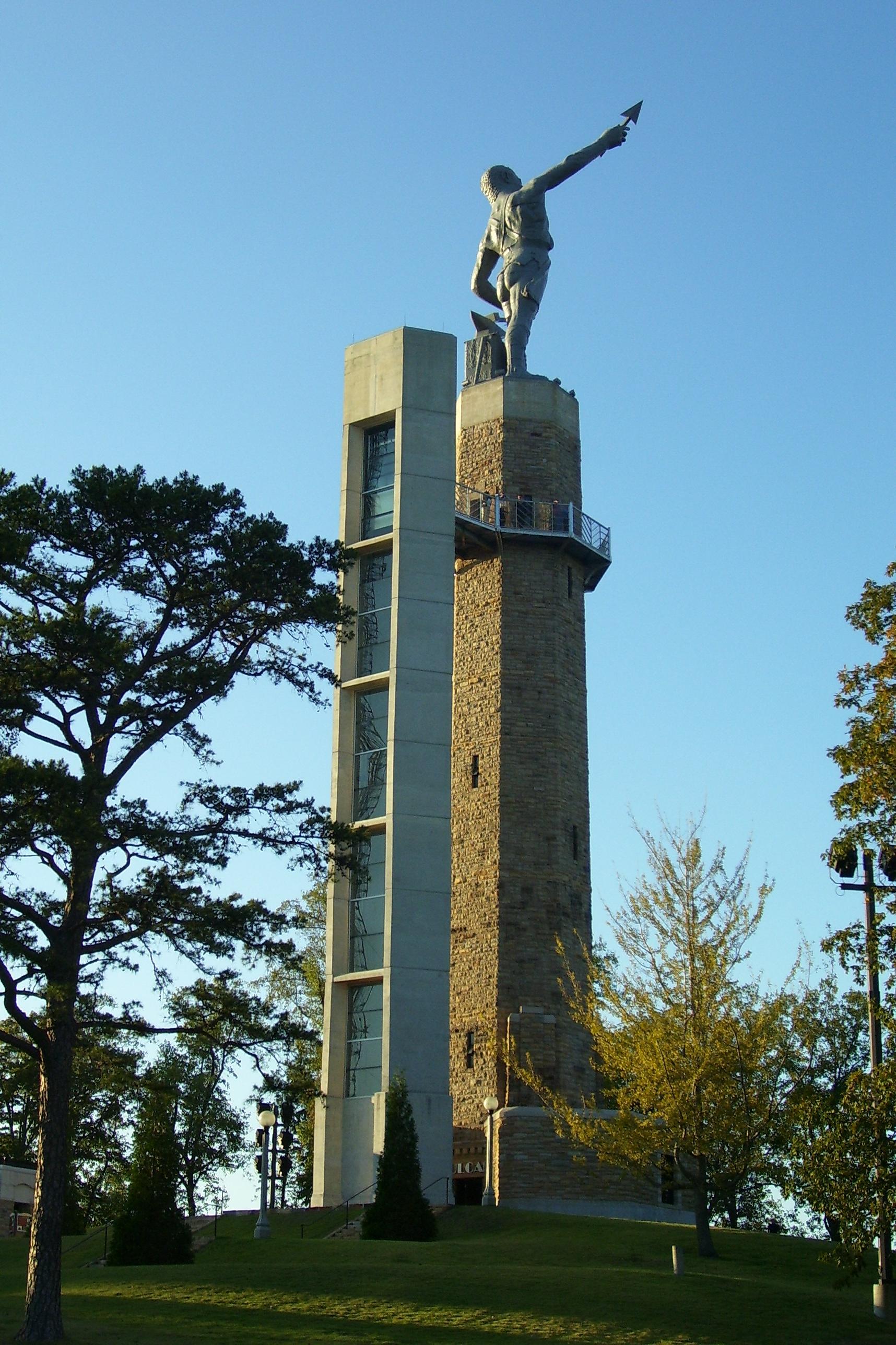
Vulcan Statue
On Red Mountain, overlooking the city built on iron ore, stands the Roman god of fire and forge. Birmingham's Vulcan is the largest cast iron statue in the world - 56 feet tall, weighing 101,000 pounds, holding a spear (originally a pickaxe, sometimes an ice cream cone, briefly a Coca-Cola bottle). Created for the 1904 World's Fair in St. Louis to promote Birmingham's iron industry, Vulcan has stood watch over the city since 1936. The statue embodies Birmingham's identity: born from industry, forged from the ore in the ground beneath it, presiding over a city that was America's iron and steel capital. Vulcan holds no shield - he's a worker, not a warrior - his arm raised to the sky, Birmingham's patron saint of manufacturing.
The Creation
Vulcan was designed by Italian sculptor Giuseppe Moretti and cast in Birmingham by the Birmingham Steel and Iron Company in 1903-1904. The statue was created specifically for the 1904 Louisiana Purchase Exposition (World's Fair) in St. Louis, where Birmingham hoped to showcase its iron industry. The statue was cast in sections - over 20 major pieces - from Birmingham iron. Assembled in St. Louis, Vulcan won the Grand Prize for metals and mining at the fair. After the exposition, the statue was disassembled and shipped back to Birmingham, where it languished in pieces at the state fairgrounds for decades before finding its permanent home.
The Travels
After the World's Fair, Vulcan had an undignified few decades. The statue was reassembled at the Alabama State Fairgrounds, but incorrectly - he faced the wrong direction, and his spear was replaced with an ice cream cone (promoting the fair's ice cream vendor) and later a Coca-Cola bottle. He stood amid carnival rides and livestock exhibits. In 1936, Birmingham finally gave Vulcan a proper home on Red Mountain, erected on a 124-foot pedestal with an observation deck. The spear returned. But years of exposure and improper assembly had damaged the statue; by the 1990s, Vulcan was deteriorating dangerously.
The Restoration
By 1999, Vulcan's condition was critical - cracks in the iron, structural instability, and years of weather damage threatened the statue's survival. Birmingham launched an $14 million restoration project. Vulcan was disassembled piece by piece, each section repaired, cracks welded, surfaces treated. The restoration revealed original details obscured by decades of paint. The statue was reassembled correctly for the first time since 1904. The pedestal was rebuilt, the park redesigned, and a new museum added. Vulcan reopened in 2004, exactly 100 years after his World's Fair debut, finally receiving the treatment Birmingham's symbol deserved.
The Symbol
Vulcan represents Birmingham's industrial identity. The city was founded in 1871 at the intersection of iron ore, coal, and limestone - the three ingredients for making iron. Birmingham became the 'Pittsburgh of the South,' its economy built on steel mills and foundries. The iron in Vulcan came from local ore; the god of the forge was literally made from Birmingham's earth. As industry declined in the late 20th century, Vulcan became nostalgic - a reminder of what Birmingham once made. Today he's a tourist attraction, but also an identity marker: Birmingham was built by working people who made things from fire and metal.
Visiting Vulcan Park
Vulcan Park and Museum is located at 1701 Valley View Drive in Birmingham, Alabama, atop Red Mountain. The park is open daily; admission is charged. The observation deck inside Vulcan's pedestal offers 360-degree views of Birmingham. The museum tells the story of Birmingham's iron industry and Vulcan's history. The park grounds include walking trails and overlooks. Downtown Birmingham is visible below. The park is 3 miles south of downtown via US-31. Birmingham-Shuttlesworth International Airport is 6 miles northeast. Allow 1-2 hours for the museum, observation deck, and grounds. Evening visits offer city lights; the statue is illuminated at night.
From the Air
Located at 33.49°N, 86.80°W on Red Mountain in Birmingham, Alabama. From altitude, Vulcan is visible as a statue atop a tall pedestal on the mountain ridge overlooking Birmingham. The figure is distinctive - arm raised, facing the city. Downtown Birmingham spreads below to the north. The Birmingham-Shuttlesworth International Airport is northeast. The surrounding terrain is the Birmingham metropolitan area - Red Mountain forms a ridge separating the city from suburbs to the south. The industrial history that Vulcan represents is visible in the landscape - former mill sites, railyards, and the iron ore ridge of Red Mountain itself.