Vulture Mine: Arizona's Wickedest Town
The hanging tree still has rope marks. In Vulture City, Arizona's richest gold mine town, justice came from an ironwood tree where at least eighteen men were hanged for high-grading - stealing ore from the mine. The Vulture Mine, discovered in 1863, produced over $200 million in gold and silver, built a city of 5,000, and earned a reputation as the wickedest town in Arizona Territory. Miners stole ore constantly; lynching was the standard response. When the gold played out in the 1940s, the town died. But the mine remains, the hanging tree remains, the buildings slowly collapse into the desert. Vulture City is Arizona's best-preserved ghost town - emphasis on ghost.
The Discovery
Henry Wickenburg found gold in 1863 while prospecting in the Arizona desert. The legend says he followed vultures circling over a quartz outcrop - hence Vulture Mine. The reality was probably less cinematic but equally lucky: Wickenburg stumbled onto one of Arizona's richest ore bodies. He lacked capital to develop the mine, selling shares and eventually losing control entirely. The mine changed hands repeatedly, each owner extracting more gold and more chaos from the desert. Wickenburg himself died poor, possibly by suicide, while his discovery made others fantastically wealthy.
The Town
Vulture City grew to 5,000 residents at its peak - larger than Phoenix at the time. The town had everything a mining camp needed: saloons, brothels, a company store, housing ranging from adobe to canvas tents. What it lacked was law. The mine owners enforced their own rules, the primary rule being don't steal ore. High-grading - workers concealing ore in clothing, lunch pails, body cavities - was epidemic and punishable by death. The ironwood tree near the mine became the execution site, its branches sagging with the weight of rough justice. Eighteen confirmed hangings; the real number was probably higher.
The Ore
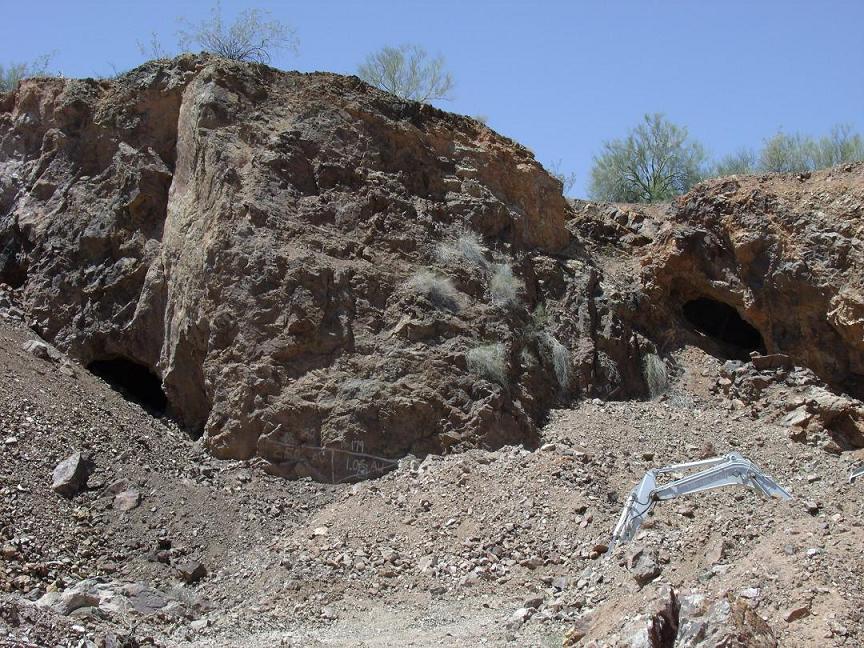
The Vulture Mine produced staggering wealth: estimates range from $200 million to $400 million in gold and silver at historical prices. The ore body was relatively easy to extract - surface mining gave way to shafts and tunnels, but the gold remained accessible. The challenge was keeping it. Every method of theft was attempted; the hanging tree proved an imperfect deterrent. The mine operated almost continuously from 1863 to 1942, when wartime labor shortages and declining ore grades forced closure. Underground workings extend 2,500 feet below surface; the tunnels contain an estimated $50 million in remaining gold, uneconomical to extract at current prices.
The Ghosts
Vulture City's ghost stories are as numerous as its hangings. Visitors report figures in period clothing, disembodied voices, cold spots in desert heat. The hanging tree radiates particular menace - photographs sometimes show anomalies, and sensitives claim to feel the hanged men's terror. Skeptics attribute the experiences to desert isolation, heat, and power of suggestion. Believers counter that eighteen violent deaths in one location should produce exactly this type of residue. The ghost tours are popular; the experiences are personal. What's certain is that Vulture City feels haunted, whether by spirits or by its own violent history.
Visiting Vulture Mine
Vulture City is located 12 miles southwest of Wickenburg, Arizona, roughly 60 miles northwest of Phoenix via US-60. The site operates as a private attraction with guided tours and self-guided walking access. The hanging tree, assay office, blacksmith shop, and numerous collapsed structures remain. Mine tunnels are visible but not accessible to visitors. Ghost tours run on selected evenings. Photography is encouraged; the decaying buildings against desert backdrop create compelling images. The site is hot in summer - visit fall through spring. Wickenburg offers services and additional Old West attractions. The drive from Phoenix passes through classic Sonoran Desert, the vultures still circling overhead.
From the Air
Located at 33.82°N, 112.83°W in the Sonoran Desert, roughly 12 miles southwest of Wickenburg and 60 miles northwest of Phoenix. From altitude, Vulture City appears as a cluster of decaying structures in otherwise empty desert - the town's isolation is immediately apparent. The Vulture Mountains rise to the south; the desert flats extend in all directions. The mine workings are visible as disturbed terrain near the townsite. The landscape is classic Arizona: saguaro cacti, creosote flats, volcanic hills. The isolation that made ore theft tempting also made escape impossible - the same emptiness that visitors appreciate now made the hanging tree the only law that mattered.