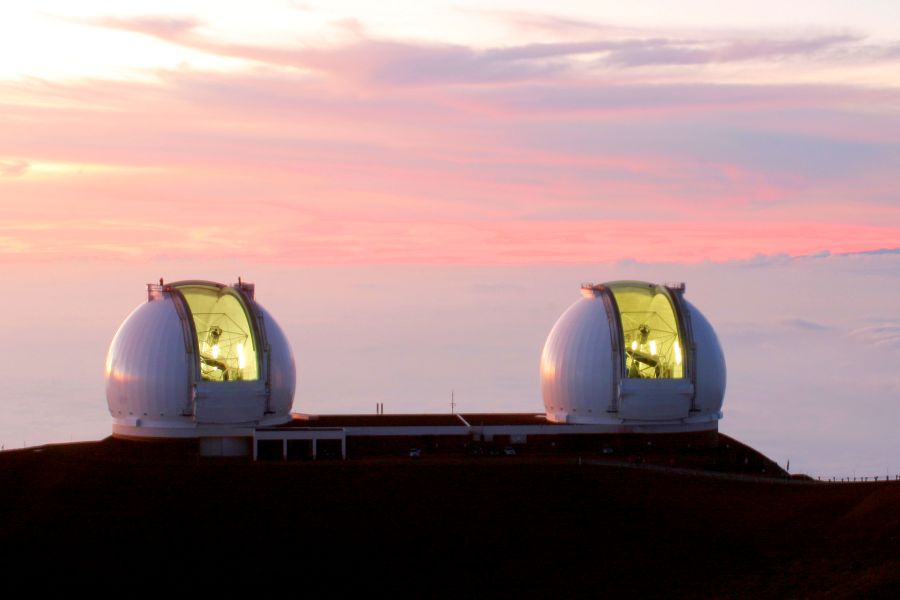
W. M. Keck Observatory
No single piece of glass ten meters across could hold its own shape. It would sag under its own weight each time the telescope moved, blurring the very images it was built to sharpen. In the late 1970s, Jerry Nelson at Lawrence Berkeley Laboratory and Terry Mast at UC Berkeley proposed a radical alternative: build the mirror from thirty-six hexagonal segments, each 1.8 meters wide and just 7.5 centimeters thick, and use computers to adjust them twice every second. When Howard B. Keck of the W. M. Keck Foundation gave $70 million in 1985 to test this idea on Mauna Kea, he was funding what many considered an engineering gamble. It paid off spectacularly.
Thirty-Six Pieces of One Mirror
Each segment of a Keck primary mirror weighs half a ton and was machined from Zerodur glass-ceramic by Schott AG in Germany, then polished at Itek Optical Systems in Lexington, Massachusetts. On the telescope, three actuators beneath each hexagon adjust its position relative to its neighbors, maintaining a surface accuracy of four nanometers -- roughly fifty times thinner than a strand of DNA. The computer-controlled system compensates for gravity, temperature shifts, and wind loading as the telescope tracks objects across the sky. This segmented approach, once considered impractical, has since become the template for every next-generation telescope design, including the Thirty Meter Telescope and the European Extremely Large Telescope. The technology that skeptics doubted in the 1980s is now the standard for the 2030s.
First Light and the Second Eye
Keck I saw first light on November 24, 1990, using just nine of its eventual thirty-six mirror segments. Even incomplete, the images were sharper than anything a ground-based telescope had produced at that scale. By May 1993, Keck I was conducting full science operations, and construction of an identical twin was already underway. Keck II achieved first light on April 27, 1996, and NASA joined the partnership that same year. Sitting at 4,145 meters on Mauna Kea's summit, each telescope weighs over 300 tons yet can be pointed with enough precision to track a dime at two miles. When the two were briefly operated as an interferometer, combining their light across an 85-meter baseline, the effective resolution reached 5 milliarcseconds -- sharp enough to read a car's license plate from the distance of the Moon.
A Universe of Discoveries
The Keck Observatory's instrument suite reads like a catalog of astronomical ambition. HIRES, the High Resolution Echelle Spectrometer, breaks starlight into thousands of color channels with enough precision to detect the gravitational wobble of a star caused by an orbiting planet -- its radial velocity measurements reach one meter per second. This capability helped launch the exoplanet revolution. DEIMOS can capture spectra from over 1,200 objects in a single exposure using its Mega Mask mode, making it a workhorse for surveying distant galaxies. The Keck Planet Finder, which achieved first light in 2022, was purpose-built to identify Earth-like worlds by the radial velocity method. And both telescopes carry laser guide star adaptive optics systems that shoot an artificial star into the upper atmosphere, then use its twinkling to calculate and cancel out atmospheric distortion in real time.
The Partnership Model
The Keck Observatory is managed by the California Association for Research in Astronomy, a nonprofit whose board includes representatives from Caltech and the University of California. Total construction costs exceeded $140 million, all from private philanthropy through the W. M. Keck Foundation. Telescope time is divided among the partner institutions and NASA, each of which solicits proposals from its own researchers. Jerry Nelson, the project scientist who conceived the segmented mirror concept, continued contributing to multi-mirror telescope designs until his death in June 2017. His legacy extends far beyond Mauna Kea: every large telescope built in the coming decades will owe its fundamental architecture to the proof of concept that Nelson and Mast demonstrated on this Hawaiian summit.
Twin Domes on the Horizon
From the air, the two Keck domes are among the most recognizable structures on Mauna Kea, their white cylindrical housings standing side by side near the summit ridge. On clear days they catch the last light of sunset and glow amber against the darkening sky, a scene that has become iconic in astronomical photography. At night, the laser guide stars shoot bright orange beams into the atmosphere, visible for miles. The observatory sits in the company of eleven other telescope facilities, but the twin Kecks remain the anchors of the complex -- a paired testament to the idea that a mirror does not need to be a single sheet of glass to be the sharpest eye on the cosmos.
From the Air
Located at 19.83N, 155.47W near the summit of Mauna Kea, elevation 4,145 meters (13,600 feet). The twin Keck domes are distinctive white cylinders visible from cruising altitude, often above the cloud deck. Nearest airports: PHTO (Hilo International, 28 nm southeast), PHKO (Kona International, 40 nm west). At night, the observatory's laser guide stars are sometimes visible as bright orange beams cutting through the atmosphere. The summit area hosts twelve other telescope facilities, making the Keck domes part of a larger cluster of observatory structures.