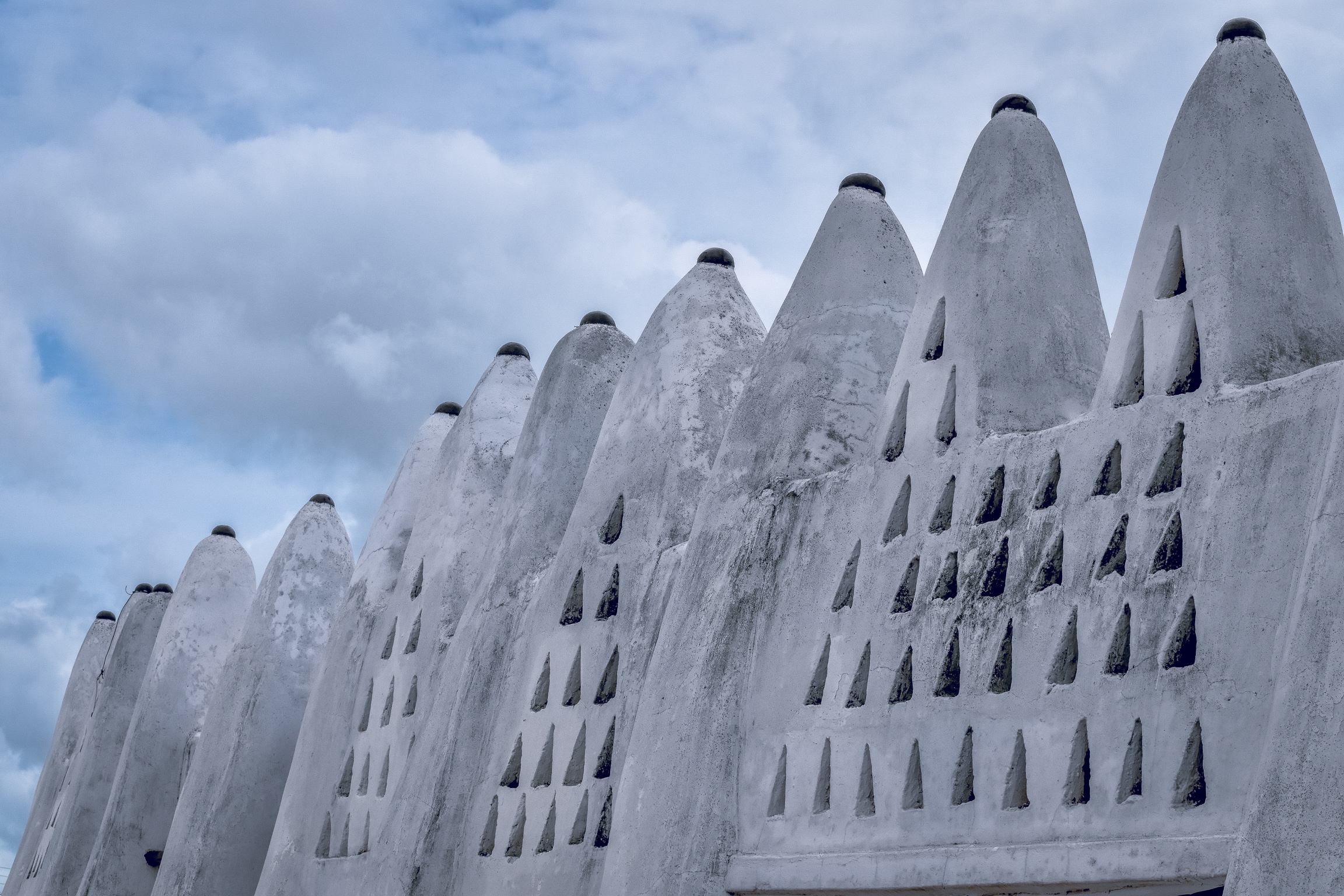
Wa Naa's Palace
The chief sits on a lion skin. His elders sit on cowhide and sheepskin, the material beneath them signaling rank as clearly as any crown or scepter. This protocol has not changed at Wa Naa's Palace since the Wala people established their kingdom in what is now Ghana's Upper West Region. What has changed is the building itself -- once a cluster of round thatched cottages, rebuilt in 1919 into the flat-roofed, buttressed form that stands today. The palace occupies the heart of Wa, the regional capital, and serves simultaneously as royal residence, seat of government, and cemetery. Former kings are buried in the forecourt, directly in front of the entrance, so that everyone who approaches the living ruler walks past the dead ones.
From Round Huts to Sudanese Walls
The original palace was built in 1889 in the traditional Mole-Dagban style -- round thatched cottages grouped within a compound. In 1919, Wa Naa Yamusa Pelpuo III commissioned a reconstruction in the western Sudanese architectural style, transforming the residence into the mud-brick structure that survives today. The walls are sundried mud-brick, supported by distinctive Y-shaped wooden columns that hold up the flat roofs of bush-pole framework covered with packed earth. The frontage features a series of buttresses topped with pinnacles rising above the parapet, a visual grammar shared with mosques and palaces across the Sahel from Djenne to Agadez. The result is a building that reads simultaneously as fortress, palace, and sacred site -- its thick walls designed to absorb heat during the day and release it at night, and to resist attack if enemies ever came.
A People Who Traveled Far
Historians trace the origins of the Wala people to migrations from Sudan in the northern part of Africa. They were nomadic herders who traveled enormous distances to feed their livestock before settling in the area around present-day Wa. Once settled, they installed a king -- the Wa Naa -- as supreme leader, creating a political institution that has endured through colonial occupation and independence alike. The palace is more than a residence; it is the constitutional center of Wala society. Cultural, political, religious, and social matters are adjudicated here. The Wa Naa's authority draws from both secular governance and spiritual legitimacy, a dual role reflected in the palace's function as both court and shrine. The burial of former kings in the forecourt reinforces this -- the past rulers literally undergird the ground the living king walks upon.
The Y-Shaped Columns
The most structurally distinctive feature of the palace is its Y-shaped wooden columns. These forked timbers support the flat mud roofs and give the interior its character -- a forest of branching supports holding up low ceilings of packed earth. By 2009, the columns and the building they supported were deteriorating. The World Monuments Fund, in collaboration with the Ghana Museums and Monuments Board, undertook a preservation project to stabilize the structure, recognizing it as one of the finest and last remaining examples of this ancient architectural form in the Upper West Region. The project was completed in 2012. The challenge is ongoing: mud-brick buildings in the Sahel require annual maintenance, and the skilled artisans who know how to replaster and repair traditional earthen structures are becoming scarce.
The Heart of Wa
Wa is the capital of Ghana's Upper West Region, a city of roughly 100,000 people in the dry savannah near the Burkina Faso border. The palace sits at the city's center, and from the air it is distinguishable by its flat roofline, buttressed facade, and the open forecourt that serves as both ceremonial ground and royal burial site. The surrounding streets are dense with low-rise buildings, market stalls, and the mosques that reflect the region's strong Islamic heritage. Wa Airport (DGLW) lies nearby, serving as the Upper West's link to Accra and the south. The gazetted national monument stands in contrast to the modern concrete buildings encroaching around it -- a structure built from the earth it stands on, maintained by the community it governs, and still serving the purpose for which it was first constructed over a century ago.
From the Air
Coordinates: 10.0637N, 2.5005W. Located in the center of Wa, capital of Ghana's Upper West Region. Wa Airport (ICAO: DGLW) is the nearest airfield, very close to the city. Flat savannah terrain at roughly 300m elevation. The palace is identifiable from lower altitudes by its flat-roofed, buttressed Sudanese-style architecture in the dense city center. The forecourt and surrounding open spaces provide contrast against the urban fabric. Dry season (Nov-Mar) offers best visibility.