Waddesdon Manor
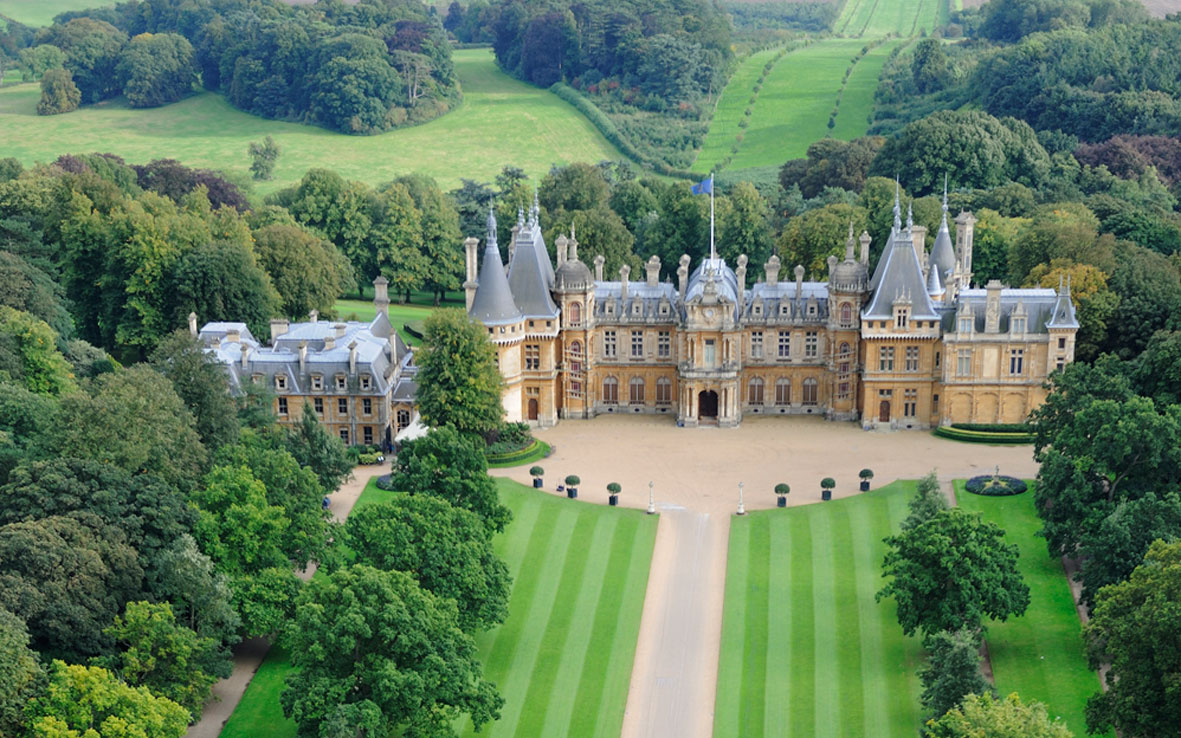
The hilltop was bare when Baron Ferdinand de Rothschild bought it. By the time he was finished, a French Renaissance chateau had appeared on the Buckinghamshire skyline, surrounded by formal gardens, filled with Sevres porcelain, Beauvais tapestries, and paintings by Gainsborough and Reynolds, with full-grown trees hauled up the slopes by teams of horses working a specially built steam tramway. Waddesdon Manor was never meant to be subtle. It was a statement about what Rothschild wealth could accomplish, and the answer -- delivered between 1874 and 1889 -- was almost anything.
Building a Chateau in England
Ferdinand de Rothschild, born in Paris in 1839 to the Austrian branch of the banking family, chose the French architect Gabriel-Hippolyte Destailleur to design his country retreat. Destailleur drew inspiration from several French chateaux of the Loire Valley and created a building in the Neo-Renaissance style that, from a distance, looks as though it has been airlifted from the banks of the Loire to the Chiltern Hills. The logistics were formidable. The hilltop had to be levelled, the ground terraced, and mature trees transported by Percheron horses pulling specially built carts along a steam-powered tramway. Water was piped from miles away. The interiors were fitted with panelling salvaged from Parisian hôtels particuliers, rooms designed to display a collection of French eighteenth-century decorative arts that was already, before the house was complete, among the finest in private hands.
The Rothschild Weekend
Ferdinand built Waddesdon as a weekend residence for entertaining, and its guest lists read like a roll call of late Victorian power. The Prince of Wales -- the future Edward VII -- was a regular visitor. Queen Victoria came in 1890. Politicians, diplomats, and aristocrats made the journey from London to the Buckinghamshire countryside, arriving at the purpose-built railway halt to be conveyed to a house whose every room was designed to impress and delight. Ferdinand's hospitality was legendary: guests might find themselves admiring Savonnerie carpets in the morning, walking through gardens filled with exotic birds in the afternoon, and dining beneath painted ceilings at night. The collection grew with each generation. Ferdinand's sister Alice continued the tradition after his death in 1898, and James de Rothschild, who inherited next, expanded the holdings further.
A Gift to the Nation
In 1957, James de Rothschild bequeathed Waddesdon Manor and its contents to the National Trust, ensuring public access to a collection that had been assembled across three generations of Rothschild taste and wealth. Unusually for a National Trust property, the Rothschild family continues to manage the house through the Rothschild Foundation, chaired by Dame Hannah Rothschild. This arrangement has allowed ongoing investment that many Trust properties cannot match: the wine cellars remain stocked with Rothschild vintages, the gardens are maintained to exacting standards, and the collection continues to be augmented. In 2019, Waddesdon received over 463,000 visitors, making it one of the National Trust's most popular properties.
The Collection Within
What distinguishes Waddesdon from other English country houses is the quality and coherence of its collection. The French decorative arts -- Sevres porcelain, Aubusson and Beauvais tapestries, furniture by the great eighteenth-century ebenistes -- rank alongside the holdings of the Louvre and the Wallace Collection in London. The paintings include works by Rubens, Watteau, and Chardin. The Rothschild family's connection to the wine trade means that the cellars hold vintages from the family's own Bordeaux estates, and the house hosts regular wine-tasting events. The Waddesdon Bequest, a separate collection of medieval and Renaissance objects that Ferdinand left to the British Museum in 1898, includes some of the finest goldsmiths' work in any museum collection. The house is, in effect, a private museum of exceptional depth, set in a landscape designed to be its equal -- all of it perched on a hilltop in Buckinghamshire that was bare earth 150 years ago.
From the Air
Located at 51.84N, 0.93W near the village of Waddesdon in Buckinghamshire. The chateau is visible on a prominent hilltop, its French Renaissance profile distinctive amid the English countryside. Formal gardens and parkland extend around the building. The Chiltern Hills rise to the south. Nearest airports: EGTK (Oxford Kidlington, 20nm west), EGLL (Heathrow, 35nm southeast). The village of Waddesdon sits below to the east.