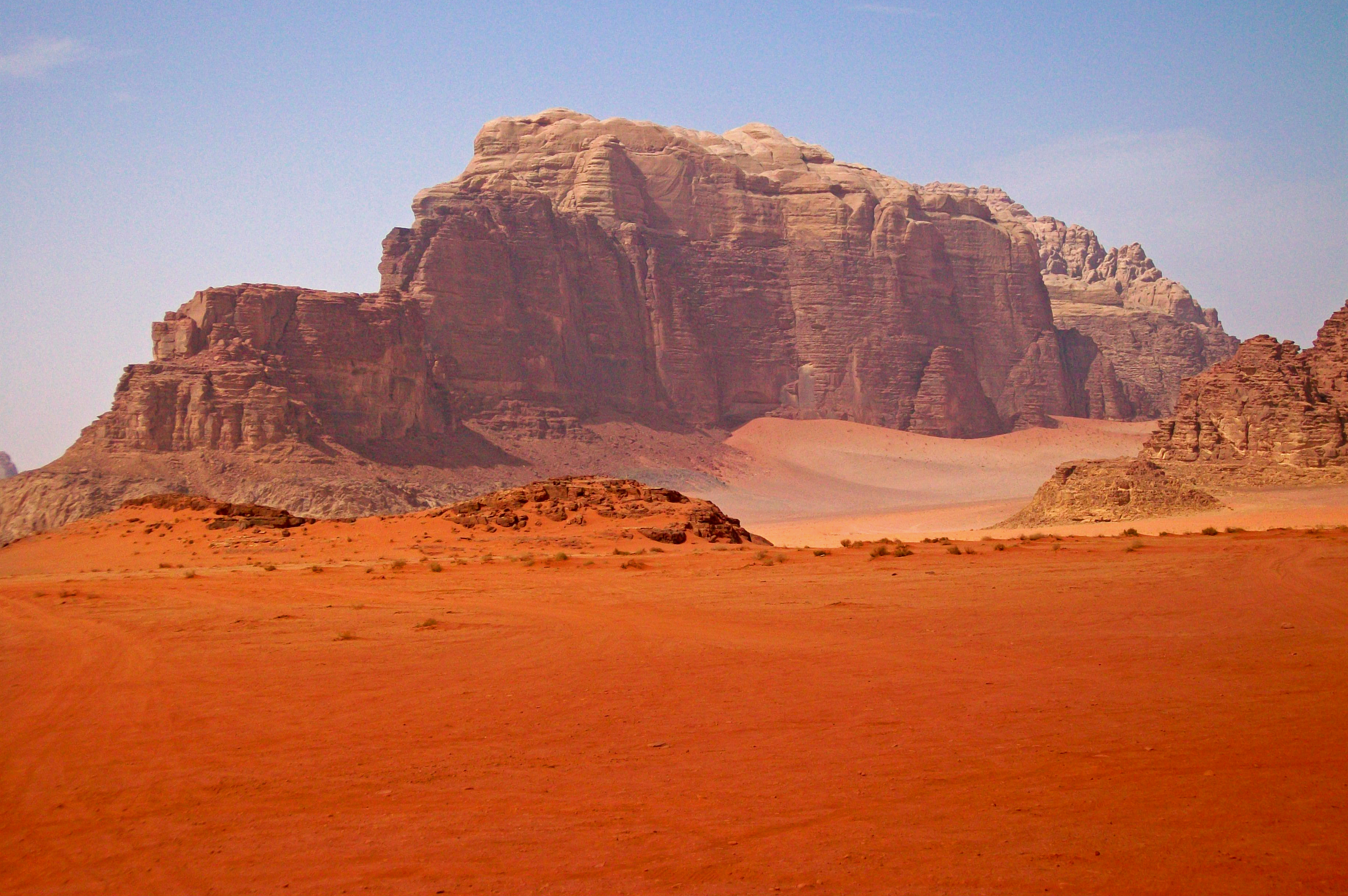
Wadi Rum
T. E. Lawrence called it "this irresistible place: this processional way greater than imagination." He was describing the moment when Wadi Rum's sandstone walls close in from both sides, a thousand feet of red rock towering above a valley floor that stretches for miles. Lawrence passed through here during the Arab Revolt of 1917-18, and his account in Seven Pillars of Wisdom planted Wadi Rum in the Western imagination. But the valley had been drawing people long before Lawrence -- the Nabataeans carved inscriptions into its cliffs, the Kingdom of Edom controlled it between the thirteenth and sixth centuries BCE, and Thamudic petroglyphs in Khaz'ali Canyon depict humans and antelopes from an even older time. At 720 square kilometers, it is the largest wadi in Jordan.
Stone and Sand, Deep Time
The geology reads like a cross-section of deep time. Wadi Rum's towering cliffs are iron-rich Umm Ishrin Sandstone -- the thickest formation in the Nubian Sandstone sequence, laid down between the Lower Palaeozoic and Upper Cretaceous periods. These vertical walls of erosion-resistant rock stand above flat valley floors of alluvial sediment, wind-blown sand, and salt pans. Beneath the sandstone lies the Salib Arkosic Formation, which in turn rests on the eroded Aqaba Complex of plutonic granitoids -- basement rock billions of years old. Where sandstone meets granite, aquifers form, and springs emerge on the eastern mountain slopes. Wind has sculpted the softer stone into tafoni, natural bridges, and sand dunes that include barkhans, climbing dunes that reach hilltops, and echo dunes deposited on sheltered lee sides. Jabal Umm ad Dami, Jordan's highest point at 1,854 meters, rises 30 kilometers south of the village. On a clear day, its summit offers views of the Red Sea.
Inscriptions in the Rock
Human presence in Wadi Rum stretches back to prehistoric times, and nearly every era left its mark literally carved into the canyon walls. Thamudic inscriptions in Khaz'ali Canyon are among the oldest, depicting people and animals from a civilization that predates written Arabic. The Nabataeans, who built Petra to the north, left their own inscriptions and a temple in the valley. Trade routes connecting Arabia to the Levant threaded through this landscape, and copper mining sites at nearby Wadi Feynan attest to the area's economic importance. The name Wadi Rum itself may derive from Iram of the Pillars, a lost city mentioned in the Quran. Today the Zalabieh Bedouins, who arrived around 1980, are the valley's primary inhabitants. Their village of several hundred people -- goat-hair tents alongside concrete houses, schools, shops, and the headquarters of Jordan's Desert Patrol -- sits in a landscape that has been continuously inhabited yet never tamed.
Hollywood's Favorite Desert
Filmmakers discovered what Lawrence already knew: Wadi Rum looks like no other place on Earth -- or, more precisely, like every imagined place that is not Earth. David Lean filmed much of Lawrence of Arabia here in 1962, and the valley has since stood in for Mars in both The Martian and The Last Days on Mars, for the desert planet Arrakis in Dune and Dune: Part Two, for Jedha in Rogue One: A Star Wars Story, and for the planet Pasaana in The Rise of Skywalker. The Jordanian Royal Film Commission received the Location Managers Guild International Award for Outstanding Film Commission in 2017. The irony is that Wadi Rum's most famous association -- with Lawrence's Seven Pillars of Wisdom -- is itself a misattribution. The rock formation now called the Seven Pillars of Wisdom, originally known as Jabal al-Mazmar (the Mountain of the Plague), was renamed in the 1980s after Lawrence's book, though the pillars Lawrence described had nothing to do with Rum.
Bedouin Roads and Bolt Routes
Local Bedouin have climbed Wadi Rum's sandstone walls for generations, following routes passed down through families. In 1949, Sheikh Hamdan led surveyors to the summit of Jabal Ram, and in 1952 he guided the first recorded European ascent of the peak by Charmian Longstaff and Sylvia Branford. Modern technical climbing arrived in 1984 with British climbers who rediscovered and documented the old Bedouin routes. Tony Howard published the first dedicated climbing guidebook in 1987. The Zalabieh Bedouins have since built an eco-adventure tourism industry around the protected area, offering 4x4 tours, camel rides, hiking, and overnight stays in traditional camps. The Wadi Rum Protected Area became a UNESCO World Heritage Site in 2011, and 162,000 tourists visited in 2017 alone. Using local Bedouin guides ensures both that the protected area stays protected and that the people who have called this valley home continue to earn their living from the land they know best.
From the Air
Located at 29.58N, 35.42E in southern Jordan, approximately 60 km east of Aqaba. The valley's massive sandstone formations are unmistakable from the air -- vertical red and orange cliffs rising from flat desert floors. Nearest airport is King Hussein International Airport in Aqaba (OJAQ), about 60 km west. At cruising altitude, Wadi Rum appears as a dramatic zone of isolated rock towers and sandy valleys between the Aqaba-Amman highway and the Saudi border. Best viewed at 5,000-10,000 feet to appreciate the scale of the formations. Jabal Umm ad Dami (1,854m) is visible as Jordan's highest point.