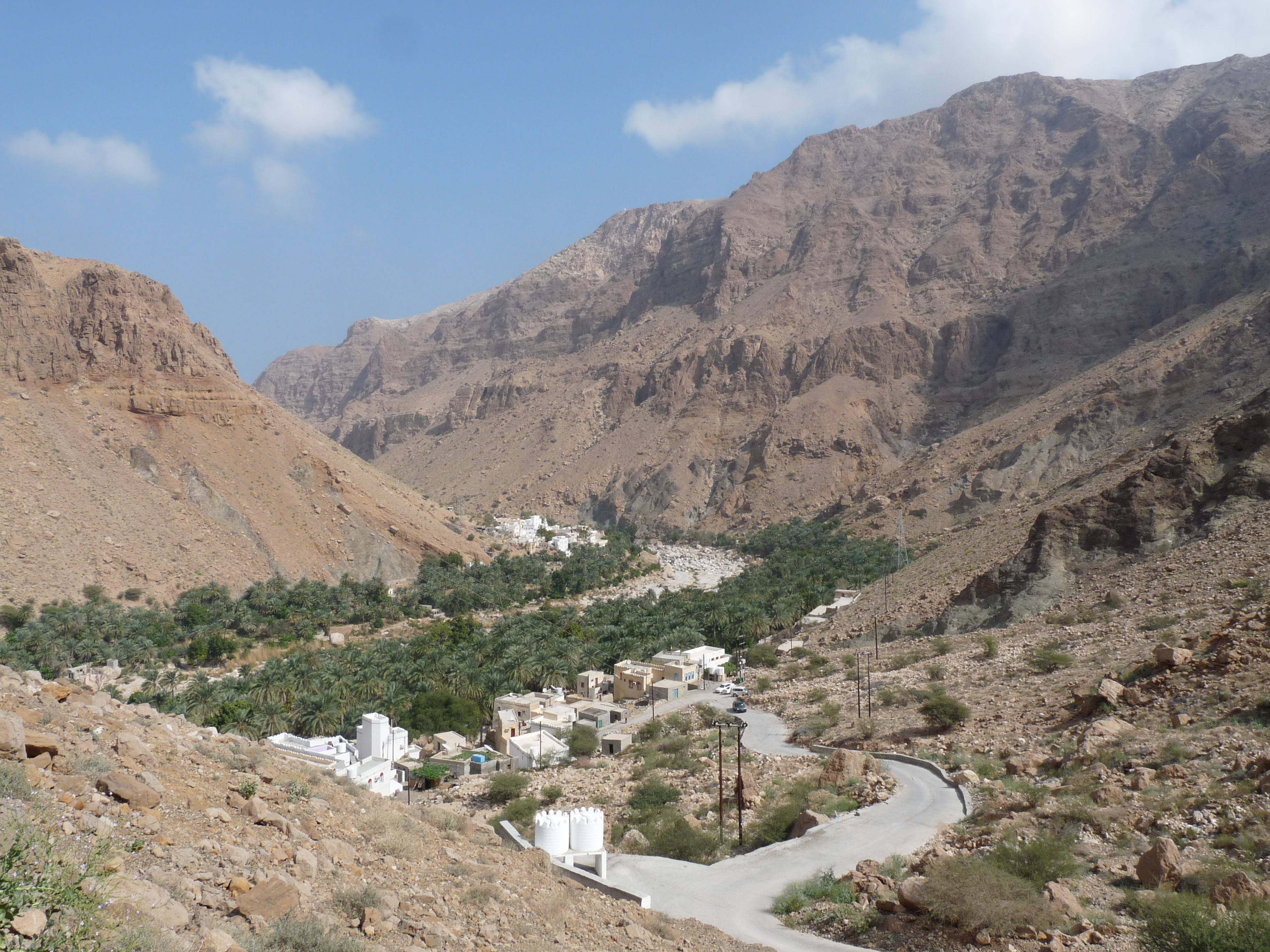
Wadi Tiwi
Seven different cultivars of bananas grow in a desert canyon. That fact alone tells you something extraordinary has been happening in Wadi Tiwi for a very long time. Forty kilometers north of Sur, where the Hajar Mountains crash into the Gulf of Oman, this narrow gorge has been continuously inhabited for at least a thousand years. Water flows year-round in the upper reaches, even during drought, and generations of Omani farmers have channeled it through an intricate network of falaj irrigation systems to create an improbable garden in the rock.
Engineering in Stone
The falaj system at Wadi Tiwi is a masterwork of hydraulic engineering refined over centuries. These channels, carved into the canyon walls and threaded between terraced farms, distribute water from the mountain plateau to every cultivable patch of ground. Date palms dominate the agricultural landscape, their fronds shading the canyon floor. Beneath them grow bananas, limes, papayas, and mangoes. Before modernization around 1970, wheat, sorghum, and alfalfa filled the terraces. The canal network keeps this unlikely oasis alive without pumps, electricity, or any technology more complicated than gravity and stone.
Bananas from the Silk Road
The banana diversity in Wadi Tiwi tells a story of deep trade connections. Dwarf Cavendish and Bluggoe varieties make up over ninety percent of the plants, but seven distinct cultivars have been documented. This variety traces back to trade with India beginning in the 1400s. The Oman Botanic Garden successfully cultivated a Musa banana plant from Wadi Tiwi that is estimated to have been growing in the canyon for five hundred years. Each variety represents a deliberate choice made by farmers who understood their soil, their water, and their market. The canyon functions as a living agricultural archive, preserving cultivars that have disappeared from commercial production elsewhere.
A Canyon Full of Life
At the mouth of the canyon, two large pools attract grey herons, great cormorants, grey wagtails, and Temminck's stints. Further in, where villages cluster among the date palms, rose-ringed parakeets dart between treetops. Indian silverbills and palm doves forage in the tall Pennisetum grass that lines the wadi stream. Growing beside the road is the Ziziphus hajarensis, a buckthorn tree endemic to northern Oman that takes its name from the Hajar mountain range itself. Ferns and mosses cling to the canyon walls in unexpected profusion. Near the village of Harat Bidah, pools harbor red garra fish, the so-called 'doctor fish' famous for nibbling dead skin from swimmers' feet. Arabian toads call at dusk.
Between Mountains and Sea
Wadi Tiwi stretches thirty-six kilometers from the coast to the mountain village of Mibam. The canyon walls rise steeply on both sides, creating a microclimate dramatically different from the surrounding desert. From certain vantage points along the upper reaches, you can look back down through the gorge and catch a glimpse of the Gulf of Oman's blue water framed by the rock. Villages cling to every habitable shelf, their stone houses built into the terrain rather than imposed upon it. The effect is less a landscape shaped by people than one where people have shaped themselves to fit the landscape. A thousand years of careful adaptation have created something that feels both ancient and fragile, sustained by the same water that carved the canyon in the first place.
From the Air
Coordinates: 22.83N, 59.26E, on Oman's northeastern coast where the Hajar Mountains meet the Gulf of Oman. Best viewed at 3,000-6,000 ft to appreciate the canyon's depth and green vegetation against desert terrain. The wadi mouth at Tiwi village is visible from the coast. Nearest airport is Muscat International (OOMS), approximately 150 km northwest. Dry and clear conditions predominate.