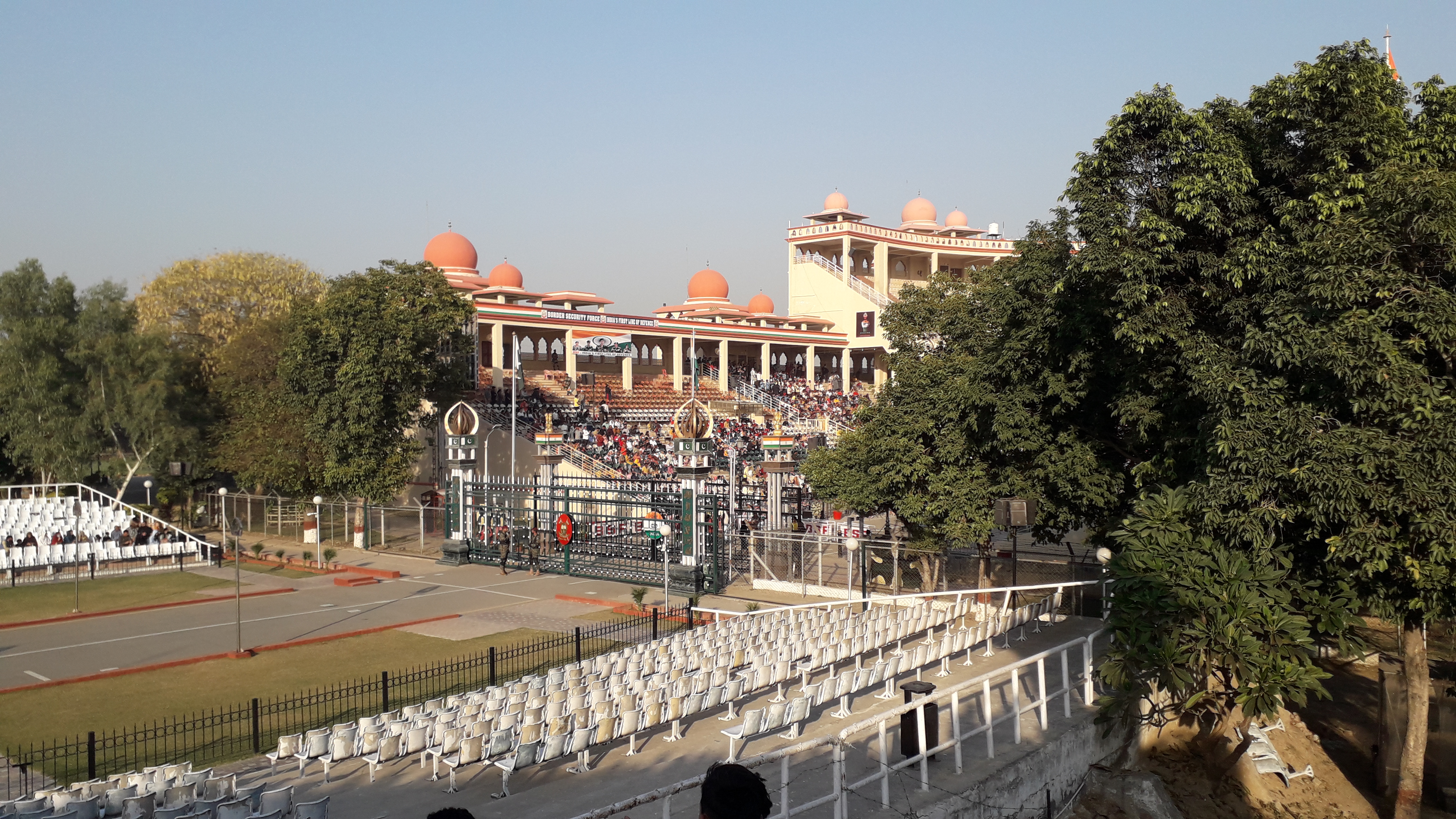
Wagah
Every evening, just before sunset, two nations that share a language, a cuisine, and a deeply complicated history face each other across a white line painted on asphalt. On one side, Indian Border Security Force soldiers in khaki and red-plumed fan hats. On the other, Pakistani Rangers in black shalwar kameez. What follows is forty-five minutes of elaborate, high-kicking, goose-stepping theater so aggressively choreographed it has been compared to Monty Python -- and so emotionally charged that spectators on both sides weep. This is Wagah, the only open land crossing between India and Pakistan, where the nightly flag-lowering ceremony has turned a geopolitical fault line into one of South Asia's most extraordinary public rituals.
Born from Partition
Wagah sits on the Grand Trunk Road, one of Asia's oldest and longest trade routes, 24 kilometers from Lahore and 32 kilometers from Amritsar. Before 1947, this stretch of road was unremarkable -- just another village along a highway that had carried merchants, armies, and pilgrims for centuries. Then came Partition. The Radcliffe Line, drawn in haste by a British lawyer who had never visited India, sliced Wagah in two. Millions of refugees streamed past in both directions, Hindu and Sikh families heading east, Muslim families heading west, in one of the largest and most violent mass migrations in human history. The border ceremony began on October 11, 1947, founded by Brigadier Mohinder Singh Chopra on the Indian side and Brigadier Nazir Ahmed on the Pakistani side. What started as a practical protocol for lowering flags at sunset evolved, by 1959, into the elaborate daily ritual that draws thousands of spectators today.
The Peacock Parade
The ceremony is officially called the Beating Retreat. In practice, it is part military drill, part competitive dance-off, part sporting event. Guards are selected for imposing height and physical presence, and their performance is anything but subtle. Legs kick above head height. Boots slam the ground hard enough to echo off the concrete grandstands. Each side tries to out-shout, out-stomp, and out-strut the other while the crowd roars approval. On the Indian side, Bollywood music blasts from speakers and spectators rush forward to dance in the road. On the Pakistani side, nationalist songs fill the air and the energy is no less fervent. Since 2010, the ceremony has been toned down somewhat -- less of the dramatic peacock-helmeted flourishing -- but the essential drama remains. At the climax, the two head guards march to the gate, exchange a brisk handshake, and the flags descend in unison. For one brief moment, rivalry gives way to symmetry.
Two Grandstands, One Performance
Up to two thousand people pack the Indian grandstand on a busy day, with another thousand or more on the Pakistani side. The atmosphere resembles a cricket match more than a diplomatic event. Concrete bleachers rise on both sides of the border road, divided into VIP seating near the gates, a women-and-children section, and general admission that fills quickly on weekends. Foreigners get a reserved, partly shaded section -- bring your passport -- and can skip much of the queue. On the Indian side, Bhangra dancers warm up the crowd before the soldiers appear. Mobile phone signals are jammed for security, which only intensifies the analog, in-the-moment feeling of the spectacle. No tickets are needed; the show is free on both sides. During the holidays of Eid and Diwali, the border troops exchange sweets with their counterparts across the line, a small gesture of shared humanity that belies the razor wire.
Crossing the Line
For those actually crossing the border rather than watching the ceremony, Wagah offers a different kind of drama. The crossing opens daily at 8:30 AM and closes at 3:30 PM, and formalities can stretch from thirty minutes to over two hours. E-visas are not valid here; only a proper stamp in your passport will do. No regular vehicles are permitted in the 500-meter no-man's land between the two border posts, so travelers walk the distance themselves, luggage in tow. Indian porters in blue coats and Pakistani porters in green coats wait on their respective sides to carry bags for a fee. The walk itself is strangely quiet -- a half-kilometer of empty road flanked by gates and flags, a buffer zone where neither country's noise quite reaches. It is, for a few minutes, the loneliest stretch of the Grand Trunk Road.
Where Rivalry Becomes Ritual
Wagah is a contradiction held in balance. It is a place of fierce nationalism that somehow produces mutual respect, a militarized border that attracts families with children, a wound from Partition that has healed into a shared tradition. The ceremony exists because two nations cannot agree on much, but they can agree to lower their flags together at sunset. Lahore's food stalls and Amritsar's Golden Temple are each less than an hour away, connected by a road that once carried unbroken traffic between two cities that were part of the same Punjab. Today, that road narrows to a single gate. But every evening, for forty-five minutes, the gate opens just enough to let something through that is neither entirely war nor entirely peace -- a performance that acknowledges both, and belongs to both sides equally.
From the Air
Located at 31.60N, 74.57E on the India-Pakistan border along the Grand Trunk Road. The border area is visible as a cleared strip running north-south with grandstands on both sides. Nearby airports: Allama Iqbal International Airport, Lahore (OPLA) 25 km west; Sri Guru Ram Dass Jee International Airport, Amritsar (VIAR) 28 km east. Best viewed from 3,000-5,000 feet AGL. The flat Punjab plains offer excellent visibility in clear conditions.