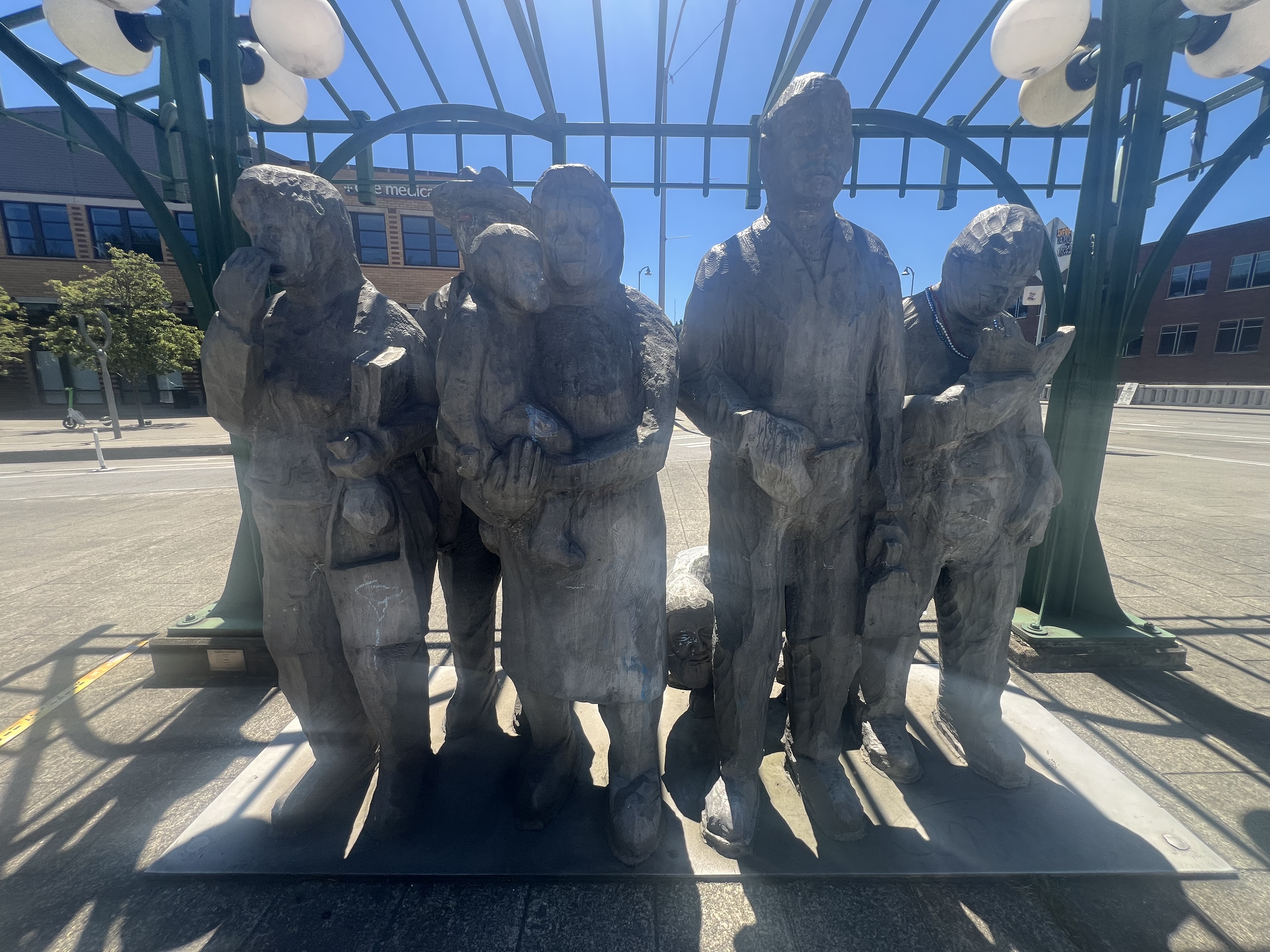
Waiting for the Interurban
Look closely at the dog. Its face is not a dog's face. Sculptor Richard Beyer modeled it after Armen "Napoleon" Stephanian, a Fremont political leader and self-proclaimed "godfather of recycling" with whom Beyer had feuded publicly throughout the 1970s. The insult was cast in aluminum and mounted on a public street corner, where it has stood since 1978, wearing whatever costume the neighborhood decides to put on it. This is Waiting for the Interurban, Seattle's most decorated sculpture in every sense of the word.
Six Commuters for a Train That Will Never Come
The sculpture depicts six people and a dog standing at a bus stop, waiting for the Seattle-Everett Interurban, an electric railway that ran through Fremont from 1910 until 1939. The interurban actually stopped on Fremont Avenue, not on North 34th Street where the sculpture faces, a geographic joke that nobody seems to mind. The Fremont Arts Council selected Beyer in 1975 to create the piece, commissioning it to mark the 100th anniversary of Fremont's founding. It cost $18,210, funded mostly through private donations and the city's art fund. Beyer initially went unpaid for his labor until private fundraisers scraped together the $6,000 he was owed. The six figures stand in cast aluminum, life-sized and patient, their postures conveying the universal experience of waiting for public transit that no longer exists.
The Neighborhood's Living Canvas
Almost immediately after the statues were erected on June 15, 1978, and dedicated two days later during the Fremont Fair, people began dressing them. It has not stopped since. Holiday sweaters at Christmas. Seahawks jerseys on game days. Wedding veils, graduation caps, political slogans, protest signs. The costumes change with the seasons and with whatever is on Fremont's mind, which can be anything from a Mariners losing streak to a mayoral election. There are no rules and no permission required -- the community simply shows up with fabric and zip ties and makes the sculptures say something new. History House, located nearby, has documented some of the most elaborate displays over the years. The tradition turns a static artwork into a running conversation between the neighborhood and itself, six aluminum commuters serving as a communal bulletin board, dressed and redressed with an energy that the sculptor could not have anticipated but almost certainly would have appreciated.
Surviving Fremont
The sculptures have not always had an easy life. Concerns about weather and automobile damage led artist Pete Larsen to build a protective pergola over them in 1979, though electrical power for its lighting was not installed until nearly a decade later. When repairs to the Fremont Bridge began in February 2006, the entire sculpture was relocated roughly 100 meters east to History House, where it waited -- appropriately enough -- until the bridge work was finished in May 2007. The Seattle City Council formally accepted the sculpture as a donation to the city in January 1980, giving the piece official civic status. Andy Rooney once featured it in a 60 Minutes segment criticizing modern art, though whether that counts as damage or free publicity depends on your view of Andy Rooney.
Company Down the Block
In 2008, a companion sculpture appeared one block away on North 34th Street. Late for the Interurban, by sculptor Kevin Pettelle of Sultan, Washington, depicts J. P. Patches, the beloved 1970s Seattle television clown, and his sidekick Gertrude, scrambling to catch the same train the original six have been waiting for since 1978. Fremont collects oddities the way other neighborhoods collect coffee shops. The Fremont Troll lurks under the Aurora Bridge. A Cold War-era rocket stands on a corner. A statue of Lenin, salvaged from Slovakia, presides over a busy intersection. Waiting for the Interurban is the neighborhood's oldest and most interactive piece of public art, the one that residents have claimed not just as a landmark but as a medium. The train will never arrive. The waiting, it turns out, is the point.
From the Air
Located at 47.65N, 122.35W on the corner of N. 34th Street and Fremont Avenue N. in Seattle's Fremont neighborhood, just east of the Fremont Bridge over the Lake Washington Ship Canal. The bridge is the key visual landmark from the air; the sculpture sits at street level on its northeast side. Nearest airport is Boeing Field/King County International (KBFI), approximately 6 nm south. The Ship Canal and the distinctive drawbridge are primary orientation features. Best viewed from 1,500-2,500 ft AGL.