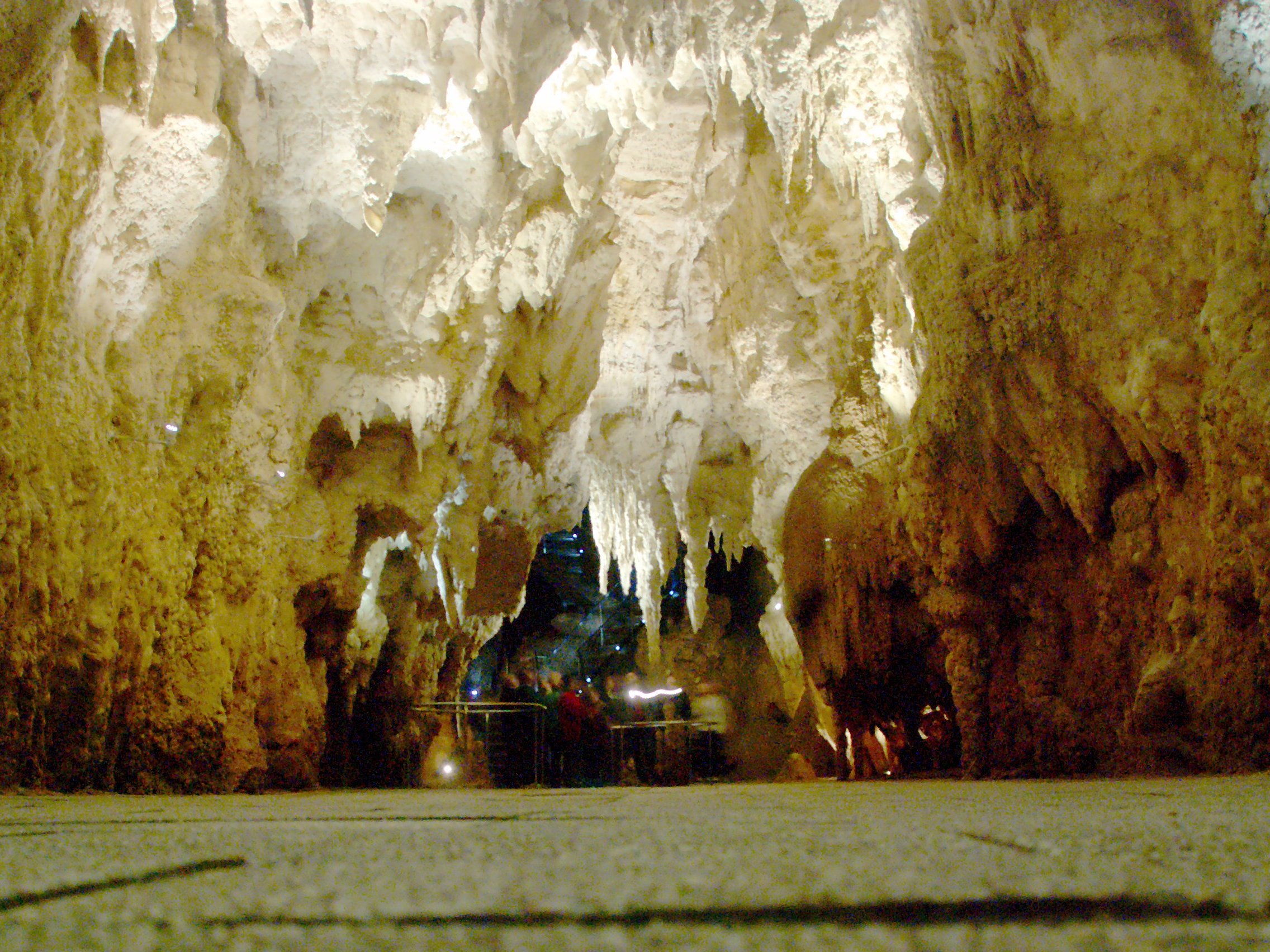
Waitomo Glowworm Cave
In December 1887, Tane Tinorau and Fred Mace built a raft from flax and poled it into the darkness where the Waitomo Stream disappears underground. They carried candles. What they found did not need them. As the two men drifted into the grotto, the ceiling came alive with thousands of blue-green points of light, tiny larvae of the fungus gnat Arachnocampa luminosa, a species found nowhere outside New Zealand. The name Waitomo comes from the Maori words wai, meaning water, and tomo, meaning hole or shaft. By 1889, Tinorau and his wife Huti were guiding paying visitors through the cave by canoe, leading them up 25-foot ladders and out through an opening 50 feet above the water. Today, the Waitomo Glowworm Cave is the most visited glowworm display in the world.
Living Constellations
The glowworms are not worms at all. They are the larvae of Arachnocampa luminosa, a fungus gnat about the size of a mosquito. Each larva spins a nest of silk on the cave ceiling and lowers up to 70 sticky, bead-like threads to snare midges and other insects drawn toward the bioluminescent glow. The larvae spend most of their lives in this larval stage, glowing blue-green to lure prey into their fishing lines. They are found throughout the cave but concentrate most densely on the ceiling of the Glowworm Grotto, where the underground Waitomo Stream provides the humidity their silk structures require and a steady supply of aquatic midges. A Scientific Advisory Group monitors the cave's air quality, carbon dioxide levels, temperature, and humidity with automated equipment, determining how many visitors can enter each day without disrupting the ecosystem that keeps the glowworms alive.
Graffiti, Vandals, and the Government
Thomas Humphries, Commissioner of Crown Lands for Auckland, conducted a full study of the cave in 1889. He noted that graffiti had already been inscribed on the most delicate limestone formations, though he acknowledged that the local Maori were taking great care of the caves. He recommended government oversight to provide better visitor facilities. By 1891, more than 500 tourists had visited in the first 18 months under a government-appointed caretaker. But vandalism escalated in the following years. After repeated failed attempts to purchase the cave, the government used the Scenery Preservation Act 1903 and the Public Works Act 1905 to compulsorily acquire it for 625 pounds. Electric lighting replaced candles, hurricane lamps, and magnesium flares in 1926, and in 1909 the government built the Waitomo Caves Hotel to accommodate the growing stream of visitors.
Thirty Million Years in the Making
The limestone that forms the cave was laid down about 30 million years ago when the Waitomo region lay beneath the ocean. It is composed of fossilized corals, seashells, fish skeletons, and countless small marine organisms, compressed over millennia into rock that can be hundreds of metres thick. The Blanket Chamber leads into the Cathedral, the largest chamber in the cave. When opera singer Malvina Major performed for 150 people in the Cathedral in 1998, scientists monitored carbon dioxide, heat, and humidity to measure the audience's impact on the delicate environment. A side passage leads to the Organ Loft, where a mass of stalagmites resembles a pipe organ. On busy days this area closes because carbon dioxide can build to hazardous levels. The Banquet Chamber earned its name in 1889 when Maori cave owners set up a table and served dinner to the government surveying party underground.
A Cave That Breathes
During New Zealand's COVID-19 lockdown in 2020, no staff or tourists entered the cave for 60 days. Scientists seized the opportunity to study its natural state and discovered that carbon dioxide levels varied independently of human presence, influenced by rainfall, drip water, and changes in the underground stream level. The cave breathes on its own rhythms. In 2022, a new threat appeared: invasive koi carp were found in the stream running through the Glowworm Grotto. Scientists debated whether installing a fish weir downstream to keep the koi out might increase flooding risk inside the cave. Lampenflora, communities of algae and cyanobacteria that form biofilms on rock surfaces near artificial lighting, also threaten delicate formations. Managing the cave is a constant negotiation between access and preservation, between the desire to share an underground sky of living lights and the need to keep it alive.
From the Air
The Waitomo Glowworm Cave is located at 38.26S, 175.10E in the northern King Country region of the North Island, approximately 12 km northwest of Te Kuiti. From the air, the rolling green farmland of the Waitomo area gives little indication of the extensive cave systems below. The cave is about two hours south of Auckland and one hour south of Hamilton by road. The nearest significant airports are Hamilton (NZHN), approximately 75 km to the north, and Taupo (NZAP), approximately 130 km to the southeast. The visitor centre, with its distinctive crisscrossing wooden beam roof designed to evoke a traditional Maori eel trap, is visible from low altitude. The surrounding landscape is dotted with sinkholes and karst formations typical of limestone country.